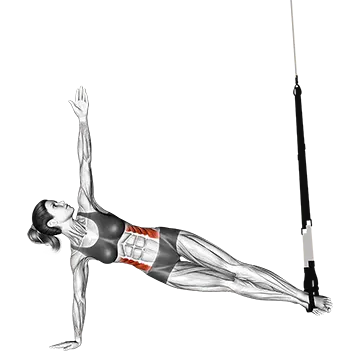
Suspension Oblique Rollout
- Músculo objetivo

- Obliques
- Músculos sinergistas
- Adductor Brevis, Adductor Longus, Iliopsoas, Latissimus Dorsi, Pectineous, Rectus Abdominis, Sartorius, Teres Major
- Equipamiento
- Suspension
- Parte del cuerpo
- Waist
- Tipo
- Strength
The Suspension Oblique Rollout is a core exercise performed with suspension straps that targets the obliques while engaging synergists including the rectus abdominis, latissimus dorsi, teres major, iliopsoas, and hip adductors. You roll your hands forward and diagonally outward, placing a strong rotational demand on the side of your core rather than the front. It suits intermediate trainees who have already mastered basic planks and want to build anti-rotation and lateral core strength.
Cómo hacer el Suspension Oblique Rollout
- 1Set the suspension straps to mid-length and hold one handle in each hand, standing facing away from the anchor point.
- 2Step your feet back so your body is at a slight forward lean, arms extended in front of you at chest height with a firm grip.
- 3Brace your core, squeeze your glutes, and align your body in a straight line from head to heels.
- 4Inhale, then slowly reach both arms forward and diagonally to one side — rolling out at roughly a 30-to-45-degree angle from your centerline — until your arms are nearly overhead.
- 5Keep your hips level and resist any rotation in your torso; the obliques on the opposite side should feel the stretch and load.
- 6Pause briefly at the end range without letting your lower back arch or your hips drop.
- 7Exhale and pull your arms back down toward your hips along the same diagonal path, using your obliques and lats to drive the return.
- 8Complete all reps to one side, then reset and repeat to the opposite diagonal.
Consejos de técnica
- Maintain a rigid plank position throughout — if your hips sag or pike at any point, shorten your range of motion before adding depth.
- Move slowly and under control on the way out; a 3-to-4 second lowering phase maximizes oblique time under tension and reduces momentum.
- Keep your shoulders packed (pulled slightly down and back) so the lats and teres major assist properly and your shoulder joints stay stable.
- Adjust difficulty by walking your feet closer to the anchor (easier) or farther away (harder) — small position changes have a large effect on load.
- Keep your head in line with your spine, eyes down between your hands, so craning your neck up does not pull your lower back into extension at full reach.
Errores comunes
- Letting the lower back sag during the rollout: this shifts load off the obliques and compresses the lumbar spine — keep a neutral spine by bracing hard before you move.
- Rolling straight forward instead of diagonally: going straight turns this into a standard rollout and removes the oblique emphasis the exercise is designed to train.
- Using momentum to swing the arms out and back: momentum bypasses the core muscles and reduces effectiveness — control every inch of the movement.
- Bending the arms to shorten the rollout: letting the elbows break cuts the lever short and hands the work to the arms and shoulders instead of the obliques — keep the arms long from start to finish.
- Switching sides without resetting your stance: asymmetric foot position causes uneven loading — reset your feet to a balanced position before rolling to the other diagonal.
Preguntas frecuentes
What muscles does the Suspension Oblique Rollout work?
The primary muscle is the obliques. The movement also heavily recruits the rectus abdominis, latissimus dorsi, teres major, iliopsoas, sartorius, and the hip adductors (adductor brevis, adductor longus, and pectineus) to stabilize the body through the diagonal rollout path.
Is the Suspension Oblique Rollout suitable for beginners?
It is best suited to intermediate trainees who can already hold a solid plank for 30-plus seconds and perform standard suspension rollouts with good form. Beginners should build baseline core stability with planks and dead bugs before attempting this variation.
How do I make the Suspension Oblique Rollout easier or harder?
Walk your feet toward the anchor point to reduce the load, or step farther away to increase it. You can also shorten the range of motion as an easier entry point and gradually increase the rollout depth as your strength improves.
How many sets and reps should I do?
For strength and stability, 3 sets of 6-to-10 controlled reps per side works well. Rest 60-to-90 seconds between sets. Prioritize quality over quantity — reduce reps if form breaks down before you hit your target number.
What is the difference between a Suspension Rollout and a Suspension Oblique Rollout?
A standard suspension rollout sends the arms straight forward, loading the rectus abdominis symmetrically. The oblique variation adds a diagonal direction to the rollout, which shifts the primary demand onto the obliques and trains the core's ability to resist lateral and rotational forces.