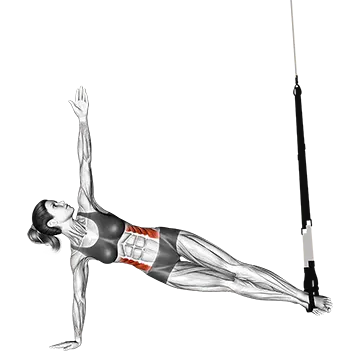
Suspension Twist
- Músculo objetivo
- Obliques
- Músculos sinergistas
- Gluteus Medius, Tensor Fasciae Latae
- Equipamiento
- Suspension
- Parte del cuerpo
- Waist
- Tipo
- Strength
The suspension twist is a rotational core exercise performed with suspension straps that trains the obliques through controlled twisting under an unstable load. Holding the handles with arms extended, you rotate your torso side to side while the straps force your obliques to control every degree of movement. The gluteus medius and tensor fasciae latae engage to stabilize the hips and prevent lateral sway throughout each rotation.
Cómo hacer el Suspension Twist
- 1Adjust the suspension straps to waist height and stand facing the anchor point.
- 2Grip both handles together with both hands, interlacing your fingers or stacking your palms, and step back until the straps are taut with your arms extended straight in front of you.
- 3Set your feet hip-width apart, brace your core, and keep your hips in a neutral position.
- 4Lean back slightly so your body forms a straight line from heels to shoulders, creating tension through the straps.
- 5Keeping your arms straight and hips square, rotate your torso to the right by driving your clasped hands to the right side of your body.
- 6Pause briefly at the end of the range of motion, keeping your hips square and your obliques under tension.
- 7Reverse the movement under control, returning your hands to center.
- 8Rotate to the left in the same controlled manner, pausing at the end range.
- 9Continue alternating sides for the prescribed number of repetitions.
Consejos de técnica
- Keep your arms as straight as possible throughout the twist — bending the elbows reduces the lever arm and shifts load away from the obliques.
- Move from your thoracic spine, not your shoulders; think of rotating your ribcage rather than just swinging your arms.
- Press your feet firmly into the floor and resist the urge to let your hips rotate with your torso — hip stability is what forces the obliques to do the work.
- Control the return to center rather than letting the strap pull you back; the eccentric phase is where much of the oblique stimulus occurs.
- Step farther from the anchor point to increase resistance, or step closer to reduce it.
Errores comunes
- Letting the hips rotate with the torso: when the hips turn to follow the arms, the obliques no longer have to resist rotation and most of the training stimulus is lost — keep your pelvis locked and facing forward throughout.
- Starting from too steep a lean: standing far from the anchor before you can hold the position makes the strap tension overwhelming, so the hips break and the rotation turns into a fall to one side — start closer to the anchor and step back only as control improves.
- Using momentum to swing through the rotation: a fast, swinging motion bypasses the obliques and relies on arm and shoulder drive; slow the movement down and feel each muscle group working.
- Dropping or rising through the hips: sagging or hiking the hips during the twist recruits the lower back rather than the obliques and places unwanted stress on the lumbar spine — maintain a rigid plank-like body position.
- Gripping too loosely: an insecure grip on the handles causes the hands to shift mid-rep, breaking rhythm and control — interlock fingers firmly before each set.
Preguntas frecuentes
What muscles does the suspension twist work?
The suspension twist primarily targets the obliques — both internal and external — which drive and resist the rotational movement. The gluteus medius and tensor fasciae latae work as synergists to stabilize the hips and pelvis so the rotation is isolated to the torso.
How is the suspension twist different from a cable woodchop?
Both exercises train rotational core strength, but the suspension twist requires you to control instability from the straps, which increases the stabilization demand on the obliques and hips. The cable machine provides a fixed line of resistance, while the suspension straps shift slightly with your movement, recruiting more stabilizing muscle activity throughout the range of motion.
How do I make the suspension twist harder or easier?
Difficulty is controlled by your foot position relative to the anchor point. Stepping farther away increases the angle of your lean and raises the load on the obliques, making the exercise harder. Stepping closer to the anchor reduces the lean and decreases the load. You can also slow the tempo or add a pause at end range to increase the challenge.
How many sets and reps should I do for the suspension twist?
For core strength and rotational stability, 3–4 sets of 10–15 reps per side works well. Rest 45–60 seconds between sets. Focus on controlled, deliberate movement rather than speed; quality repetitions with full range of motion outperform high-rep sloppy sets for oblique development.
Can I do the suspension twist if I have lower back pain?
Rotational exercises can aggravate certain lower back conditions, so consult a healthcare professional before attempting this movement if you have a history of back issues. When performed correctly with the hips locked and the movement originating from the thoracic spine, the lumbar spine stays relatively neutral, which is gentler than many rotational exercises — but proper form is essential.