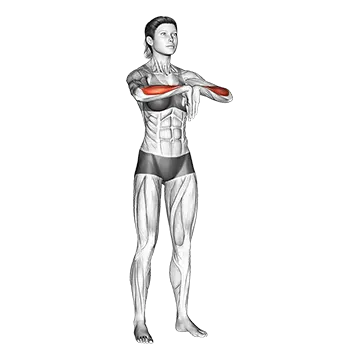
Wrist - Extension - Articulations
- Músculo objetivo
- Wrist Extensors
- Equipamiento
- Body weight
- Parte del cuerpo
- Forearms
- Tipo
- Stretching
Wrist extension articulations are a bodyweight mobility exercise that moves the wrist repeatedly through its full extension range of motion to improve flexibility and joint health in the wrist extensors. By actively controlling the movement rather than holding a static position, you train the muscles and connective tissue across the entire arc of extension. This makes it well suited for warm-up preparation, cooldown, and long-term wrist health maintenance.
Cómo hacer el Wrist - Extension - Articulations
- 1Sit or stand with your arm extended in front of you at roughly chest height, elbow straight or slightly soft, palm facing down.
- 2Allow your wrist to drop into flexion so your fingers point toward the floor — this is your starting position.
- 3Slowly raise your hand upward by extending the wrist, leading with the back of the hand, until your fingers point toward the ceiling or as far as your range allows without pain.
- 4Pause briefly at the top of the extension range, feeling a gentle stretch through the forearm.
- 5Slowly lower your hand back down through the arc into the flexed starting position under control.
- 6Repeat the movement in a smooth, continuous rhythm for the desired number of repetitions.
- 7Complete all reps on one side before switching to the other arm.
Consejos de técnica
- Move at a slow, deliberate pace — the goal is controlled articulation through the full range, not speed.
- Keep your forearm still throughout; only the wrist should move so the work stays focused on the extensors.
- Breathe normally and stay relaxed in the fingers and hand — gripping or tensing the fingers shifts the emphasis away from the wrist.
- If you feel sharp pain rather than a mild stretch at end range, reduce your range of motion and work within a pain-free arc.
- You can perform this with the palm facing up or facing down to slightly change the stress on the surrounding forearm tissues.
Errores comunes
- Moving too quickly through the range, which turns a controlled mobility drill into a passive swing and reduces the tissue adaptation stimulus.
- Bending the elbow significantly during the movement, which changes the length of the forearm muscles and reduces the stretch on the wrist extensors.
- Forcing the wrist past its comfortable end range, which can irritate the joint capsule and surrounding tendons rather than improving mobility.
- Tensing or curling the fingers during extension, which recruits finger extensors and reduces isolation of the wrist extensor muscles.
- Neglecting the lowering phase by dropping the hand passively, which wastes the eccentric portion of the movement where much of the mobility benefit occurs.
Preguntas frecuentes
What muscles do wrist extension articulations work?
The primary muscles targeted are the wrist extensors — mainly the extensor carpi radialis longus, extensor carpi radialis brevis, and extensor carpi ulnaris. These muscles run along the back of the forearm and are responsible for lifting the back of the hand upward.
How is this exercise different from a static wrist extension stretch?
A static stretch holds the end position for time, while articulations move continuously through the range. Active articulation builds both mobility and the muscular control to use that range, whereas a static hold primarily lengthens the tissue passively.
When should I do wrist extension articulations?
They work well at the start of a session to prepare the wrists for pressing or gripping movements, and at the end of a session as a cooldown after heavy forearm loading. Athletes who type extensively or play racket sports also benefit from doing them throughout the day.
How many reps and sets should I do?
For general mobility maintenance, 10–15 controlled repetitions per wrist for 2–3 sets is a reasonable starting point. Focus on quality of movement and range rather than accumulating high volume.
Can wrist extension articulations help with wrist pain?
Gentle articulation can support recovery from minor stiffness and overuse by increasing blood flow and maintaining range of motion. However, if you have an acute injury, tendinopathy, or persistent pain, consult a physiotherapist before using this or any wrist exercise.