
45 Degree Side Bend
- Target muscle
- Obliques
- Synergist muscles
- Iliopsoas
- Equipment
- Body weight
- Body part
- Waist
- Type
- Strength

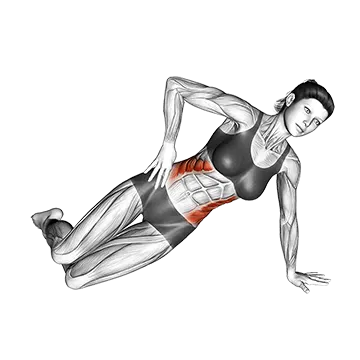

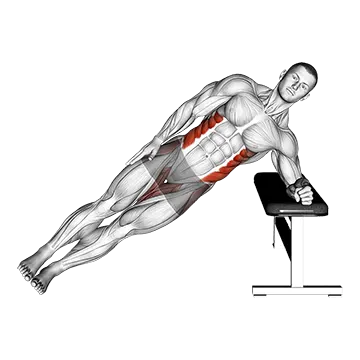
The 45 degree side bend is a body-weight core exercise that primarily targets the obliques along the sides of your waist, with the iliopsoas assisting to stabilize the hips. Performed on a 45-degree hyperextension (Roman chair) bench set up sideways, it trains lateral flexion to build a stronger, more defined midsection.
How to do the 45 Degree Side Bend
- 1Set the foot pad and hip pad of a 45-degree hyperextension bench to your height, then position yourself sideways on it.
- 2Brace your outside hip against the pad and hook your feet under the foot rollers so your body is locked in on its side.
- 3Cross your arms over your chest or place your hands lightly behind your head, and let your torso hang straight in line with your legs.
- 4Keep your legs and hips still, then lower your torso sideways toward the floor by bending at the waist under control.
- 5Lower until you feel a stretch along the upper side of your waist, without rounding or twisting your spine.
- 6Drive through your obliques to lift your torso back up until your body is straight or slightly past neutral.
- 7Pause briefly at the top to squeeze the obliques, then repeat for your target reps.
- 8Finish your set, switch sides, and repeat for the opposite obliques.
Form tips
- Move only at your waist — keep your hips and legs locked against the pad so the obliques do the work.
- Use a slow, controlled tempo in both directions instead of swinging or using momentum.
- Keep your spine long and neutral; bend sideways rather than rounding forward.
- Train both sides for the same reps and effort to keep your waist balanced.
- Add a light plate held across your chest only once you can complete clean body-weight reps.
Common mistakes
- Using momentum to swing the torso up, which takes tension off the obliques and reduces the training effect.
- Twisting or rotating the spine at the bottom instead of bending straight sideways, which stresses the lower back.
- Pulling on the head or neck when hands are placed behind it, straining the cervical spine.
- Adding heavy weight too soon, which shortens the range of motion and compromises control.
- Training only one side, leading to uneven oblique development around the waist.
Frequently asked questions
What muscles does the 45 degree side bend work?
It primarily works the obliques along the sides of your waist, with the iliopsoas (hip flexor) assisting to stabilize the hips during the movement.
Is the 45 degree side bend good for beginners?
Yes. It uses only body weight and a 45-degree hyperextension bench, so beginners can master the lateral-flexion pattern before adding any extra load.
How many sets and reps should I do?
For most lifters, 3 sets of 10–15 controlled reps per side works well. Focus on full range and a squeeze at the top rather than chasing high reps.
What's a good alternative to the 45 degree side bend?
Dumbbell side bends, hanging oblique raises, or cable side crunches all train the obliques through lateral flexion and make solid substitutes.
Where should I feel the 45 degree side bend?
You should feel it along the side of your waist over the obliques — a stretch on the upper side at the bottom and a strong contraction as you lift back up.