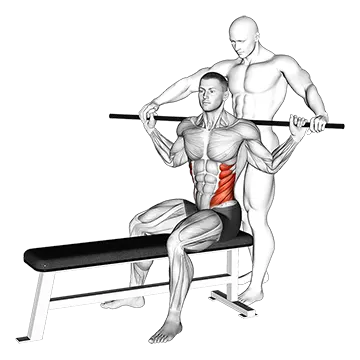
Assisted Side Bent
- Target muscle
- —
- Equipment
- Assisted, Body weight
- Body part
- Back, Waist
- Type
- Stretching
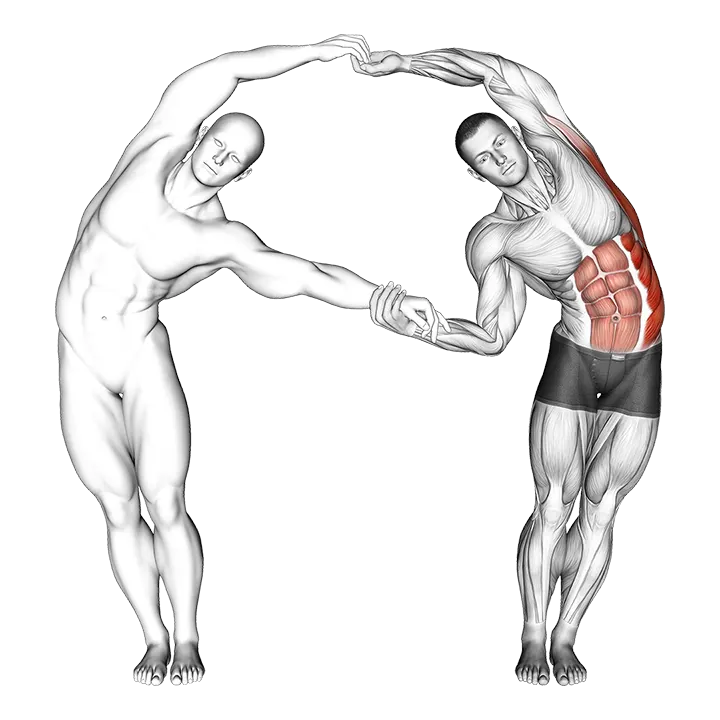
The assisted side bend is a standing bodyweight stretch for the side of the torso, lengthening the obliques, the lats, and the quadratus lumborum along the waist and lower back. A partner or a fixed support guides and deepens the lateral lean, making it a gentle way to open up the side body and improve trunk mobility.
How to do the Assisted Side Bent
- 1Stand tall with your feet about hip-width apart and your weight evenly balanced through both feet.
- 2Reach one arm overhead, keeping the opposite hand resting on your hip or holding a stable support for balance.
- 3Have your partner stand beside you, or position yourself next to a fixed support you can hold or lean against.
- 4Lengthen through your spine, then bend slowly to the side, sliding your raised arm in an arc over your head.
- 5Let your partner gently guide your upper body further into the bend, or use the support to ease yourself deeper.
- 6Keep both feet flat on the floor and your hips facing forward so the stretch stays in the side of your waist.
- 7Hold the lengthened position and breathe steadily, feeling the stretch run from your ribs down to your hip.
- 8Return slowly to upright, then repeat on the other side to balance both sides of your torso.
Form tips
- Move into and out of the bend slowly and under control rather than bouncing, letting the muscle release gradually.
- Keep your hips level and pointing forward so you bend purely sideways instead of twisting or leaning forward.
- Breathe out as you ease deeper into the stretch, which helps the side muscles relax and lengthen.
- Tell your partner to apply only light, steady pressure and to back off the moment you feel any sharp discomfort.
- Keep the stretch within a comfortable range — a side bend should feel like a long pull, never a pinch.
Common mistakes
- Letting your partner push too hard or too fast, which can strain the obliques and lower back instead of stretching them.
- Bouncing or jerking into the bend rather than holding it steadily, which reduces the stretch and risks a muscle pull.
- Twisting the torso or leaning forward, which shifts the stretch away from the waist and onto the spine.
- Lifting a foot or shifting your weight to one side, which collapses your base and removes the stretch from the target muscles.
- Holding your breath, which tenses the muscles you are trying to relax and lengthen.
Frequently asked questions
What muscles does the assisted side bend stretch?
It stretches the side of the torso — the obliques, the lats, and the quadratus lumborum along the waist and lower back. The assistance from a partner or support helps you reach a deeper lateral stretch than you could on your own.
How long should I hold the assisted side bend?
Hold each side for about 20 to 30 seconds and repeat two to three times per side. As a static stretch, the goal is a steady hold rather than reps, so ease in, breathe, and avoid bouncing.
Is the assisted side bend good for beginners?
Yes. It is a gentle bodyweight stretch, and the partner or support lets you control the depth easily. Beginners should start with a small lean and increase the range gradually as the side of the body loosens.
Where should I feel the assisted side bend?
You should feel a long, comfortable pull down the side of your torso — from the ribs through the waist to the hip. If you feel a pinch in the spine or sharp pain, ease off and check that you are bending sideways, not twisting.