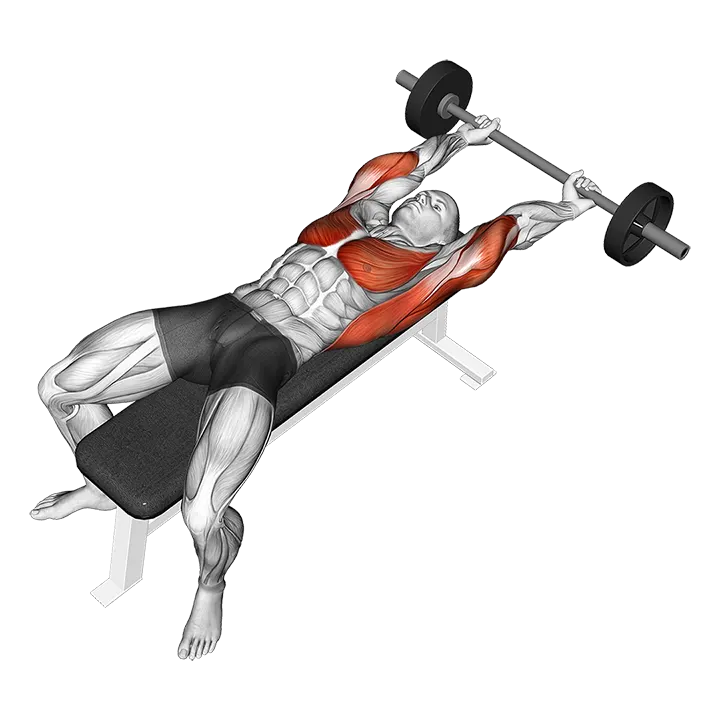
Barbell Pullover Hold Isometric
- Target muscle
- Latissimus Dorsi, Pectoralis Major Clavicular Head, Pectoralis Major Sternal Head, Triceps Brachii
- Equipment
- Barbell
- Body part
- Back
- Type
- Stretching

The barbell pullover hold isometric is a static, stretch-loaded hold that targets the lats (latissimus dorsi) while opening the chest (pectoralis major, both the clavicular and sternal heads) and engaging the triceps to keep the bar steady. Performed lying across or along a bench with the bar held back behind your head, it builds rib-cage mobility, shoulder-flexion stability, and a deep stretch through the upper body.
How to do the Barbell Pullover Hold Isometric
- 1Load a light barbell and lie on a flat bench, either lengthwise along it or with your upper back across it and feet planted on the floor.
- 2Grip the bar with both hands slightly inside shoulder-width and press it up so it sits locked out over your chest with your arms nearly straight.
- 3Take a breath, brace your core, and slowly lower the bar back over and behind your head, keeping only a soft, fixed bend in your elbows.
- 4Stop when you feel a strong stretch through your lats and chest but before your shoulders feel strained or your lower back lifts.
- 5Hold this stretched position completely still, keeping the bar from drifting lower and your ribs from flaring upward.
- 6Maintain the hold for your target time (for example 15–30 seconds), breathing slowly and steadily without losing tension.
- 7To finish, pull the bar back over your chest under control, lock out your arms, then sit up and set the bar down safely.
Form tips
- Keep your elbows at a fixed, slight bend the whole time — locking them out hard or letting them collapse changes where you feel the stretch and stresses the joint.
- Keep your core braced and your lower ribs pulled down so the stretch comes from your lats and chest, not from arching your lower back.
- Choose the depth where you feel a strong stretch without shoulder pain; go only as far as your shoulder mobility comfortably allows.
- Because this is a held position over your head and face, use a light load and have a spotter or set safety arms when you train near your limit.
Common mistakes
- Using too heavy a bar, which forces you out of position and puts the loaded stretch on your shoulder joint instead of your lats and chest.
- Letting the lower back arch and the ribs flare to chase more range, which removes core tension and strains the spine.
- Bending and straightening the elbows during the hold, which turns a static stretch into a sloppy partial rep and loses the targeted tension.
- Lowering the bar too far behind the head past your mobility, which over-stretches the shoulders and risks the bar dropping toward your face.
Frequently asked questions
What muscles does the barbell pullover hold isometric work?
It mainly works the lats (latissimus dorsi) under stretch, opens the chest (pectoralis major, both clavicular and sternal heads), and uses the triceps to keep the bar stable in the held position.
How long should I hold the position?
Hold for about 15–30 seconds per set, keeping steady tension and slow breathing. Stop sooner if your form breaks down or your shoulders feel strained, and do 2–4 sets.
Is the barbell pullover hold isometric good for beginners?
Yes, as long as you start very light and keep the bar within a comfortable range. Beginners benefit from the controlled stretch, but they should master a stable braced position before increasing depth or load.
Where should I feel this stretch?
You should feel a deep stretch along your lats and across your chest. Sharp pain in the front of the shoulder means you have gone too far or the load is too heavy — reduce the range and weight.