Lying Glute Stretch
- Target muscle
- Gluteus Maximus
- Equipment
- Body weight
- Body part
- Hips
- Type
- Stretching
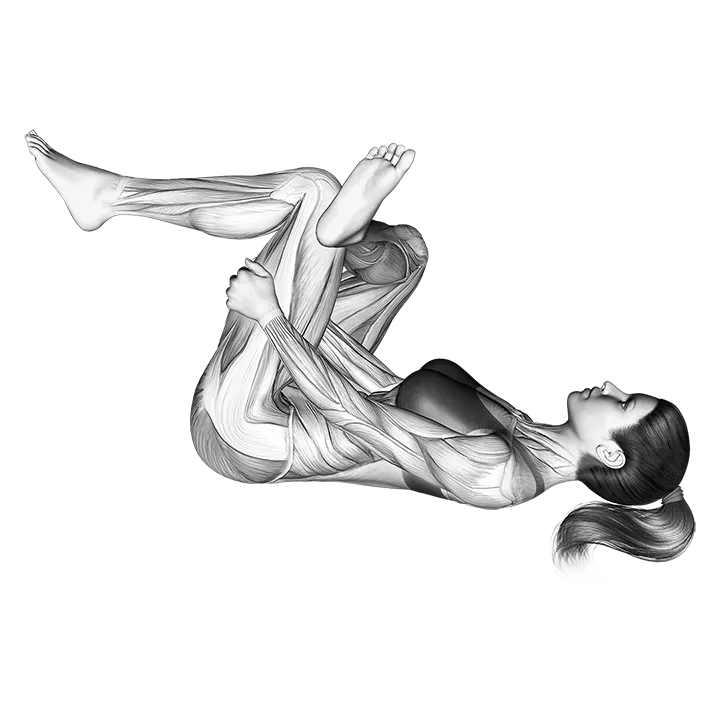
The lying glute stretch is a bodyweight flexibility exercise that targets the gluteus maximus, performed flat on your back to release tension in the hips. It is widely used as a recovery and mobility drill to improve hip range of motion and ease lower-back tightness linked to tight glutes.
How to do the Lying Glute Stretch
- 1Lie flat on your back on a mat with your legs extended and your head resting comfortably on the floor.
- 2Bend your right knee and place your right foot flat on the floor.
- 3Cross your left ankle over your right thigh, just above the knee, so your left leg forms a figure-four shape.
- 4Flex your left foot to protect the knee joint throughout the stretch.
- 5Reach both hands around your right thigh and interlace your fingers behind it.
- 6Gently pull your right thigh toward your chest until you feel a deep stretch in your left glute and hip.
- 7Hold the position for 20–40 seconds, breathing slowly and relaxing deeper into the stretch with each exhale.
- 8Release, return both feet to the floor, and repeat on the opposite side.
Form tips
- Keep your head and shoulders flat on the mat rather than lifting them — letting the floor support you helps you relax fully into the stretch.
- If you cannot reach around your thigh without lifting your head, loop a towel or strap behind it, or press the sole of the supporting foot into a wall and slide closer instead.
- Breathe out as you pull your thigh closer; use each exhale to consciously release tension in the hip.
- Move slowly and avoid jerking the leg — a steady, controlled pull produces a more effective and safer stretch.
Common mistakes
- Letting the crossing foot go limp instead of flexed, which shifts stress onto the knee ligaments rather than the glute.
- Pulling too hard or jerking the thigh, which can cause the hip to resist rather than release into the stretch.
- Rotating the pelvis to the side as you pull, which reduces the stretch on the glute and strains the lower back.
- Holding your breath, which creates unnecessary tension in the hips and prevents you from deepening the stretch.
Frequently asked questions
What muscles does the lying glute stretch target?
The lying glute stretch primarily targets the gluteus maximus, the largest muscle of the buttocks. It also helps release general hip tightness, which can indirectly relieve tension in the lower back.
How long should I hold the lying glute stretch?
Hold each side for 20–40 seconds to allow the muscle to fully relax and lengthen. Perform 2–3 rounds per side for best results.
When is the best time to do this stretch?
It is most effective after a workout when the muscles are warm, or as part of a dedicated mobility or cool-down routine. It can also be done in the morning to ease stiffness from prolonged sitting.
Can the lying glute stretch help with lower back pain?
Tight glutes can contribute to lower back discomfort, so regularly stretching them may help reduce that tension. However, if you have an existing back injury, consult a healthcare professional before adding this stretch.
Is this the same as the figure-four stretch?
Yes — the lying glute stretch is commonly called the figure-four or supine piriformis stretch because of the shape your legs form. All three names refer to the same movement performed lying on your back.