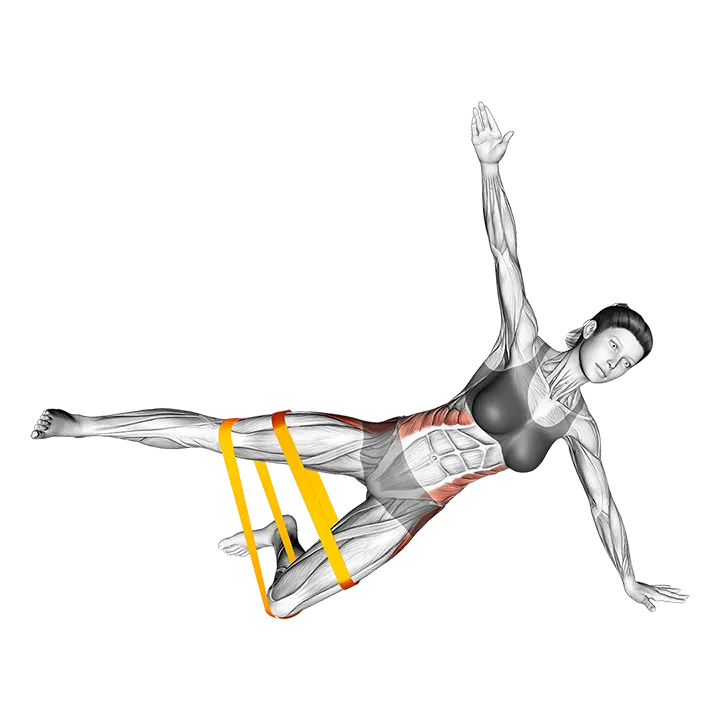
Resistance Band Kneeling Side Plank
- Target muscle
- Gluteus Medius
- Synergist muscles
- Obliques, Tensor Fasciae Latae
- Equipment
- Resistance Band
- Body part
- Hips
- Type
- Strength
The resistance band kneeling side plank is a lateral core and hip exercise that primarily targets the gluteus medius, with the obliques and tensor fasciae latae providing key support. Performed from a kneeling position with a resistance band looped above the knees, it challenges hip abduction stability and lateral trunk stiffness under added load.
How to do the Resistance Band Kneeling Side Plank
- 1Loop a resistance band just above your knees and kneel on an exercise mat with your legs together.
- 2Shift onto your right knee and the outer edge of your right shin, then extend your left leg so your body forms a straight diagonal line from knees to head.
- 3Place your right forearm flat on the mat, directly below your right shoulder, with your elbow bent at 90°.
- 4Rest your left hand on your hip or extend your left arm toward the ceiling for added challenge.
- 5Brace your core and drive your right hip upward so your hips are stacked and your body forms a straight line from knee to shoulder.
- 6Push your left knee up and away against the band to create tension, fully engaging the gluteus medius.
- 7Hold the position for the prescribed time, keeping your hips square and your core tight throughout.
- 8Lower your hip back to the mat with control, then repeat on the opposite side.
Form tips
- Keep your hips fully stacked — avoid letting the top hip rotate forward or backward, which reduces tension on the gluteus medius.
- Push your support forearm into the mat to create a stable base and prevent your shoulder from sinking.
- Actively press your top knee outward against the band throughout the hold rather than allowing it to drift inward.
- Breathe steadily and avoid holding your breath — maintain a slow, controlled exhale to keep your core engaged.
Common mistakes
- Letting the bottom hip sag toward the mat, which removes lateral tension and places stress on the lower back instead of the target muscles.
- Allowing the top knee to collapse inward, which slackens the band and defeats the purpose of the added resistance.
- Rotating the torso forward to compensate for limited hip strength, reducing oblique and gluteus medius activation.
- Placing the support elbow too far in front of or behind the shoulder, which destabilizes the base and shifts load off the hips.
Frequently asked questions
What muscles does the resistance band kneeling side plank work?
The primary target is the gluteus medius. The obliques and tensor fasciae latae act as synergists, stabilizing the lateral trunk and hip throughout the hold.
Why kneel instead of performing a full side plank?
The kneeling variation shortens the lever arm, making it more accessible for beginners or those building lateral hip strength before progressing to the full extended version. It still effectively targets the gluteus medius and obliques.
Where should I position the resistance band?
Loop the band just above your knees. This placement creates meaningful resistance when you push the top knee outward, directly loading the gluteus medius without interfering with knee-joint mechanics.
How long should I hold the kneeling side plank?
For strength and endurance, aim for holds of 20–45 seconds per side. Rest briefly between sides and perform 2–3 sets. As you get stronger, progress to longer holds or a heavier resistance band.
Can I use this exercise to fix hip drop when running or squatting?
Yes. Weakness in the gluteus medius is a common cause of hip drop and knee valgus during dynamic movements. Regularly training it with the resistance band kneeling side plank can improve lateral hip stability and carry over to running, squatting, and single-leg movements.
Related exercises
 Resistance Band Bent Leg Side Kick (kneeling)Hips
 Resistance Band ClamHips
 Resistance Band Lying AbductionHips
 Resistance Band Lying Leg RaiseHips
 Resistance Band Seated Hip AbductionHips
 Band Cross AbductionHips
 Band Hip AbductionHips
 Band horizontal Pallof Press with Resistance Band SquatHips, Thighs, Waist