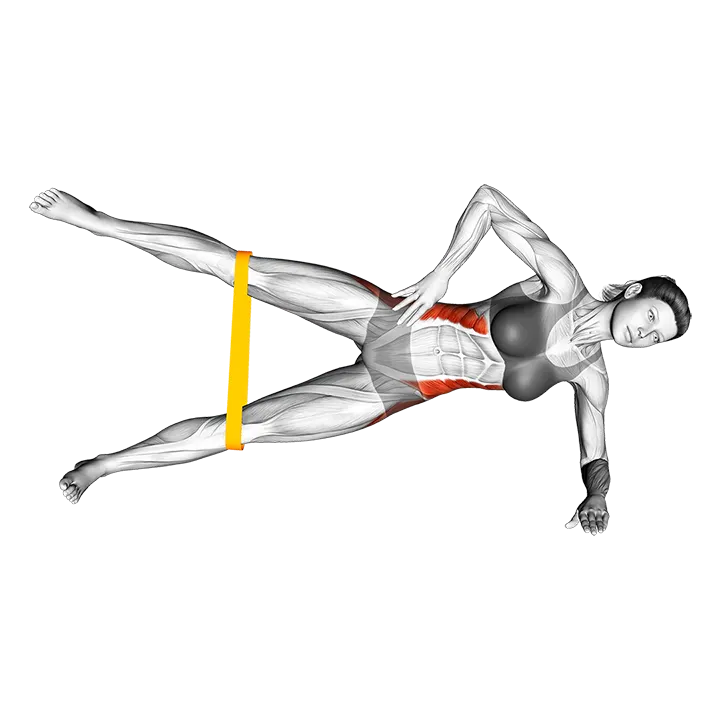
Resistance Band Side Plank
- Target muscle
- Gluteus Medius, Obliques
- Synergist muscles
- Tensor Fasciae Latae
- Equipment
- Resistance Band
- Body part
- Hips, Waist
- Type
- Strength
The resistance band side plank is a lateral core stability exercise that targets the gluteus medius and obliques, with the tensor fasciae latae acting as a synergist. A resistance band looped around your thighs or ankles adds lateral tension that intensifies glute and hip activation compared to a standard side plank. It is well suited for building hip stability, lateral core strength, and improving balance in the frontal plane.
How to do the Resistance Band Side Plank
- 1Loop a resistance band around both thighs just above the knees (or around your ankles for greater challenge) and lie on your side on an exercise mat.
- 2Stack your feet on top of each other and prop yourself up on your bottom forearm, with your elbow directly beneath your shoulder.
- 3Brace your core, squeeze your glutes, and lift your hips off the mat until your body forms a straight line from head to heel.
- 4Press your bottom hip upward and outward slightly to engage the gluteus medius, keeping your top hip stacked directly over your bottom hip.
- 5Without rotating your torso, press your top thigh outward against the band to create tension — this activates the gluteus medius and tensor fasciae latae.
- 6Keep your neck neutral, your gaze forward, and breathe steadily throughout the hold.
- 7Hold the position for the target duration (20–45 seconds for beginners, up to 60 seconds as you progress), then lower your hips with control.
- 8Repeat on the opposite side for equal time.
Form tips
- Drive your bottom elbow into the mat to keep your shoulder stable and prevent it from sinking under load.
- Think of pushing the floor away with your bottom foot to maintain hip height and avoid sagging through the waist.
- Keep tension on the band by actively pressing your top knee outward — do not let the band collapse your legs inward.
- If your form breaks before the target time is up, rest briefly and resume rather than grinding through with poor alignment.
- Progress to a straight-arm side plank or add hip dips once you can hold proper form for 60 seconds consistently.
Common mistakes
- Letting the hips sag toward the floor, which reduces oblique and glute engagement and places strain on the lower back.
- Rotating the torso forward or backward, which shifts the load away from the lateral stabilizers and defeats the purpose of the exercise.
- Placing the elbow too far from the shoulder, which creates a lever that overloads the joint and destabilizes the position.
- Holding the breath, which increases intra-abdominal pressure unevenly and makes the hold harder to sustain with control.
- Ignoring the band tension by letting the thighs collapse inward, which eliminates the added gluteus medius stimulus the band is intended to provide.
Frequently asked questions
Where should I place the resistance band for a side plank?
Loop the band around both thighs just above the knees for a moderate challenge. Moving it down to the ankles increases the moment arm and makes the glute activation more demanding.
What muscles does the resistance band side plank work?
It primarily targets the gluteus medius and obliques. The tensor fasciae latae assists by helping to stabilize and abduct the hip against the band's resistance.
How long should I hold a resistance band side plank?
Beginners should aim for 20–30 seconds per side with good form. Work toward 45–60 seconds before increasing band resistance or progressing to a harder variation.
Can I do this exercise if I have lower back pain?
A properly performed side plank is generally considered a spine-safe exercise because it avoids spinal flexion, but you should consult a healthcare professional before starting if you have an existing back condition.
How does the resistance band make the side plank harder?
The band creates lateral resistance that tries to pull your thighs together, forcing the gluteus medius and tensor fasciae latae to work continuously to maintain hip position and keep the top knee pressed outward.
Related exercises
 Band horizontal Pallof Press with Resistance Band SquatHips, Thighs, Waist
 Landmine Resistance Band One Arm Shoulder PressShoulders
 Pretzel StretchWaist
 Resistance Band 45 Degree Hip Extension Glute FocusedHips
 Resistance Band 45 degrees HyperextensionHips
 Resistance Band Adduction Split SquatThighs
 Resistance Band Air BikeWaist
 Resistance Band Air Bike (VERSION 2)Waist