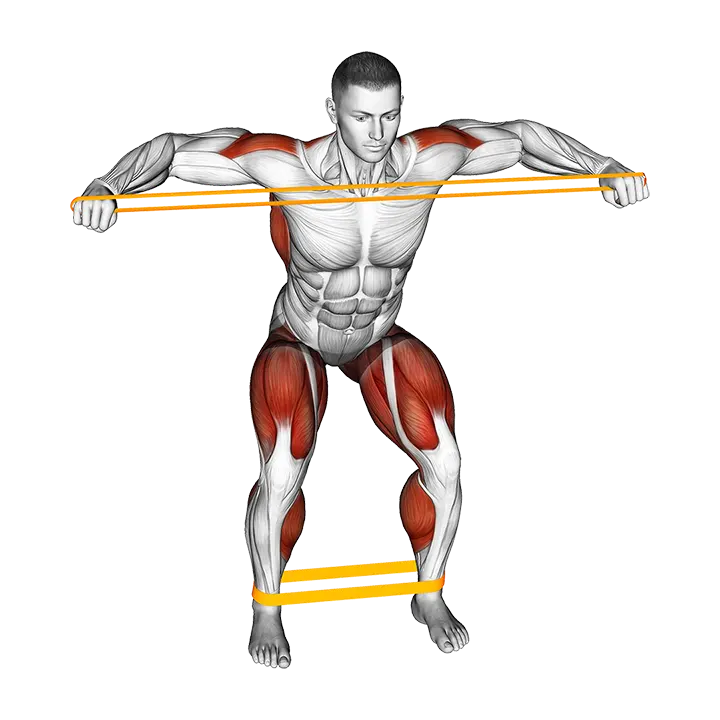

Resistance Band Squatting Front Warming-up
- Target muscle
- —
- Equipment
- Resistance Band
- Body part
- Back, Hips, Thighs
- Type
- Stretching
The resistance band squatting front warming-up is a mobility drill that uses a band held in front for balance support while you sink into a deep squat, opening the hips and warming up the lower back and thighs. It activates and loosens the hip flexors, glutes, and quadriceps without loading the spine, making it an effective pre-workout preparation for squatting movements.
How to do the Resistance Band Squatting Front Warming-up
- 1Stand with feet shoulder-width apart and hold both ends of the resistance band in front of you at roughly chest height, with the band anchored underfoot or to a fixed point low in front.
- 2Brace your core lightly and keep your chest tall as you begin to descend.
- 3Push your knees out in line with your toes and shift your hips back and down as you lower into a squat.
- 4Use the tension in the band to counterbalance your weight and allow your torso to remain upright throughout the descent.
- 5Sink until your thighs are at least parallel to the floor, or as deep as your mobility allows while keeping your heels down.
- 6Pause at the bottom for 1–2 seconds, breathing in and allowing your hips to relax and open.
- 7Drive through your heels to rise back to the starting position, keeping the band taut and your chest up.
- 8Repeat for the prescribed number of reps at a slow, controlled tempo to mobilize the joints rather than build load.
Form tips
- Let the band pull gently forward — lean into that counterbalance to sit more upright than you could unassisted.
- Focus on pushing the knees out throughout the movement to open the hips and avoid knee cave.
- Breathe in at the bottom of each rep, allowing the inhale to help your rib cage and hips relax into a deeper position.
- Move slowly — this is a warm-up, not a strength set; a 3-second descent maximizes mobility benefit.
- Keep your heels in full contact with the floor; if they rise, widen your stance slightly or elevate your heels on a small plate.
Common mistakes
- Rushing through reps, which defeats the mobility purpose and does not give joints time to open up before loading.
- Letting the knees cave inward, which puts stress on the knee joint and fails to activate the glutes and hip external rotators.
- Rounding the lower back at the bottom of the squat, which can irritate the lumbar spine and limits the hip stretch benefit.
- Using a band with too much resistance, which turns the drill into a strength exercise rather than a warm-up and adds unnecessary fatigue.
- Allowing the heels to lift off the floor, which shifts load to the knees and prevents the hip and ankle mobility gains this drill is designed to deliver.
Frequently asked questions
What is the resistance band squatting front warming-up good for?
It is a pre-workout mobility drill that opens the hips, loosens the lower back, and activates the thighs before heavy squatting or lower-body training. The band provides a counterbalance that allows you to sit in a deeper squat position than you could unassisted.
How many reps should I do as a warm-up?
Two to three sets of 8–12 slow, controlled reps is typically enough to increase blood flow and mobility without fatiguing the muscles before your main workout.
Which muscles does this exercise warm up?
It primarily mobilizes the hip flexors, glutes, and quadriceps, while also loosening the lower back and improving ankle dorsiflexion through the repeated deep-squat position.
Can beginners use this as a way to learn the squat pattern?
Yes. The band acts as a counterweight that makes it easier to stay upright and reach depth, making it an excellent teaching tool for people still developing squat mechanics.
What resistance level band should I use?
Use a light band — just enough to provide a gentle forward pull for counterbalance. A heavier band adds unnecessary load and turns the drill into a strength exercise rather than a warm-up.
Related exercises
 Band horizontal Pallof Press with Resistance Band SquatHips, Thighs, Waist
 Landmine Resistance Band One Arm Shoulder PressShoulders
 Resistance Band 45 Degree Hip Extension Glute FocusedHips
 Resistance Band 45 degrees HyperextensionHips
 Resistance Band Adduction Split SquatThighs
 Resistance Band Air BikeWaist
 Resistance Band Air Bike (VERSION 2)Waist
 Resistance Band Alternating Split Stance Pallof PressWaist