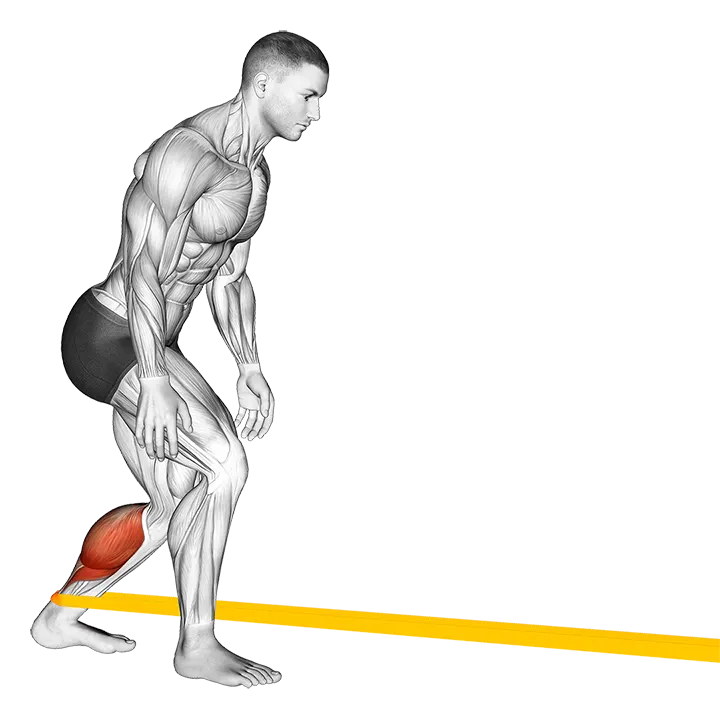
Resistance Band Standing Forward Achilles Stretch
- Target muscle

- Gastrocnemius, Soleus
- Equipment
- Resistance Band
- Body part
- Calves
- Type
- Stretching
The resistance band standing forward Achilles stretch targets the gastrocnemius and soleus, the two muscles that make up the calf complex and attach via the Achilles tendon. By looping a band around the forefoot and hinging forward, you create a controlled dorsiflexion stretch that improves ankle mobility and reduces tightness after running, jumping, or prolonged standing.
How to do the Resistance Band Standing Forward Achilles Stretch
- 1Stand upright and loop one end of a resistance band around the ball of your right foot, holding the other end in both hands in front of you.
- 2Step your right foot slightly forward, keeping your right leg straight and your heel pressed firmly into the floor.
- 3Stand tall and brace lightly through your core to keep your torso upright throughout the stretch.
- 4Gently pull the band toward you to draw your toes and forefoot back into dorsiflexion, increasing the tension along the calf and Achilles tendon.
- 5Hold this position for 20–30 seconds, breathing steadily and allowing the gastrocnemius to relax into the stretch.
- 6To shift emphasis to the soleus, soften the right knee slightly while maintaining heel contact with the floor, then hold for another 20–30 seconds.
- 7Release the band, shake out the leg, and repeat on the left side.
Form tips
- Keep your heel in full contact with the floor throughout — lifting it reduces tension on the Achilles and soleus.
- Pull the band gradually and with steady tension; do not jerk it, as a sudden pull can trigger a protective muscular contraction.
- Perform the stretch twice per side — once with the knee straight to target the gastrocnemius, then with a slight bend to reach the deeper soleus.
- Breathe out slowly as you apply band tension; exhaling helps the muscle relax and allows a deeper stretch.
Common mistakes
- Letting the heel rise off the floor, which shifts the stretch away from the Achilles and reduces the effectiveness of the exercise.
- Pulling the band too hard too quickly, which can cause the calf to reflexively tighten and may stress the Achilles tendon.
- Skipping the bent-knee variation, which means the deeper soleus muscle goes unstretched because it only crosses the ankle, not the knee.
- Rounding the back or leaning the torso excessively forward, which reduces the stretch on the calf and places unnecessary load on the lower back.
- Holding the stretch for less than 20 seconds, which is too short for the tissue to relax and adapt — static stretches require at least 20–30 seconds to be effective.
Frequently asked questions
What muscles does the resistance band standing forward Achilles stretch target?
It targets the gastrocnemius and soleus — the two muscles of the calf that converge into the Achilles tendon. Keeping the knee straight emphasizes the gastrocnemius; bending the knee slightly shifts focus to the soleus.
Why use a resistance band instead of a wall or step for this stretch?
The band lets you control the angle and amount of dorsiflexion precisely using your hands, and works well when a wall or step is not available. It also allows you to target the stretch while standing upright rather than leaning against a surface.
How long should I hold the Achilles stretch?
Hold each position for 20–30 seconds. This is the minimum time needed for a static stretch to reduce muscle stiffness. You can perform 2–3 repetitions per side for greater benefit.
When is the best time to do this stretch?
It is most effective as part of a cool-down after exercise when the tissue is warm, or as a standalone mobility session. Stretching a completely cold muscle is less productive and carries a slightly higher injury risk.
Can this stretch help with Achilles tendon tightness or plantar fasciitis?
Regularly stretching the gastrocnemius and soleus reduces tension on the Achilles tendon and can relieve tightness associated with Achilles tendinopathy or plantar fasciitis. However, if you have an acute injury or significant pain, consult a physiotherapist before performing loaded or deep stretches.
Related exercises
 Ankle - Plantar Flexion - ArticulationsCalves
 Band horizontal Pallof Press with Resistance Band SquatHips, Thighs, Waist
 Bodyweight Standing Pulse Calf RaiseCalves
 Calf Push Stretch With Hands Against WallCalves
 Calf Stretch With Hands Against WallCalves
 Calf Stretch with RopeCalves
 Calves StretchCalves
 Feet and Ankles Side to Side StretchCalves