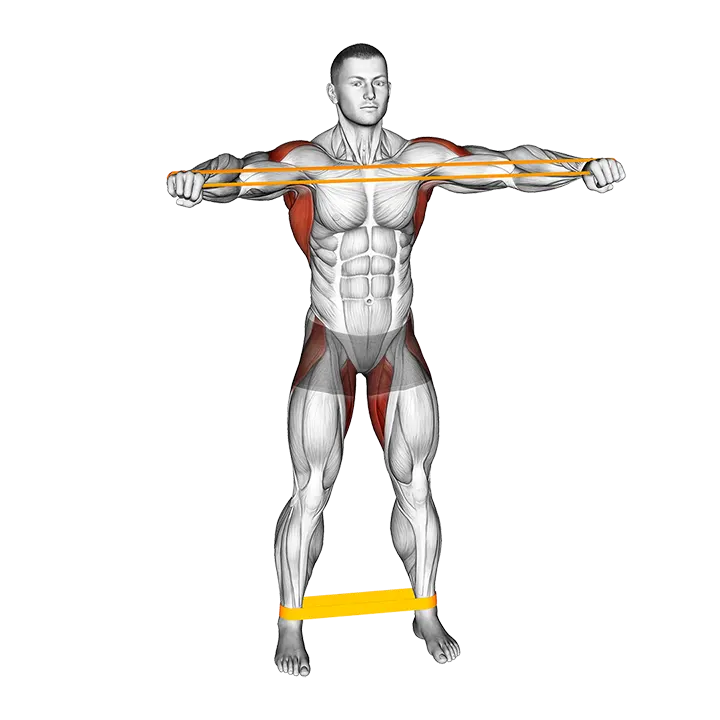

Resistance Band Standing Front Warming-up
- Target muscle
- —
- Equipment
- Resistance Band
- Body part
- Back, Hips
- Type
- Stretching
The resistance band standing front warming-up is a dynamic pre-workout stretching drill that mobilizes the back and hips by holding a band in front of the body and performing controlled forward reaches and hip hinges. It increases blood flow through the posterior chain, lengthens the lumbar and thoracic back muscles, and prepares the hip joints for load-bearing movements. Use it at the start of sessions that involve deadlifts, rows, or any hip-dominant work.
How to do the Resistance Band Standing Front Warming-up
- 1Stand with feet hip-width apart and hold the resistance band with both hands at roughly shoulder width, arms extended in front of you at chest height with light tension in the band.
- 2Engage your core lightly, set your shoulders back, and establish a neutral spine before beginning any movement.
- 3Push your hips back and hinge forward at the waist, allowing your torso to lower toward horizontal while keeping the band taut and your arms reaching straight ahead.
- 4Lower until you feel a moderate stretch across your lower back and the back of your hips, stopping before your spine rounds under load — aim for a torso angle between 45 and 90 degrees depending on your current flexibility.
- 5Pause for 1–2 seconds at the bottom of the hinge, breathing in and allowing the back and hip muscles to relax into the stretch.
- 6Drive your hips forward to return to standing, squeezing your glutes at the top and keeping the band level throughout the ascent.
- 7From the standing position, hold the band at chest height and perform a slow rotation to the left, allowing your hips to follow slightly while keeping your feet planted.
- 8Return to centre and rotate to the right to complete one full repetition.
- 9Repeat the hip-hinge and rotation sequence for the prescribed number of repetitions, moving rhythmically and maintaining steady breathing throughout.
Form tips
- Keep the band taut at all times — letting it go slack removes the proprioceptive cue that keeps your arms aligned and allows your upper back to round during the hinge.
- Initiate the hinge by pushing the hips back first, not by rounding the lower back forward; this targets the intended back and hip muscles rather than straining the lumbar spine.
- Use a slow, deliberate tempo — 2 seconds down, a brief pause, 2 seconds up — rather than bouncing, so the muscles have time to warm up and lengthen.
- On the rotation phase, let your hips rotate slightly with your torso rather than forcing a pure spinal twist; this reduces lumbar stress and better prepares the hip joint for compound movements.
- Choose a band with light resistance — you should feel gentle tension, not a strong pull; the goal is mobility and blood flow, not strength output.
Common mistakes
- Rounding the lower back during the hip hinge instead of maintaining a neutral spine, which places compressive load on the lumbar discs and defeats the purpose of a controlled warm-up stretch.
- Hinging from the waist rather than pushing the hips back, which shifts the movement into the lower back instead of loading the posterior chain muscles of the back and hips as intended.
- Letting the arms drop and the band go slack during the forward lean, removing tension and reducing the postural cue that keeps the upper back engaged.
- Rushing through the repetitions with momentum rather than a controlled range of motion, which limits the warming effect on the back and hip tissues and increases the chance of a strain at the end range.
- Locking the knees rigid throughout the movement, which reduces hip flexion depth and transfers stress to the lower back — maintain a soft bend in the knees to allow a full hip hinge.
Frequently asked questions
What muscles does the resistance band standing front warming-up target?
The exercise primarily warms up the back and hips. The hip hinge component mobilizes the glutes, hip extensors, and lumbar erectors, while the rotation phase loosens the thoracic spine and the muscles surrounding the hip joint.
How many reps should I do before a workout?
8–12 slow repetitions are enough for most people. Focus on increasing range of motion with each rep rather than hitting a specific number — stop when the back and hips feel adequately loose and warm.
What resistance band should I use for this warm-up?
Use a light flat or loop band that provides gentle tension when your arms are extended at chest height. The band should stay taut without pulling your arms down or requiring significant effort — this is a mobility drill, not a strength exercise.
Can I do this warm-up before deadlifts or squats?
Yes. The hip hinge pattern directly mirrors the setup for deadlifts and Romanian deadlifts, making this warm-up particularly useful before any posterior-chain session. The rotation component also prepares the hips for the lateral demands of squats and lunges.
What is the difference between the standing front and standing back warming-up with a resistance band?
The standing back warming-up sweeps the band from front to back overhead to stretch the chest and hip flexors. The standing front warming-up focuses the movement forward — using a hip hinge and trunk rotation to mobilize the posterior chain muscles of the back and hips.
Related exercises
 Band horizontal Pallof Press with Resistance Band SquatHips, Thighs, Waist
 Landmine Resistance Band One Arm Shoulder PressShoulders
 Resistance Band 45 Degree Hip Extension Glute FocusedHips
 Resistance Band 45 degrees HyperextensionHips
 Resistance Band Adduction Split SquatThighs
 Resistance Band Air BikeWaist
 Resistance Band Air Bike (VERSION 2)Waist
 Resistance Band Alternating Split Stance Pallof PressWaist