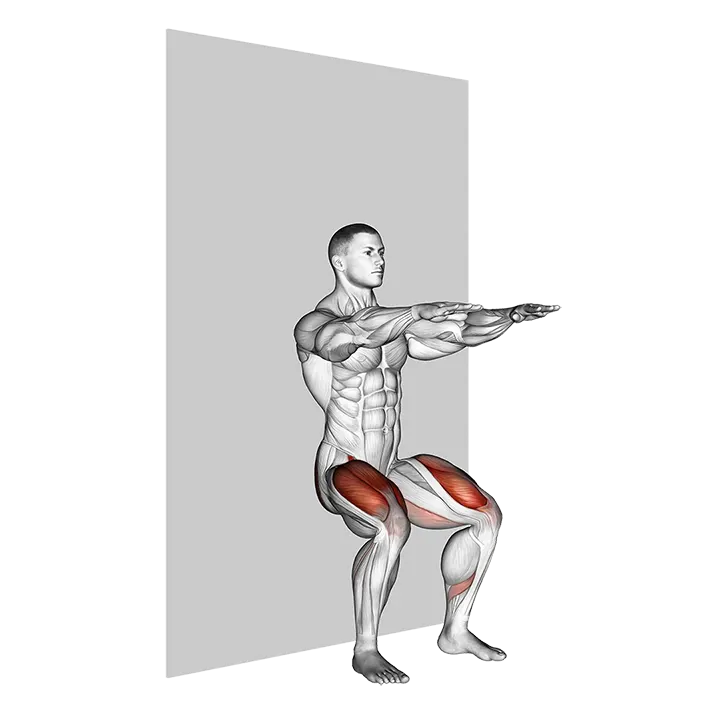
Sit (wall)
- Target muscle
- Gluteus Maximus, Quadriceps
- Synergist muscles
- Adductor Magnus, Soleus
- Equipment
- Body weight
- Body part
- Thighs
- Type
- Strength
The wall sit is an isometric lower-body exercise that holds you in a static squat position with your back flat against a wall and thighs parallel to the floor, placing sustained tension on the quadriceps and gluteus maximus. The adductor magnus and soleus assist in maintaining the position. It builds muscular endurance in the thighs and glutes without any equipment.
How to do the Sit (wall)
- 1Stand with your back against a smooth wall, feet hip-width apart and roughly 45–50 cm away from the wall — about the length of your thigh.
- 2Slide your back down the wall until your hips and knees are both at approximately 90 degrees and your thighs are parallel to the floor.
- 3Press your entire back — lower, mid, and upper — firmly into the wall throughout the hold.
- 4Position your feet so your shins are vertical and your knees track directly over your second toes.
- 5Keep your arms at your sides, resting lightly on your thighs or extended forward — do not push off your thighs.
- 6Hold the position for the target duration, breathing steadily and keeping your core braced.
- 7To finish, press through your feet and slide back up the wall to a standing position.
Form tips
- Keep your weight evenly distributed across your entire foot — avoid letting your heels rise or your toes bear all the load.
- Drive your lower back into the wall actively; do not let a gap form at the lumbar spine as fatigue sets in.
- Control your breathing with slow, steady inhales and exhales — holding your breath spikes your blood pressure and shortens how long you can maintain the hold.
- Start with shorter holds (20–30 seconds) and add time progressively rather than grinding through poor form to reach a time target.
- If your knees cave inward as you fatigue, end the set — this stresses the medial knee structures and means you have reached your limit for that effort.
Common mistakes
- Thighs above parallel: sitting too high reduces the range of knee flexion, offloading the quadriceps and making the hold far easier than intended.
- Knees traveling past the toes: letting the knees drift too far forward shifts stress onto the patellar tendon and reduces the muscular demand on the glutes.
- Pushing off the thighs with your hands: bracing your hands on your thighs takes load off the legs and defeats the purpose of the exercise.
- Feet too close to the wall: this forces the shins to angle forward and overloads the knees; the shins should remain close to vertical throughout.
- Letting the lower back peel away from the wall: losing wall contact at the lumbar spine places the spine in flexion under load and removes the stabilising feedback the wall provides.
Frequently asked questions
How long should I hold a wall sit?
Beginners typically start with 20–30 second holds and build toward 60–90 seconds over several weeks. Once you can hold good form for 90 seconds, increasing difficulty — such as adding a hold at a deeper angle or performing single-leg variations — is more productive than simply extending the time further.
What muscles does a wall sit work?
The primary muscles are the quadriceps and gluteus maximus, which work isometrically to hold the position against gravity. The adductor magnus stabilises the hip, and the soleus sustains ankle position throughout the hold.
Is a wall sit good for building strength or endurance?
Wall sits develop muscular endurance and isometric strength rather than dynamic strength. They are a useful complement to squats and lunges but should not replace them if building maximal force output is the goal.
Can I do wall sits every day?
Yes — because there is no eccentric loading, muscle damage is minimal and recovery is fast. Daily wall sit practice is well tolerated by most people, though adding rest days is still sensible if overall training volume is high.
Why do my knees hurt during a wall sit?
Knee discomfort usually comes from thighs being above parallel, feet placed too close to the wall, or the knees collapsing inward. Check that your thighs are parallel to the floor, your shins are vertical, and your knees are aligned over your toes before continuing.
Related exercises
 Alternate Sprinter LungeHips, Thighs
 Assisted Pistol Squat with Bed SheetThighs
 Bodyweight Drop Jump SquatHips, Thighs
 Bodyweight Forward Lunge (Hinge at Hips)Hips, Thighs
 Bodyweight Glute Dominant Step-UpHips, Thighs
 Bodyweight Kneeling Hold to StandThighs
 Bodyweight Narrow Stance SquatThighs
 Bodyweight Overhead SquatThighs