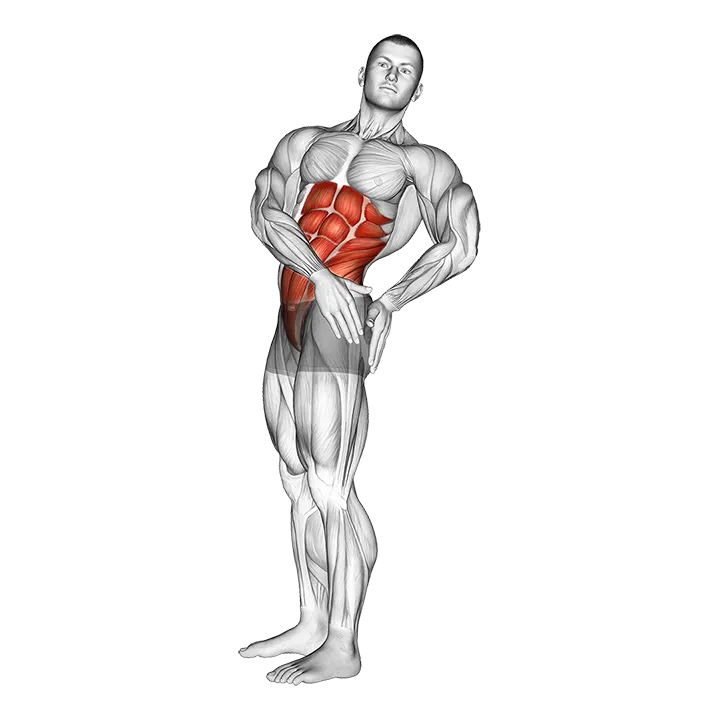
Standing Abs Rotation Stretch
- Target muscle
- Obliques, Rectus Abdominis
- Equipment
- Body weight
- Body part
- Waist
- Type
- Stretching

The standing abs rotation stretch is a bodyweight mobility exercise that targets the obliques and rectus abdominis through controlled trunk rotation. Performed upright with no equipment, it improves waist flexibility, opens the rotational range of motion through the core, and works equally well as a warm-up before training or a cool-down movement at the end of a session.
How to do the Standing Abs Rotation Stretch
- 1Stand with your feet hip-width apart, knees soft (slightly bent), and your weight evenly distributed across both feet.
- 2Place your hands on your hips or extend your arms out to the sides at shoulder height to act as a counterbalance.
- 3Engage your core lightly and stand tall — keep your hips square and facing forward throughout the movement.
- 4Exhale and slowly rotate your upper body to the right as far as is comfortable, leading with your chest rather than your shoulders.
- 5Pause for one to two seconds at the end of the range, feeling the stretch along the left side of your waist and abdomen.
- 6Inhale and return smoothly to the center without rushing.
- 7Rotate to the left with the same controlled tempo, pause, and feel the stretch on the right side.
- 8Return to center — that is one full repetition. Continue alternating sides for the desired number of reps or duration.
Form tips
- Keep your hips locked forward throughout each rotation — all movement should come from the mid-spine and waist, not from the pelvis swinging.
- Move slowly and with intention; a gentle, sustained stretch is more effective and safer than a fast, jerky rotation.
- Breathe out as you rotate into the stretch and breathe in as you return to center to help relax the abdominal muscles.
- Stand as tall as possible — imagine a string pulling the crown of your head toward the ceiling to prevent slouching, which reduces the stretch quality.
Common mistakes
- Rotating the hips along with the torso, which transfers the stretch away from the obliques and rectus abdominis and reduces effectiveness.
- Using momentum to swing the upper body side to side instead of moving with control, which makes the stretch too brief and risks straining the spinal muscles.
- Holding your breath during the rotation, which causes the core to tighten unnecessarily and limits your range of motion.
- Leaning forward or backward as you twist, which compresses the lumbar spine rather than lengthening the abdominal muscles you are trying to stretch.
Frequently asked questions
What muscles does the standing abs rotation stretch work?
It primarily stretches the obliques (internal and external) and the rectus abdominis. Rotating the trunk places a lengthening load on the muscles on the opposite side from the direction of rotation.
When should I do the standing abs rotation stretch?
It works well as a dynamic warm-up before core or cardio training to prepare the spine for rotation, and equally well as a static cool-down stretch after a workout to release tension in the waist.
How many reps or how long should I hold the stretch?
For a warm-up, perform 8–12 controlled rotations per side with a brief one-second pause at end range. For a cool-down, slow the tempo and hold each rotation for 20–30 seconds per side.
Can I do this stretch if I have lower back pain?
Gentle trunk rotation can be beneficial for some types of back tightness, but keep the movement pain-free and avoid any twisting that causes discomfort. Consult a healthcare professional before adding it to your routine if you have a known back condition.
How is the standing abs rotation stretch different from a torso twist machine?
The standing version relies entirely on bodyweight and active muscle control, requiring you to stabilize your own hips and spine, which also trains proprioception. A machine guides the path and adds resistance, making it more of a strengthening exercise than a stretch.