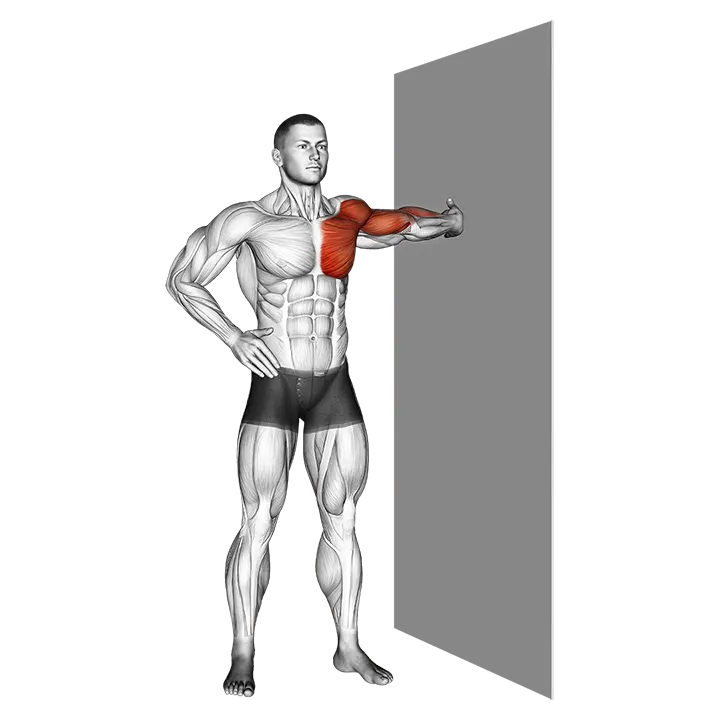
Standing one arm chest stretch
- Equipment
- Body weight
- Body part
- Chest
- Type
- Stretching
The Standing One Arm Chest Stretch is a bodyweight stretching exercise that targets both the pectoralis major clavicular head (upper chest) and the pectoralis major sternal head (lower and mid chest fibers). Performed with one arm anchored against a wall or doorframe, it isolates one side at a time and is effective for improving chest flexibility and relieving tightness that accumulates from prolonged sitting or pressing work.
How to do the Standing one arm chest stretch
- 1Stand beside a wall or doorframe and place your right palm flat against the surface at shoulder height, keeping your arm nearly straight with only a soft bend at the elbow.
- 2Set your feet hip-width apart and stagger them slightly — right foot forward — to create a stable base.
- 3Stand tall with your core lightly braced and your right shoulder blade drawn down and back before you begin rotating.
- 4Slowly rotate your torso and hips to the left, away from the wall, until you feel a distinct stretch across the front of the right shoulder and chest.
- 5Keep your shoulder actively pressed down throughout — do not allow it to shrug or rise toward your ear.
- 6Hold the position for 20–30 seconds, breathing steadily and allowing the chest to soften and open with each exhale.
- 7Return to the starting position to release the stretch.
- 8Repeat on the opposite side, completing 2–3 rounds per arm.
Form tips
- Adjust arm height to shift emphasis between the two pectoral heads: placing the arm lower than shoulder height biases the clavicular head (upper chest), while raising it above shoulder height biases the sternal head (lower and mid chest fibers). Explore both positions within your comfortable range.
- Rotate from your torso and hips as a unit rather than simply turning your head and neck — the fuller the body rotation, the more the pectoralis fibers are pulled away from the anchored arm.
- Stretch when the chest is already warm — after a warm-up, between pressing sets, or at the end of a session. Cold tissue tolerates less range, so the same effort buys you more at the end of a workout than at the start of one.
- Increase the depth of the stretch gradually with each exhale rather than forcing the rotation at the start of the hold — passive, relaxed holds yield better flexibility gains than forced end-range loading.
- If you feel pinching or discomfort in the shoulder joint rather than a broad stretch through the chest, reduce the rotation and lower your arm until the sensation moves into the muscle belly.
Common mistakes
- Allowing the shoulder to shrug upward — elevating the shoulder reduces tension on the pectoralis major and can impinge the anterior shoulder structures. Actively press the shoulder down and maintain that position for the full duration of the hold.
- Bending the elbow too deeply — a sharply bent arm shortens the lever and significantly reduces the pectoral stretch achieved. Keep the arm roughly straight with only a slight, soft bend to protect the elbow joint.
- Leaning the torso sideways away from the wall instead of rotating — side-bending shifts tension toward the side of the ribcage rather than the chest. Rotate your hips and torso together to keep the pectoralis major under tension.
- Cutting the hold too short — holding for fewer than 15 seconds does not give the muscle and its surrounding fascia enough time to begin lengthening. Aim for at least 20 seconds per side to see a meaningful response.
- Forcing the arm higher than your current shoulder mobility allows — pushing the anchored arm above a comfortable range to try to target the sternal head can stress the shoulder joint. Start at shoulder height and raise the arm only as far as it moves without pain or compensation.
Frequently asked questions
What muscles does the Standing One Arm Chest Stretch target?
It targets both heads of the pectoralis major: the clavicular head, which forms the upper chest, and the sternal head, which covers the lower and mid chest. Lowering the arm below shoulder height emphasizes the clavicular head; raising it above shoulder height shifts the emphasis toward the sternal head.
How long should I hold the Standing One Arm Chest Stretch?
Hold each side for 20–30 seconds. This gives the pectoralis major enough time to relax and begin lengthening. Two to three rounds per side produces better results than a single long hold, and the total time investment per session is under five minutes.
Is the Standing One Arm Chest Stretch good for beginners?
Yes. It requires no equipment beyond a wall, involves no external load, and is easy to self-regulate — you control stretch depth entirely through how far you rotate your torso. Begin with a gentle rotation and increase range gradually as your chest opens over time.
Where should I feel the Standing One Arm Chest Stretch?
You should feel a broad pull across the front of the chest and the front of the shoulder on the side of the anchored arm. A pinching sensation inside the shoulder joint — rather than a stretch through the muscle — signals that the arm is too high or the rotation is too aggressive; reduce both until the sensation moves into the chest.
How often should I do chest stretches?
Daily or near-daily chest stretching is safe and beneficial for most people, particularly those who sit at desks, drive frequently, or do a lot of pressing work. Two to three rounds per side held for 20–30 seconds each is a practical routine that fits into a warm-up, cool-down, or standalone mobility session.