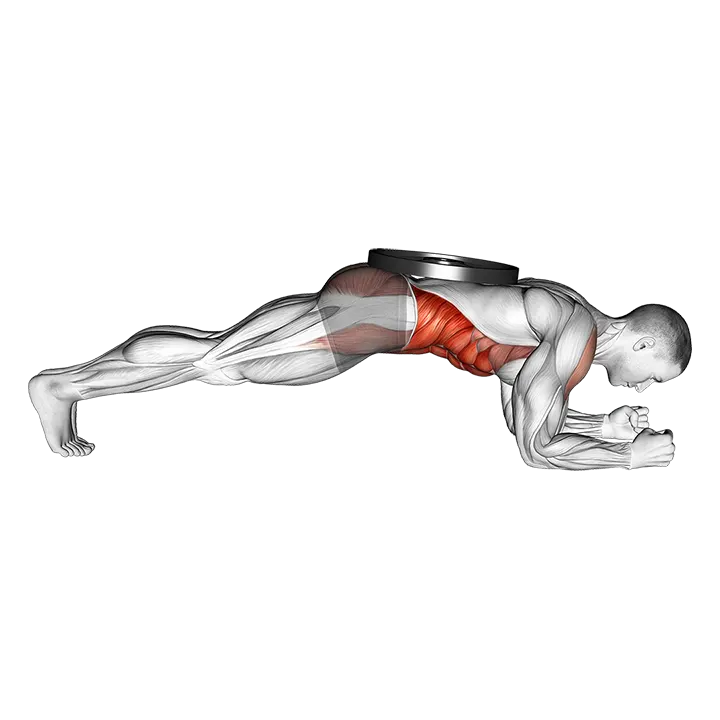
Weighted Front Plank
- Target muscle
- —
- Equipment
- Weighted
- Body part
- Waist
- Type
- Stretching
The weighted front plank is an advanced isometric core exercise that intensifies the standard plank by placing a weight plate on the upper back, increasing demand on the rectus abdominis and transverse abdominis. The added load forces the shoulders and glutes to work harder as stabilizers, making it an effective progression for building deep core strength and anti-extension endurance.
How to do the Weighted Front Plank
- 1Set up on a mat in a forearm plank position — elbows directly beneath your shoulders, forearms flat on the floor, and hands either clasped together or placed palm-down.
- 2Have a training partner carefully place a weight plate on your upper back, between the shoulder blades, before you begin the hold.
- 3Press your forearms into the floor and extend your legs fully, resting on the balls of your feet so your body forms a straight line from head to heels.
- 4Brace your core by drawing your navel gently toward your spine and tightening the abdominals as if bracing for a punch.
- 5Squeeze your glutes and keep your hips level — they should neither sag toward the floor nor rise into a pike.
- 6Maintain a neutral neck by gazing at the floor a few inches in front of your hands, keeping your chin tucked.
- 7Breathe steadily throughout the hold — inhale through the nose, exhale through the mouth — without letting the breath disrupt your brace.
- 8Hold the position for the target duration, then have your partner remove the weight plate before you carefully lower your knees to the floor to rest.
Form tips
- Start with a lighter plate than you think you need — even 5–10 lb (2–5 kg) adds significant difficulty to an isometric hold you must sustain for time.
- Push your elbows actively into the floor and imagine pulling them toward your feet; this "hollow body" cue engages the lats and transfers force through the entire core.
- Always use a partner to place and remove the plate — attempting to load yourself disrupts position and increases injury risk.
- Keep your breathing rhythmic and controlled; holding your breath spikes intra-abdominal pressure and shortens the hold you can sustain with good form.
- If your hips begin to sag before the target time, end the set — a partial hold with poor form is less effective and stresses the lumbar spine.
Common mistakes
- Letting the hips sag toward the floor, which collapses the lumbar spine into extension and removes the anti-extension demand from the core.
- Piking the hips upward to compensate for fatigue, which shifts the load off the abdominals and turns the hold into more of a shoulder exercise.
- Holding the breath for the entire duration, which raises blood pressure unnecessarily and leads to premature fatigue — breathe steadily throughout.
- Placing the weight plate too high (on the neck/upper traps) or too low (on the lumbar), both of which can cause discomfort or injury — the plate belongs on the mid-to-upper back, between the shoulder blades.
- Progressing to too much weight too quickly; isometric holds require the stabilizing muscles to fire continuously, and excessive load before the core is ready leads to form breakdown within seconds.
Frequently asked questions
How much weight should I use for a weighted front plank?
Beginners to the weighted variation should start with 5–10 lb (2–5 kg) and focus on holding perfect form for 20–30 seconds before adding more. Intermediate exercisers can work up to 25–45 lb (10–20 kg) over time. Always prioritize a flat, neutral body line over the amount of weight on your back.
How long should I hold a weighted front plank?
A good target is 20–45 seconds per set for most people using added weight — significantly shorter than unweighted plank holds. Aim for 3–4 sets with full recovery between efforts. Once you can hold 45–60 seconds with solid form, add a small amount of weight rather than extending the duration further.
What muscles does the weighted front plank work?
The primary muscles are the rectus abdominis and transverse abdominis, which resist spinal extension under the added load. The anterior deltoids, serratus anterior, and rotator cuffs work as shoulder stabilizers, while the glutes and hip flexors help keep the body in a straight line.
How is the weighted front plank different from a regular plank?
The weight plate increases the gravitational force trying to collapse your hips toward the floor, which directly amplifies the anti-extension demand on the core. This makes the hold harder in far less time than simply extending the duration of an unweighted plank, serving as an effective strength progression once a 60-second bodyweight plank becomes easy.
Is the weighted front plank suitable for beginners?
No — it is an intermediate-to-advanced variation. You should be able to hold a strict bodyweight forearm plank for at least 60 seconds with a neutral spine before attempting the weighted version. Beginners should first build core endurance with standard planks, then progress to the weighted variation.
Related exercises
 Assisted Weighted Push-upChest
 Bottle Hammer CurlUpper Arms
 Bottle Weighted Alternate Biceps CurlUpper Arms
 Bottle Weighted Alternate Front RaiseShoulders
 Bottle Weighted Alternate Hammer CurlUpper Arms
 Bottle Weighted Armpit RowShoulders
 Bottle Weighted Bent Over Reverse FlyBack
 Bottle Weighted Bent Over RowBack