Handboard Half Crimp
- Zielmuskel
- Wrist Flexors
- Equipment
- Body weight
- Körperregion
- Forearms
- Typ
- Stretching

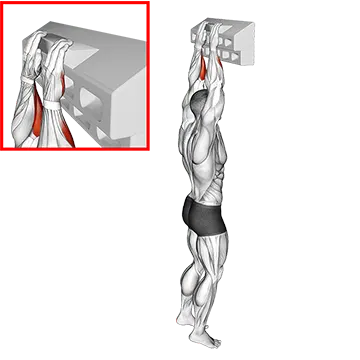



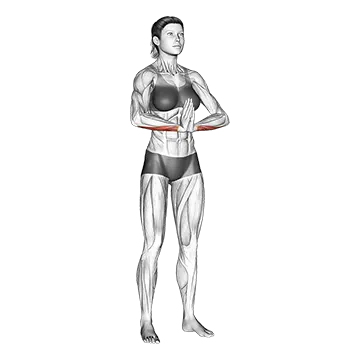
The handboard half crimp is a bodyweight isometric grip exercise that builds finger and forearm strength by hanging from a board edge in a half-crimp position. It primarily loads the wrist flexors of the forearms, training the grip strength climbers rely on for holding small edges.
Handboard Half Crimp: So führst du sie aus
- 1Set up a fingerboard or hangboard at a height you can reach with arms extended overhead, and warm up your fingers and forearms thoroughly.
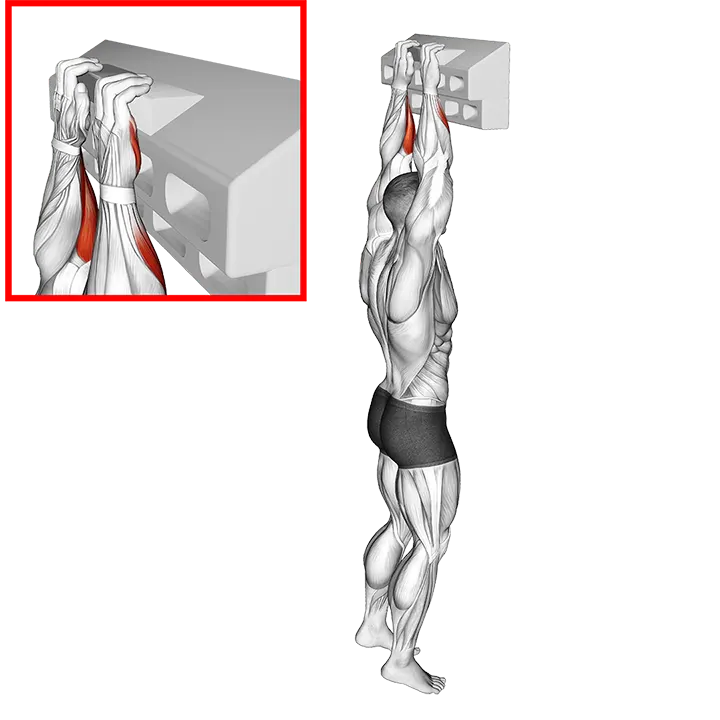
- 2Place your fingers on a comfortable edge, then form a half-crimp: your first knuckles bend over the edge while your fingertips stay roughly vertical and your thumb rests beside your index finger.
- 3Keep your wrist straight and your forearm aligned, with the load running through your fingers rather than collapsing into a full crimp.
- 4Engage your shoulders by pulling them down and back, keeping a slight bend in your elbows rather than hanging fully dead.
- 5Lift your feet off the ground and let your bodyweight settle onto your fingers, maintaining the half-crimp shape.
- 6Hold the position for a set time, typically 7 to 10 seconds, breathing steadily and keeping tension in your fingers and forearms.
- 7Lower your feet back to the ground under control before your grip fails, rest fully, then repeat for the prescribed number of hangs.
Technik-Tipps
- Keep your shoulders active and engaged throughout the hang to protect them and to spread load away from your fingers alone.
- Maintain the half-crimp angle deliberately and avoid drifting into an open hand or a closed full crimp, which change the muscles and stress involved.
- Start with feet partially supported on the floor or a stool to scale the load down if a full bodyweight hang is too much.
- Stop the hang while you can still hold the position cleanly rather than grinding until your fingers slip off the edge.
- Warm up your fingers progressively and never train half crimps on small edges when your tendons feel cold or sore.
Häufige Fehler
- Hanging with completely straight, passive arms and shrugged shoulders, which strains the shoulder joints and elbows instead of loading the forearms safely.
- Letting the fingers collapse from a half crimp into a full crimp, which spikes stress on the finger pulleys and increases injury risk.
- Using an edge that is too small or adding too much load too soon, overloading the finger flexor tendons before they have adapted.
- Holding the hang until the grip gives out and the fingers tear off the edge, which can strain the pulleys and tendons.
- Skipping a proper warm-up, leaving cold tendons unprepared for the high tension of a half-crimp hang.
Häufig gestellte Fragen
What muscles does the handboard half crimp work?
It mainly works the wrist flexors of the forearms, the finger flexor muscles that close your hand and let you grip small edges. The forearms are the body part trained, and it builds the isometric grip strength used in climbing.
How long should I hold a half-crimp hang?
A common range is 7 to 10 seconds per hang, repeated for several sets with full rest between them. Hold only as long as you can keep a clean half-crimp shape, and stop before your fingers slip off the edge.
Is the handboard half crimp good for beginners?
It can be, but beginners should scale it carefully. Use a larger edge, keep your feet partly on the floor or a stool to reduce load, and build up slowly, since finger tendons adapt more slowly than muscles.
What is the difference between a half crimp and an open hand grip?
In a half crimp the first knuckles bend over the edge while the fingertips stay vertical, biasing the finger flexors hard. An open hand keeps the fingers more relaxed and extended, shifting the load and reducing stress on the finger pulleys.