Wrist - Flexion - Articulations
- Zielmuskel
- Wrist Flexors
- Equipment
- Body weight
- Körperregion
- Forearms
- Typ
- Stretching

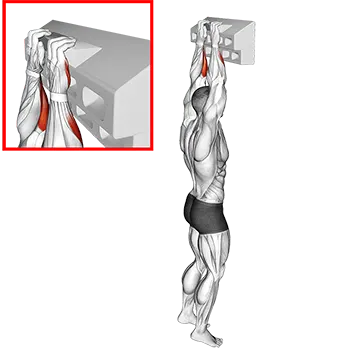
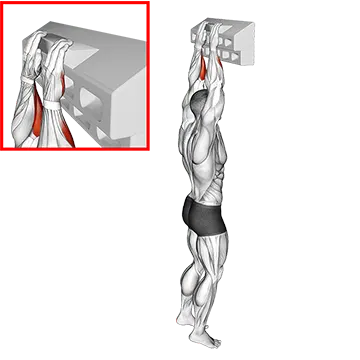


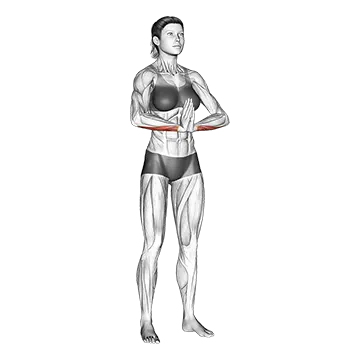

Wrist Flexion Articulations is a bodyweight mobility drill that repeatedly cycles your wrists through their full flexion range of motion, targeting the wrist flexor muscles of the forearms. Unlike a static stretch, the rhythmic articulation warms up the joint, improves active range of motion, and reduces stiffness — making it an effective warm-up or cool-down for any activity that loads the wrists and forearms.
Wrist - Flexion - Articulations: So führst du sie aus
- 1Sit or stand with a tall spine, arms extended in front of you at approximately shoulder height, palms facing down.
- 2Relax your fingers and allow your wrists to drop into full flexion so the backs of your hands face upward — this is your starting position.
- 3Slowly extend your wrists back to a neutral position, keeping your forearms still and moving only at the wrist joint.
- 4Continue past neutral into gentle wrist extension, feeling a mild stretch across the forearm flexors.
- 5Reverse the direction and lower your wrists back through neutral and into full flexion again, moving with deliberate control.
- 6Repeat this flexion-to-extension arc in a smooth, continuous rhythm for the target number of repetitions or time.
- 7Keep the movement isolated to the wrist joint — your elbows and shoulders should remain relaxed and stationary throughout.
- 8At the end of the set, hold the bottom of the flexion range for 2–3 seconds to deepen the stretch before releasing.
Technik-Tipps
- Move slowly and deliberately — the benefit of articulations comes from actively controlling the full range, not from swinging through it quickly.
- Keep your forearms level and still; if they drift or rotate, the wrist flexors do less work and you lose joint specificity.
- Breathe steadily throughout — exhale as you move into flexion and inhale as you return to neutral or extension.
- If one wrist feels stiffer than the other, perform a few extra reps on that side before moving on.
- For a deeper stimulus, perform the drill with your palms facing upward (supinated forearm) to vary the line of pull on the flexor tendons.
Häufige Fehler
- Moving too fast and using momentum rather than muscular control, which limits the mobility benefit and reduces time under tension for the wrist flexors.
- Bending the elbow during the movement, which shortens the forearm flexors and reduces the stretch — keep the arms extended.
- Only moving through a partial range, which does not train the wrist flexors at end range where stiffness and weakness most commonly exist.
- Tensing the fingers and gripping throughout the drill, which creates compensatory tension in the flexor tendons — keep the fingers relaxed and loose.
- Performing the drill at too high a volume without adequate recovery on inflamed or already-sore wrists, which can aggravate tendon tissue — start conservatively and build gradually.
Häufig gestellte Fragen
What muscles do wrist flexion articulations work?
The primary muscles targeted are the wrist flexors — mainly the flexor carpi radialis, flexor carpi ulnaris, and palmaris longus — which run along the inner forearm. The rhythmic articulation also mobilizes the surrounding tendons, ligaments, and connective tissue of the wrist joint.
What is the difference between wrist flexion articulations and a static wrist flexor stretch?
A static stretch holds one position to lengthen the tissue passively, whereas articulations move continuously through the full range, training the wrist flexors to actively control the joint at every point. Articulations are better for warming up and building usable mobility; static holds are better for lengthening tissue post-workout.
When should I do wrist flexion articulations in my workout?
They work well as a warm-up before exercises that load the wrists — such as push-ups, bench press, gymnastics, or weightlifting — or as a cool-down drill afterward to flush the joints and reduce stiffness. Two to three sets of 10–15 slow reps is a practical starting point.
Are wrist flexion articulations good for relieving wrist pain?
Gentle articulations can help reduce stiffness and improve circulation around the wrist joint for those with general tightness or minor discomfort. However, if you have an acute injury, tendinitis, or persistent wrist pain, consult a healthcare professional before adding any wrist-loading drill to your routine.
How many reps and sets should I do for wrist flexion articulations?
For mobility maintenance, 2–3 sets of 10–15 controlled reps per wrist is a solid starting point. For active warm-up purposes, 20–30 seconds of continuous, slow articulations per arm is equally effective. Focus on full range and control rather than accumulating high rep counts.