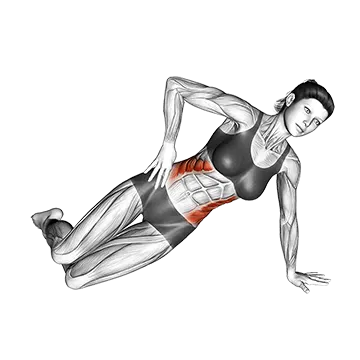
Bank-Seitstütz
- Zielmuskel
- Obliques
- Synergistenmuskeln
- Adductor Brevis, Adductor Longus, Gracilis, Iliopsoas, Pectineous, Serratus Anterior, Tensor Fasciae Latae
- Equipment
- Body weight
- Körperregion
- Waist
- Typ
- Strength
Der Bank-Seitstütz ist eine isometrische Körpergewicht-Übung, die die schrägen Bauchmuskeln trainiert und dabei den Serratus anterior, den Tensor fasciae latae, den Iliopsoas, den Adductor brevis, den Adductor longus, den Gracilis und den Pectineus aktiviert. Durch die Erhöhung der Füße auf einer Bank erhöht sich die seitliche Belastung auf deinen Rumpf, was dies zu einer effektiven Progression zum Aufbau von Rumpfstabilität und seitlicher Rumpfkraft macht.
Bank-Seitstütz: So führst du sie aus
- 1Stelle eine flache Bank neben dich und lege dich auf die Seite auf den Boden, während du deine Füße und Unterschenkel auf der Bank positionierst und deine Hüfte noch auf dem Boden ruht.
- 2Lege deine Füße aufeinander und stütze deinen unteren Ellbogen direkt unter deiner Schulter ab, während dein Unterarm flach auf dem Boden liegt und senkrecht zu deinem Oberkörper verläuft.
- 3Lege deine obere Hand auf deine Hüfte oder strecke sie zur Decke, um dein Gleichgewicht zu halten.
- 4Spanne deinen Rumpf an und aktiviere deine schrägen Bauchmuskeln, dann drücke deine Hüfte vom Boden ab, bis dein Körper eine gerade Linie von Kopf bis Fuß bildet.
- 5Halte deinen Nacken in einer neutralen Position — weder nach oben ausgestreckt noch zum Boden abgesenkt.
- 6Halte deine Hüfte vollständig gestreckt und verhindere, dass sie durchhängt oder sich nach oben wölbt.
- 7Atme während der gesamten Haltung gleichmäßig ein und aus; halte deinen Atem nicht an.
- 8Halte die Brückenposition für die gewünschte Dauer (z.B. 20–45 Sekunden), dann senke deine Hüfte kontrolliert ab.
- 9Absolviere alle Wiederholungen auf einer Seite, bevor du zur anderen Seite wechselst.
Technik-Tipps
- Stelle dir vor, dass du deinen unteren Unterarm in den Boden drückst und gleichzeitig deine Hüfte zur Decke drückst — diese doppelte Spannung aktiviert die schrägen Bauchmuskeln intensiv.
- Aktiviere die Adduktoren, indem du deinen oberen Fuß gegen deinen unteren Fuß drückst; dies stabilisiert deine Hüfte und rekrutiert die Innenseite der Oberschenkel.
- Halte deinen Serratus anterior aktiviert, indem du deine Schulter aktiv von deinem Ohr wegschiebst, anstatt sie hochzuziehen.
- Stelle dir deinen Körper als ein Brett vor — jede Beugung in der Taille oder Hüfte mindert die Aktivierung der schrägen Bauchmuskeln und verlagert die Belastung auf passive Strukturen.
- Progrediere, indem du die Haltedauer steigerst, bevor du die Schwierigkeit erhöhst; hochwertige Spannung für 20 Sekunden ist besser als ein durchhängendes 45-Sekunden-Hold.
Häufige Fehler
- Die Hüfte zum Boden durchhängen lassen — dies reduziert die Spannung in den schrägen Bauchmuskeln und belastet die Lendenwirbelsäule und das Schultergelenk übermäßig.
- Die Hüfte zu hoch nach oben drücken — dies verkürzt den Bewegungsumfang der schrägen Bauchmuskeln und verwandelt die Übung in ein Ausweichmuster statt in einen echten Seitstütz.
- Die tragende Schulter nach innen einklappen lassen — eine eingeklappte Schulter aktiviert den Serratus anterior unzureichend und kann die Rotatorenmanschette im Laufe der Zeit beeinträchtigen.
- Den Atem während der Serie anhalten — dies erhöht unnötig den intraabdominalen Druck und beschleunigt die Ermüdung; kontrollierte Atmung verlängert die Haltedauer.
- Den Oberkörper zum Boden drehen — diese Rotation außerhalb der echten Seitenlage vermindert die Aktivierung der schrägen Bauchmuskeln und verlagert die Belastung auf die Hüftbeuger, einschließlich des Iliopsoas.
Häufig gestellte Fragen
Was ist der Unterschied zwischen einem normalen Seitstütz und einem Bank-Seitstütz?
Bei einem normalen Seitstütz ruhen deine Füße auf dem Boden auf gleicher Höhe wie der tragende Ellbogen. Wenn du deine Beine auf einer Bank positionierst, erhöht sich die untere Stütze, sodass dein Körper kopfabwärts neigt. Dies verlagert mehr deines Körpergewichts durch die untere Schulter und Hüfte. Diese zusätzliche Anforderung an die schrägen Bauchmuskeln und seitlichen Stabilisatoren macht dies zu einer schwierigeren Progression.
Wie lange sollte ich den Bank-Seitstütz halten?
Anfänger sollten 15–20 Sekunden pro Seite mit korrekter Form anstreben. Trainierte arbeiten normalerweise im Bereich von 30–45 Sekunden, und fortgeschrittene Trainierende können bis zu 60 Sekunden oder mehr erreichen. Prioritisiere immer Form vor Dauer.
Kann der Bank-Seitstütz bei Rückenschmerzen helfen?
Das Stärken der schrägen Bauchmuskeln und der seitlichen Rumpfmuskulatur kann die Wirbelsäulenstabilität verbessern und das Risiko von Rückenproblemen verringern. Wenn du jedoch derzeit Rückenschmerzen hast, konsultiere einen Arzt, bevor du diese Übung versuchst.
Wie kann ich den Bank-Seitstütz vereinfachen, wenn ich die richtige Form nicht halten kann?
Wechsle zu einem normalen Seitstütz auf dem Boden mit gestapelten Füßen oder mit gebeugtem unterem Knie. Steigere die Haltedauer auf 30–45 Sekunden mit der Bodenvariation, bevor du die Bankerhöhung wieder einführst.
Wie viele Sätze und Wiederholungen sollte ich beim Bank-Seitstütz machen?
Da dies ein isometrisches Hold ist, werden Sätze in Zeit gemessen, nicht in Wiederholungen. Zwei bis vier Sätze von 20–45 Sekunden pro Seite mit 60–90 Sekunden Pause zwischen den Sätzen sind ein praktischer Ausgangspunkt für die meisten Trainingsprogramme.