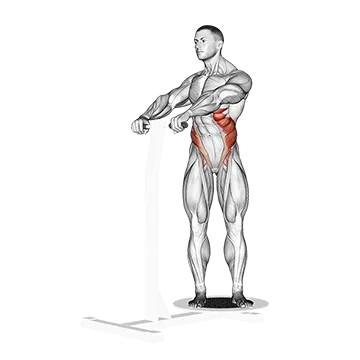
Lever Trunk Rotation
- Zielmuskel
- Obliques
- Synergistenmuskeln
- Rectus Abdominis
- Equipment
- Leverage machine
- Körperregion
- Waist
- Typ
- Strength
The lever trunk rotation is a machine-based core exercise that directly targets the obliques (internal and external), with the rectus abdominis assisting. Performed on a rotary torso leverage machine with the hips secured, it isolates rotational movement and is an effective, low-impact way to build rotational core strength and waist definition.
Lever Trunk Rotation: So führst du sie aus
- 1Sit on the rotary torso machine and adjust the seat height so your shoulders align with the axis of rotation.
- 2Secure your lower body against the hip pads or thigh supports so your hips and legs remain fixed throughout the movement.
- 3Grip the handles or cross your arms over the pad in front of you, keeping your spine tall and chest lifted.
- 4Brace your core and exhale as you rotate your upper torso to one side as far as you can comfortably go without forcing at the end range.
- 5Pause briefly at the peak of rotation, feeling the stretch and contraction in your obliques.
- 6Inhale and slowly return your torso to the starting position under control — do not let the weight snap back.
- 7Complete all reps to one side, then adjust the machine or your position to work the opposite side.
Technik-Tipps
- Keep your hips firmly pressed against the seat pad throughout each rep — any hip movement shifts the work away from the obliques.
- Move at a slow, deliberate tempo on both the way out and the way back; momentum defeats the purpose of the machine.
- Focus on initiating the rotation from your waist, not by pulling with your arms or shoulders.
- Choose a weight that lets you reach a full range of motion without discomfort in your lower back or spine.
Häufige Fehler
- Allowing the hips to rotate along with the torso, which reduces oblique isolation and transfers stress to the lower back.
- Using too much weight and swinging through the movement, which relies on momentum instead of muscular control and increases injury risk.
- Jerking or bouncing the weight at the end of the return phase, which can strain the spinal discs.
- Holding your breath throughout the set, which increases intra-abdominal pressure unnecessarily — exhale on the rotation, inhale on the return.
Häufig gestellte Fragen
What muscles does the lever trunk rotation work?
It primarily targets the obliques (both internal and external), which are the main drivers of rotational movement at the waist. The rectus abdominis acts as a synergist to stabilize the torso during the movement.
Should I do lever trunk rotations on both sides?
Yes — always train both sides equally. Perform your full set of reps rotating to one side, then reposition and repeat for the other side to ensure balanced oblique development.
How is the lever trunk rotation different from cable woodchops or twists?
The leverage machine fixes your hips and guides the rotation through a set arc, making it easier to isolate the obliques with strict form. Free-weight or cable variations allow more natural movement patterns but require greater stability and technique to target the obliques as precisely.
Is the lever trunk rotation safe for people with lower back issues?
For many people it can be a lower-risk option because the machine controls the movement path. However, any rotational exercise can aggravate certain spinal conditions. If you have lower back problems, consult a healthcare professional before adding this exercise to your routine.
How many reps and sets should I do for this exercise?
For core endurance and definition, 2–4 sets of 12–20 reps per side with a controlled tempo is a common approach. Because the obliques recover relatively quickly, they respond well to moderate-to-higher rep ranges.