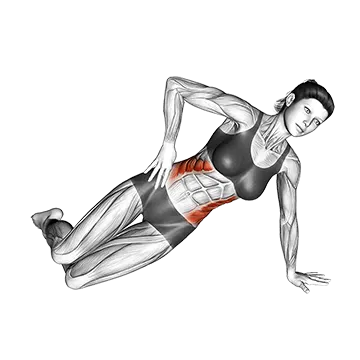
Oblique Crunch (Version 2)
- Zielmuskel
- Obliques
- Synergistenmuskeln
- Rectus Abdominis
- Equipment
- Body weight
- Körperregion
- Waist
- Typ
- Strength
The Oblique Crunch (Version 2) is a bodyweight floor exercise performed in a side-lying position to target the obliques directly. The rectus abdominis assists as a synergist to stabilize the trunk during the lateral crunch. It fits well into a core routine for building rotational strength and waist definition without any equipment.
Oblique Crunch (Version 2): So führst du sie aus
- 1Lie on your side on a mat with your legs stacked or slightly staggered, knees bent at roughly 45 degrees.
- 2Place your bottom arm across your torso or rest it on the floor in front of you for light support.
- 3Bring your top hand to the side of your head, fingertips touching your temple without pulling on your neck.
- 4Brace your core to stabilize your spine and press your hips into the mat.
- 5Exhale and laterally crunch upward, shortening the distance between your top hip and your top shoulder.
- 6Lift your upper body as high as the obliques allow — typically 20 to 30 degrees — without rotating your torso.
- 7Pause briefly at the top and squeeze the obliques before lowering.
- 8Inhale and lower your torso under control back to the starting position without fully relaxing.
- 9Complete all reps on one side, then switch to the other side.
Technik-Tipps
- Focus on the lateral shortening motion rather than a forward crunch — think of bringing your ribs toward your hip, not your chest toward your knees.
- Keep your hips stacked throughout; letting them roll backward turns the movement into a standard crunch and takes the obliques out of the work.
- Use a slow, deliberate tempo — two counts up, two counts down — to maintain tension and reduce the temptation to use momentum.
- A small range of motion done correctly is more effective than a large range done with hip roll or neck pull.
- Match reps and sets on both sides to avoid developing an asymmetry in lateral core strength.
Häufige Fehler
- Pulling on the neck with the top hand, which shifts strain to the cervical spine and reduces oblique activation.
- Rotating the torso forward during the crunch, which recruits the rectus abdominis instead of keeping the load on the obliques.
- Letting the hips lift or roll backward off the mat, which destabilizes the spine and reduces the isolation on the target muscle.
- Using momentum to swing the upper body up rather than contracting the obliques, which removes the training stimulus and increases injury risk.
- Skipping one side or doing fewer reps on the weaker side, which reinforces lateral strength imbalances over time.
Häufig gestellte Fragen
What muscles does the Oblique Crunch (Version 2) work?
The primary target is the obliques, which produce the lateral flexion of the trunk. The rectus abdominis acts as a synergist, helping to stabilize the torso during the movement.
How is Version 2 different from Version 1?
Version 1 is typically performed supine with both knees dropped to one side, then crunching upward. Version 2 is a side-lying variation where you lie fully on your side and crunch laterally, which places the obliques in a more mechanically direct line of pull and reduces hip-flexor involvement.
Is this exercise suitable for beginners?
Yes. It requires no equipment and uses a modest range of motion. Beginners should start with slow, controlled reps and prioritize feeling the obliques contract before adding volume.
How many sets and reps should I do?
Three sets of 12 to 20 reps per side is a practical starting point. Because body weight limits load, higher rep ranges with strict form tend to produce better results than low-rep sets with poor technique.
What are good alternatives if this feels too easy?
You can progress to a side plank with lateral crunch, a cable oblique crunch, or a dumbbell side bend. These add external load while targeting the same muscle in a similar plane of motion.