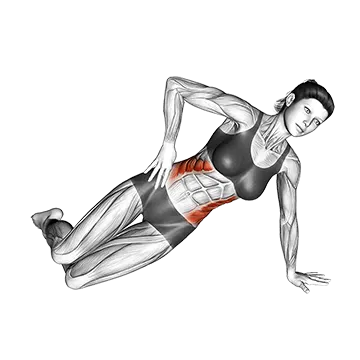
Seitliches Crunchen
- Zielmuskel
- Obliques
- Synergistenmuskeln
- Rectus Abdominis
- Equipment
- Body weight
- Körperregion
- Waist
- Typ
- Strength
Das seitliche Crunchen ist eine Eigengewichtsübung in Seitenlage, die die seitlichen Bauchmuskeln (externe und interne Oblique) direkt trainiert, während die geraden Bauchmuskeln (Rectus abdominis) unterstützen. Durch die seitliche Beugung isoliert es die Seitenflankenmuskeln stärker als Standard-Crunches. Es ist ein zugänglicher Einstiegspunkt für den Aufbau von seitlicher Rumpfstabilität und Rotationskraft.
Seitliches Crunchen: So führst du sie aus
- 1Lege dich auf deine rechte Seite auf eine Matte, deine Beine übereinander gestapelt, die Knie leicht gebeugt oder gestreckt, und dein Körper bildet eine gerade Linie von Kopf bis Hüfte.
- 2Platziere deinen rechten Arm auf der Matte vor dir für leichte Stütze oder ruhe ihn an deiner Seite. Bring deine linke Hand hinter deinen Kopf, mit dem Ellbogen nach oben zeigend.
- 3Spanne deinen Rumpf an und drücke die rechte Seite deiner Taille sanft in die Matte, um eine stabile Basis zu schaffen.
- 4Atme aus und beuge dich seitlich nach oben, hebe deine Schultern und deinen Oberkörper von der Matte ab, indem du die seitlichen Bauchmuskeln auf deiner rechten Seite anspannst – die Seite, auf der du liegst. Halte die Bewegung kontrolliert – reiße nicht mit deinem Ellbogen.
- 5Halte die obere Position kurz an und spanne die seitlichen Bauchmuskeln kräftig an, bevor du dich senkst.
- 6Atme ein, während du deinen Oberkörper kontrolliert absenkst, stoppe kurz bevor du ganz entspannst, um Spannung auf dem Muskel zu halten.
- 7Führe alle Wiederholungen auf der rechten Seite aus, wechsele dann zur linken Seite und wiederhole.
Technik-Tipps
- Konzentriere dich darauf, den Abstand zwischen deinen unteren Rippen und deiner Hüfte auf der Seite, auf der du liegst, zu verkürzen – denke daran, diese Lücke zu schließen, nicht deinen Kopf nach oben zu heben.
- Halte deinen Nacken neutral; deine Hand sollte deinen Kopf leicht stützen, nicht nach vorne ziehen.
- Bewege dich langsam und bewusst – zwei Sekunden heben und zwei Sekunden senken maximieren die Zeit unter Spannung und reduzieren Momentum.
- Verankere deine Beine, indem du sie übereinander gestapelt hältst und leicht zusammendrückst, damit die Bewegung von deiner Taille kommt, nicht vom Treten oder Verschieben deines Unterkörpers.
Häufige Fehler
- Die Hüften während des Crunchens nach hinten rollen, was die Last von den seitlichen Bauchmuskeln zu den geraden Bauchmuskeln verlagert und den Zweck der Übung zunichte macht.
- Mit der stützenden Hand am Nacken ziehen, was Belastung der Halswirbelsäule riskiert und die Aktivierung der seitlichen Bauchmuskeln nicht verbessert.
- Momentum nutzen, um den Oberkörper hochzuschwingen, anstatt die seitlichen Bauchmuskeln anzuspannen, was die Muskelaktivierung reduziert und das Verletzungsrisiko erhöht.
- Direkt nach unten fallen, ohne oben innezuhalten, sodass die seitlichen Bauchmuskeln nie eine harte Spitzenkontraktion erreichen und der Satz in schnelle Teilwiederholungen abfällt.
- Den Bewegungsbereich zu klein halten, indem du kaum von der Matte abhebst, was verhindert, dass die seitlichen Bauchmuskeln vollständige Kontraktion erreichen.
Häufig gestellte Fragen
Welche Muskeln trainiert das seitliche Crunchen?
Das primäre Ziel sind die seitlichen Bauchmuskeln (interne und externe Oblique), die diagonal entlang deiner Seiten verlaufen und für Seitbeugung und Rotation zuständig sind. Die geraden Bauchmuskeln (Rectus abdominis) wirken unterstützend und bieten Stabilität während der Bewegung.
Wie unterscheidet sich das seitliche Crunchen von einem normalen Crunchen?
Ein Standard-Crunchen beugt die Wirbelsäule nach vorne und trainiert hauptsächlich die geraden Bauchmuskeln. Das seitliche Crunchen fügt eine Seitkomponente hinzu, die den Schwerpunkt auf die seitlichen Bauchmuskeln verlagert – Muskeln, die das normale Crunchen kaum erreicht.
Ist das seitliche Crunchen für Anfänger geeignet?
Ja. Es ist keine Ausrüstung erforderlich und die Bewegung ist gelenkschonend, was sie für die meisten Fitnessstufen zugänglich macht. Anfänger sollten die Bewegung langsam ausführen und sich darauf konzentrieren, die Kontraktion der seitlichen Bauchmuskeln zu spüren, anstatt den Bewegungsumfang zu maximieren.
Wie viele Sätze und Wiederholungen sollte ich machen?
Zwei bis vier Sätze mit 12–20 Wiederholungen pro Seite funktioniert bei den meisten Zielen gut. Da die seitlichen Bauchmuskeln schnell regenerieren, reagieren sie gut auf mittlere bis hohe Wiederholungsbereiche und können zwei bis drei Mal pro Woche trainiert werden.
Was sind gute Alternativen, wenn sich das seitliche Crunchen unbequem anfühlt?
Aufrechte seitliche Crunches, Fahrrad-Crunches und seitliche Planks trainieren die seitlichen Bauchmuskeln alle effektiv. Wenn es sich unbequem anfühlt, auf deiner Seite zu liegen, eliminiert ein aufrechtes seitliches Crunchen diesen Druck vollständig.