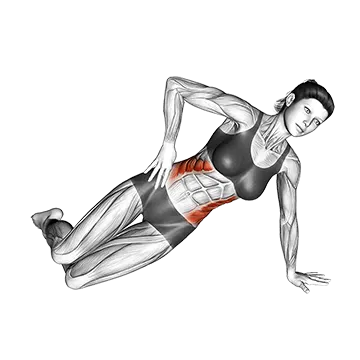
Seitliche Hebungen mit vertikaler Drehung (gestreckte Beine)
- Zielmuskel
- Obliques
- Synergistenmuskeln
- Rectus Abdominis
- Equipment
- Body weight
- Körperregion
- Waist
- Typ
- Strength
Seitliche Hebungen mit vertikaler Drehung (gestreckte Beine) ist eine Körpergewicht-Kernübung, die liegend auf der Seite durchgeführt wird. Du führst dabei beide gestreckten Beine in einer kontrollierten Winkelschlag-Bewegung durch einen vertikalen Bogen, um die schrägen Bauchmuskeln (Obliquus) als Hauptbeweger und den geraden Bauchmuskel (Rectus abdominis) als Synergist zu trainieren. Vollständig gestreckte Knie maximalisieren den Hebelarm, halten die seitliche Rumpfspannung und machen diese Bewegung effektiv zum Aufbau von Rotationskraft und seitlicher Rumpfkontrolle.
Seitliche Hebungen mit vertikaler Drehung (gestreckte Beine): So führst du sie aus
- 1Lege dich seitlich auf eine Matte mit deinem Körper in gerader Linie hin, die Hüften senkrecht zum Boden gestapelt und die Beine zusammen gestreckt.
- 2Lege deinen unteren Arm entlang der Matte ab und stütze deinen Kopf darauf, oder beuge den Ellbogen, um deinen Kopf in deiner Handfläche zu abstützen.
- 3Platziere deine obere Hand leicht auf der Matte vor deiner Brust, um leichte Balancestütze zu bieten – lehne dich nicht schwer hinein.
- 4Spanne deinen Rumpf an und drücke deine Beine fest zusammen, halte beide Knie während des gesamten Satzes vollständig gestreckt.
- 5Beim Ausatmen führst du beide Beine langsam in einem Bogen nach oben zur Decke, während du durch die Vertikalebene direkt vor dir rotierst.
- 6Führe den Bogen fort, senke die Beine vorwärts und abwärts in einer sanften Winkelschlag-Bewegung, bis sie so nah am Boden vor dir sind, wie dein Bewegungsumfang erlaubt.
- 7Halte kurz am Ende des Bogens inne und halte die Spannung in deinen schrägen Bauchmuskeln, dann kehre den Schwung durch die obere Position zurück zum Start.
- 8Absolviere alle Wiederholungen auf dieser Seite, dann rolle dich um und wiederhole die gesamte Abfolge auf der anderen Seite.
Technik-Tipps
- Streck oder beuge deine Füße durchgehend vom Start bis zum Finish, um das gesamte Bein engagiert zu halten und zu verhindern, dass die Beine mitten im Bogen auseinanderdriften.
- Drücke deine untere Schulter sanft in die Matte, um eine stabile Basis zu schaffen; ein wiegender Oberkörper verlagert die Arbeit weg von den schrägen Bauchmuskeln.
- Atme aus, während du die Beine durch die Aufwärtsphase führst, und atme beim Zurückgang ein – gleichmäßiges Atmen ermöglicht es dir, eine leichte Anspannung über den gesamten Bogen zu halten, anstatt die Luft auszugehen und die letzten Wiederholungen zu beschleunigen.
- Wenn deine Beine durchhängen oder dein Becken rollt, verkürze den Bogen, anstatt die Knie zu beugen – ein kleinerer Schwung, den du kontrollieren kannst, belastet die schrägen Bauchmuskeln mehr als ein voller Bogen, den du nicht kontrollieren kannst.
Häufige Fehler
- Die Knie während des Bogens zu beugen, was den Hebelarm verkürzt, die Anforderung an die schrägen Muskeln drastisch reduziert und die bestimmende Herausforderung dieser geraden-Bein-Variation aufhebt.
- Zulassen, dass das Becken mit den Beinen rollt, anstatt gestapelt zu bleiben, was die Last von den schrägen Muskeln zu den Hüftbeugern verschiebt und den Rumpfstabilisierungsvorteil aufhebt.
- Die Beine mit Schwung zu schwingen, anstatt den Bogen unter Muskelspannung zu kontrollieren, was die schrägen Muskeln um Zeit unter Spannung betrügt und das Risiko von Lendenwirbelverspannungen durch unkontrollierte Rotation erhöht.
- Zusätzliche Wiederholungen auf deiner stärkeren Seite durchzudrücken und die zweite Seite zu verkürzen, was ein Links-Rechts-Ungleichgewicht in den schrägen Muskeln aufbaut und die symmetrische Rotationskontrolle, die diese Übung entwickeln soll, untergräbt.
- Sich schwer in die obere Hand stützen zur Unterstützung, was den Oberkörper kippen lässt und die schrägen Muskeln und den geraden Bauchmuskel der Stabilisierungsherausforderung beraubt, die sie zum Entwickeln brauchen.
Häufig gestellte Fragen
Welche Muskeln trainiert Seitliche Hebungen mit vertikaler Drehung (gestreckte Beine)?
Die schrägen Bauchmuskeln (Obliquus) sind das primäre Ziel und kontrollieren die Rotations- und Seitenkräfte, die durch das Führen der gestreckten Beine durch den vertikalen Bogen entstehen. Der gerade Bauchmuskel (Rectus abdominis) wirkt als Synergist, spannt den Rumpf an und stabilisiert das Becken während der gesamten Bewegung.
Wie unterscheidet sich dies von einer normalen seitlichen Beinhebung?
Eine seitliche Beinhebung hebt nur das obere Bein in einer einfachen Auf-und-Ab-Ebene. Die vertikale Drehungsvariante führt beide gestreckten Beine durch einen breiteren Winkelschlag-Bogen, erhöht die Zeit unter Spannung und erfordert eine größere Obliquus-Koordination, um den längeren, schweren Hebelarm zu handhaben.
Ist Seitliche Hebungen mit vertikaler Drehung für Anfänger geeignet?
Sie erfordert ein Grundmaß an Rumpfkraft und Hüftflexibilität, um sie mit gestreckten Beinen und in einem kontrollierten Bogen auszuführen. Anfänger profitieren mehr davon, eine Grundlage mit seitlichen Planken und normalen seitlichen Beinhebungen zu schaffen, bevor sie zu dieser Variation übergehen.
Wie viele Sätze und Wiederholungen sollte ich machen?
Ein typisches Protokoll sind 2–4 Sätze mit 8–15 kontrollierten Wiederholungen pro Seite mit 30–60 Sekunden Ruhe zwischen den Seiten. Priorisiere Bewegungsumfang und Muskelspannung vor hohen Wiederholungszahlen.
Benötige ich irgendwelche Geräte?
Nein – diese Übung nutzt nur Körpergewicht. Eine Matte ist auf harten Böden für Komfort hilfreich, aber keine anderen Geräte erforderlich.