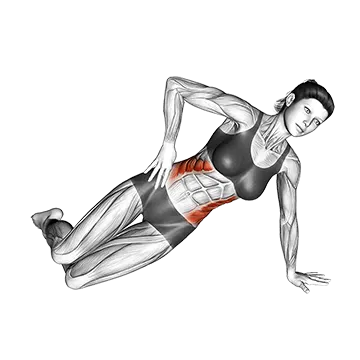
Spine Twist
- Zielmuskel
- Obliques
- Equipment
- Body weight
- Körperregion
- Waist
- Typ
- Strength




The Spine Twist is a bodyweight core exercise that primarily targets the obliques through controlled rotational movement of the torso. Performed seated or standing with the spine tall, it develops rotational strength and mobility in the waist while reinforcing postural stability along the entire spine.
Spine Twist: So führst du sie aus
- 1Sit upright on the floor with your legs extended straight in front of you and feet flexed, pressing through the heels.
- 2Extend both arms out to your sides at shoulder height, palms facing down, forming a T-shape with your torso.
- 3Inhale to lengthen through the crown of your head, sitting as tall as possible and engaging your core.
- 4Exhale and rotate your torso to the right, leading with your upper back while keeping your hips and legs completely still.
- 5Pulse gently at the end of the rotation two to three times without losing spinal length.
- 6Inhale to return to the center, maintaining the tall spine.
- 7Exhale and rotate to the left with the same controlled motion, pulsing at the end range.
- 8Return to center to complete one full repetition.
- 9Continue alternating sides for the prescribed number of repetitions, keeping each rotation smooth and deliberate.
Technik-Tipps
- Think of wringing the waist rather than swinging the arms — the rotation should originate from your obliques, not momentum from your shoulders.
- Keep both sit bones evenly grounded throughout the movement; if one hip lifts as you rotate, reduce your range of motion.
- Maintain active engagement in your core throughout — do not let the lower back collapse or arch between repetitions.
- Keep your chin level and your gaze traveling with your chest so your neck stays long and aligned with the spine.
Häufige Fehler
- Letting the hips rotate along with the torso, which removes the stretch and tension from the obliques and defeats the purpose of the exercise.
- Rounding the lower back instead of sitting tall, which compresses the lumbar spine and limits rotational range.
- Using arm swing to generate momentum rather than muscular rotation, reducing oblique engagement and increasing injury risk.
- Holding the breath through the movement, which creates unnecessary tension and prevents full rotational range.
- Collapsing through the ribcage at the end of each rotation instead of maintaining length, which shortens the working range of the obliques.
Häufig gestellte Fragen
What muscles does the Spine Twist work?
The Spine Twist primarily targets the obliques — both the internal and external obliques — which drive the rotational movement. The deep spinal stabilizers also work isometrically to keep the spine tall and the hips anchored throughout.
Can beginners do the Spine Twist?
Yes. The Spine Twist requires no equipment and is low-impact, making it accessible to beginners. Start with a modest range of motion and focus on keeping the hips still before gradually increasing the depth of rotation as control improves.
How many reps and sets should I do for the Spine Twist?
For strength and mobility, 2–3 sets of 8–12 repetitions per side is a practical starting range. Because the movement is low load, higher rep sets (up to 15–20 per side) can also be effective for endurance and postural work.
Is the Spine Twist the same as a Russian Twist?
No. The Spine Twist is performed with a tall, upright spine and legs extended, emphasizing slow, controlled rotation and spinal length. The Russian Twist is typically performed with a reclined torso and involves faster, heavier rotational movement — placing more demand on hip flexors alongside the obliques.
Should I feel a stretch or a burn during the Spine Twist?
Both. You should feel a mild stretch through the obliques on the side you are rotating away from, and a working contraction on the side driving the rotation. If you feel discomfort in your lower back rather than your waist, check that your spine is fully lengthened and your hips are not lifting off the floor.