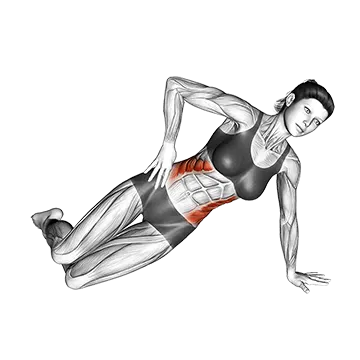
Standing Side Bend (bent arm)
- Zielmuskel
- Obliques
- Synergistenmuskeln
- Iliopsoas
- Equipment
- Body weight
- Körperregion
- Waist
- Typ
- Strength
The standing side bend (bent arm) is a bodyweight oblique exercise performed with one arm bent overhead, placing the hand behind the head while you lean laterally to one side. It directly targets the obliques along the waist and engages the iliopsoas as a synergist. It is a practical movement for developing lateral core strength and improving side-to-side flexibility.
Standing Side Bend (bent arm): So führst du sie aus
- 1Stand with your feet shoulder-width apart, knees soft, and your weight evenly distributed across both feet.
- 2Raise one arm and bend it so your elbow points upward and your hand rests lightly behind your head or at your ear.
- 3Let the opposite arm hang naturally at your side or rest the hand against your thigh for stability.
- 4Brace your core and stand tall with your chest up and spine neutral before initiating the movement.
- 5Slowly lean your torso directly to the side of the hanging arm, sliding that hand down the outside of your thigh as a guide.
- 6Lean only as far as your obliques allow with control — avoid rotating your hips or shoulders forward.
- 7Pause briefly at the bottom of the range, feeling a stretch along the bent-arm side of your waist.
- 8Contract your obliques to pull your torso back up to the starting upright position.
- 9Complete all reps on one side before switching the arm position and repeating on the other side.
Technik-Tipps
- Keep your hips square and facing forward throughout the movement — any rotation steals work from the obliques.
- Move in a single plane: imagine you are sliding between two panes of glass so you cannot lean forward or backward.
- Control the return as deliberately as the descent; the obliques on the bent-arm side do the most work on the way back up.
- Keep the bent-arm elbow pointing straight up toward the ceiling — letting it drift forward turns this into a rotation rather than a pure lateral bend.
- Breathe out as you lean to the side and inhale as you return to center to maintain intra-abdominal pressure.
Häufige Fehler
- Rotating the torso forward as you lean, which shifts stress away from the obliques and onto the lower back.
- Using momentum to swing the body to the side instead of controlled muscle contraction, reducing time under tension and increasing injury risk.
- Bending at the lower back rather than through the entire lateral chain, which compresses the lumbar spine unnecessarily.
- Placing the hand on top of the head and pulling the neck sideways, which strains the cervical spine — the hand should rest lightly without pulling.
- Shortening the range of motion by only leaning a few degrees; insufficient range limits oblique activation and the stretch benefit.
Häufig gestellte Fragen
What muscles does the standing side bend (bent arm) work?
It primarily targets the obliques along the sides of the waist. The iliopsoas acts as a synergist, helping to stabilize the hip and assist with the lateral lean.
What is the difference between the bent-arm and straight-arm versions of the standing side bend?
In the bent-arm version one arm is folded with the elbow pointing up and the hand behind the head, which shifts the load and leverage compared to having both arms straight or one arm extended overhead. The bent position is generally more comfortable on the shoulder and keeps the movement focused on the obliques.
How many reps and sets should I do for standing side bends?
For oblique endurance and flexibility, 2–3 sets of 12–20 controlled reps per side works well. Prioritize a full range of motion over chasing high rep counts.
Can standing side bends reduce love handles or trim the waist?
Standing side bends strengthen and tone the obliques but do not spot-reduce fat. Reducing waist fat requires a caloric deficit through overall diet and exercise; the side bend builds the underlying muscle.
Is it okay to hold a dumbbell in the lowering hand to add resistance?
Yes — holding a light dumbbell in the hanging hand increases the resistance against which the obliques must work on the return phase. Start light to maintain proper form before progressing the load.