
Suspension Side Bend
- Zielmuskel
- Obliques
- Synergistenmuskeln
- Adductor Brevis, Adductor Longus, Gracilis, Iliopsoas, Tensor Fasciae Latae
- Equipment
- Suspension
- Körperregion
- Waist
- Typ
- Strength
The suspension side bend is a lateral-flexion core exercise performed with both feet secured in suspension trainer cradles, where you lower and raise your hips sideways to work the obliques through a controlled range of motion. The hip adductors — adductor brevis, adductor longus, and gracilis — along with the iliopsoas and tensor fasciae latae assist in stabilizing the legs throughout the movement. It is well suited for building oblique strength and lateral core stability without loading the spine with external weight.
Suspension Side Bend: So führst du sie aus


- 1Set the suspension trainer foot cradles to a height where, with your feet inside, your body forms a straight line parallel to the floor when you are in a side-lying position.

- 2Sit beside the anchor point, place both feet into the cradles, and roll onto your side so your body extends straight out away from the anchor.
- 3Extend your lower arm along the floor directly beneath your shoulder and press your forearm into the ground to support your upper body, or place your lower hand flat on the floor.
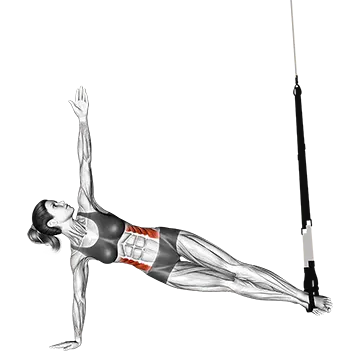
- 4Stack your feet in the cradles one on top of the other and straighten your legs fully so your body forms a rigid plank from head to feet.
- 5Brace your core and let your hips drop toward the floor in a controlled descent, allowing lateral flexion to occur at the waist.
- 6Lower your hips as far as your oblique flexibility and strength allow without letting your legs separate or your torso collapse forward or backward.
- 7Drive your hips back up by contracting the obliques on the working side until your body returns to a straight line.
- 8Complete all repetitions on one side, then reposition to work the other side.
Technik-Tipps
- Keep your body in a single plane throughout — your hips, shoulders, and feet should stay aligned front-to-back so the movement is purely lateral and does not drift into rotation.
- Control the descent rather than dropping your hips; the eccentric phase under load is what builds oblique strength, so slow it down.
- Press your supporting forearm or hand firmly into the floor to free your obliques to do the lateral work rather than using your arm to compensate for instability.
- Squeeze your legs together throughout the set — allowing the feet to separate in the cradles reduces the stability challenge and shifts load away from the target muscles.
- Adjust cradle height before you start: if the straps are too low, your hips will touch the floor before you achieve full range; too high and the leverage becomes difficult to control.
Häufige Fehler
- Rotating the torso forward or backward during the dip — this turns a lateral flexion exercise into a partial rotation and reduces oblique loading while adding unnecessary stress to the lower back.
- Using a swinging or momentum-driven hip drop instead of a controlled descent, which shortens the effective time under tension for the obliques and reduces the training stimulus.
- Allowing the top hip to pike upward at the top of the rep rather than holding a neutral line, which removes tension from the obliques at the position where they should be fully contracted.
- Placing the supporting hand too far from the shoulder, which forces the arm to do stabilizing work and shifts attention away from the obliques.
- Letting the feet drift apart in the cradles, which reduces the demand on the hip adductors and gracilis as stabilizers and makes the position less controlled overall.
Häufig gestellte Fragen
What muscles does the suspension side bend work?
The primary muscle worked is the obliques, which perform the lateral flexion of the spine as your hips lower and rise. The hip adductors — adductor brevis, adductor longus, and gracilis — work to keep the legs pressed together in the cradles, while the iliopsoas and tensor fasciae latae stabilize the hip and thigh position throughout the movement.
How is the suspension side bend different from a standing dumbbell side bend?
The suspension version uses your body weight and the instability of the cradles as resistance rather than a held weight, and it loads the obliques horizontally instead of vertically. The working side is the one nearest the floor: those obliques lengthen under load as the hips drop and shorten to drive them back up. A standing dumbbell side bend trains the same lateral flexion but through a shorter range and with far less demand on shoulder and hip stability.
Is this exercise suitable for beginners?
It requires a solid base of core stability before attempting. Beginners who struggle to hold a standard forearm side plank for 20–30 seconds should build that capacity first. Once you can maintain a stable side plank, start with a shallow range of motion on the suspension side bend and increase depth gradually as strength improves.
How do I progress the suspension side bend over time?
The main progression levers are range of motion and tempo. First aim to achieve a full hip drop with complete control, then slow the descent to increase time under tension. You can also raise the cradle height slightly to increase the effective load on the obliques, or add a brief pause at the lowest point of each rep.
Can I do this exercise if I have lower back pain?
Lateral flexion exercises are generally lower-stress on the lumbar spine than flexion or rotation movements, but any lower back pain warrants caution. The suspension side bend requires a stable, neutral spine at the top position, so if you cannot maintain that or if the movement causes discomfort in your back, stop and consult a qualified health professional before continuing.