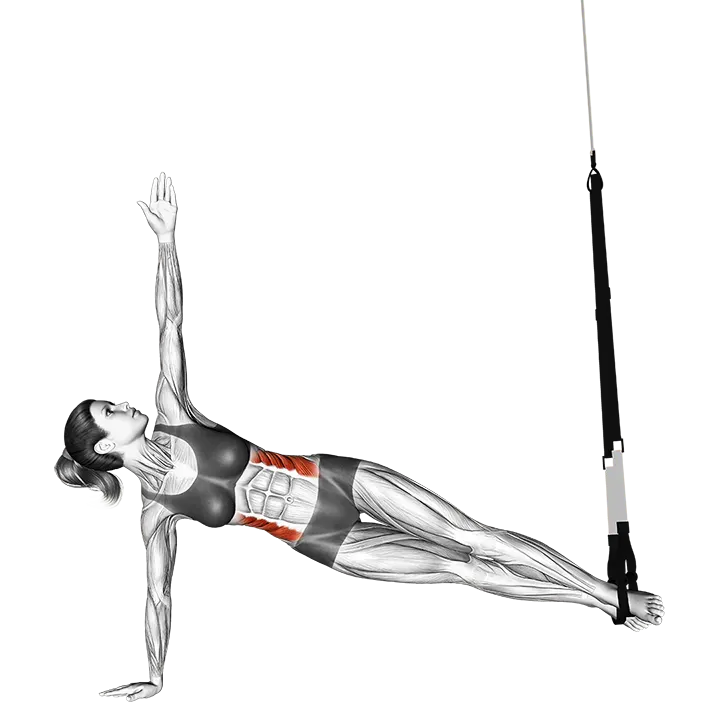
Suspension Star Plank
- Zielmuskel
- Obliques
- Equipment
- Suspension
- Körperregion
- Waist
- Typ
- Strength



The Suspension Star Plank is an advanced core stability exercise that targets the obliques by holding a spread-eagle plank position with your feet suspended in a suspension trainer. The unstable straps amplify the anti-rotation demand on the obliques, making it an effective choice for building lateral core strength and improving total-body stability.
Suspension Star Plank: So führst du sie aus
- 1Adjust the suspension trainer so the foot cradles hang approximately 6–12 inches above the floor.

- 2Kneel facing away from the anchor point and place one foot, then the other, into the suspension foot cradles with the tops of your feet resting in the cradles.

- 3Walk your hands out and lower yourself into a high plank position — hands directly under your shoulders, body in a straight line from heels to head.
- 4Brace your core, squeeze your glutes, and ensure your hips are level and not sagging or piking upward.
- 5Keeping your body rigid, slide your feet apart and your hands out to the sides to form a wide star shape, spreading as far as you can control with good form.
- 6Hold the star position for the target duration — typically 10–30 seconds — breathing steadily while maintaining a neutral spine.
- 7Slowly draw your hands and feet back in toward the center to return to the high plank position.
- 8Rest briefly, then repeat for the prescribed number of sets.
Technik-Tipps
- Set the cradles at roughly the height your feet sit at in a floor plank (6–12 inches) so your body stays level — raising them higher elevates the feet, shifts more bodyweight onto your hands, and makes the hold considerably harder.
- Keep your hips level throughout the hold; if one hip drops or rotates, the obliques on that side are not firing evenly and you risk lower-back strain.
- Actively push the floor away with your hands and squeeze your glutes to lock your spine into a neutral position before you spread into the star shape.
- Control the spread slowly on the way out — the eccentric phase is where most of the oblique work happens and where form breaks down fastest.
- Look straight down at the floor to keep your cervical spine neutral; avoid craning your neck up or tucking your chin to your chest.
Häufige Fehler
- Letting the hips sag toward the floor as the star position is reached, which unloads the obliques and dumps the load into a hyperextended lower back.
- Piking the hips upward during the hold, which shifts the work to the shoulders and hip flexors instead of keeping tension on the obliques.
- Spreading the arms and legs too quickly, which sacrifices stability and reduces the time under tension the obliques need to develop strength.
- Holding the breath throughout the hold, which raises blood pressure, can leave you lightheaded, and forces you to cut the set short before the obliques are actually fatigued.
- Using momentum to snap back to the plank position instead of returning under control, which eliminates the eccentric oblique loading and can strain the lower back.
Häufig gestellte Fragen
What muscles does the Suspension Star Plank work?
The Suspension Star Plank targets the obliques, which work hard to resist rotation and lateral flexion as your body spreads into the star shape. The wider the spread and the longer the hold, the more the obliques have to fight to keep your torso square and your hips level.
Is the Suspension Star Plank good for beginners?
It is not recommended for beginners. You should first be comfortable holding a solid forearm or high plank for at least 45–60 seconds and have experience with basic suspension trainer exercises before attempting this movement. The unstable straps make core bracing errors much harder to correct mid-set.
How long should I hold the Suspension Star Plank?
Start with holds of 10–15 seconds per set and focus on perfect form before extending duration. Intermediate athletes typically work up to 20–30 second holds. Quality of position matters more than duration — end the hold the moment your hips sag or rotate.
What is the difference between a Suspension Star Plank and a regular star plank?
A regular star plank is performed on the floor with all four limbs extended on a stable surface, making it primarily a static hold. The suspension version places your feet in unstable straps, which dramatically increases the demand on the obliques and deep core muscles to resist unwanted movement in every direction.
How do I make the Suspension Star Plank easier or harder?
To make it easier, narrow the spread of your hands and feet, shorten the hold, or spread only the feet while your hands stay under your shoulders. To make it harder, widen the spread, extend the hold duration, raise the foot cradles so your feet sit above hip height, or add slow controlled pulses in and out of the star position.