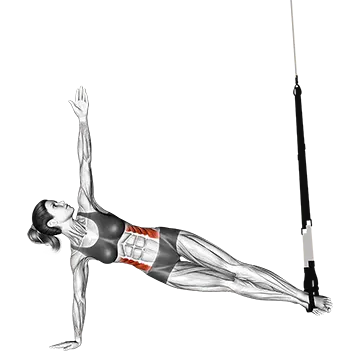
Suspension Twist-Up
- Zielmuskel
- Obliques
- Synergistenmuskeln
- Adductor Brevis, Adductor Longus, Iliopsoas, Tensor Fasciae Latae
- Equipment
- Suspension
- Körperregion
- Waist
- Typ
- Strength
The suspension twist-up is a rotational core exercise performed with a suspension trainer that primarily targets the obliques. Starting in a plank position with feet in the handles, you drive the knees up and across the body, with the iliopsoas, tensor fasciae latae, adductor brevis, and adductor longus assisting the movement. It builds rotational core strength and stability under full-body tension.
Suspension Twist-Up: So führst du sie aus
- 1Set the suspension trainer handles low to the ground, roughly 6–12 inches above the floor.
- 2Face away from the anchor point and place both feet through the handles so the tops of your feet rest inside the loops.
- 3Walk your hands out to a strong push-up position, arms fully extended, body in a straight line from head to heels.
- 4Brace your core and keep your hips level to establish a stable starting plank.
- 5Exhale and drive both knees up and diagonally across your body toward one elbow, rotating through your waist.
- 6Pause briefly at the top of the rotation, squeezing your obliques.
- 7Return both feet under control back to the starting plank position.
- 8Repeat the movement toward the opposite elbow, alternating sides each rep.
Technik-Tipps
- Initiate the rotation from your waist, not your hips or shoulders — think about your ribcage twisting toward your hip.
- Keep your shoulders stacked directly over your wrists throughout the movement to maintain a stable base.
- Control the return to plank on every rep; letting the feet swing back uncontrolled reduces oblique engagement.
- Keep your hips from piking too high or sagging too low — the plank alignment between reps protects your lower back.
- Breathe out on the twist and in on the return to help brace your core and maintain intra-abdominal pressure.
Häufige Fehler
- Rotating at the hips instead of the waist, which reduces oblique recruitment and turns the move into a hip-flexor exercise.
- Letting the hips pike upward during the twist, which shifts load off the obliques and into the shoulders.
- Swinging the knees across with momentum rather than controlled muscle action, reducing time under tension and increasing injury risk.
- Placing the hands too far forward or backward, which destabilizes the shoulder joint and forces poor trunk alignment.
- Holding your breath through the rep, which compromises core bracing and can spike blood pressure unnecessarily.
Häufig gestellte Fragen
What muscles does the suspension twist-up work?
The obliques are the primary target. The iliopsoas, tensor fasciae latae, adductor brevis, and adductor longus assist by driving and controlling the knee lift and crossing motion.
How is the suspension twist-up different from a mountain climber?
A standard mountain climber drives the knee straight forward, targeting the hip flexors. The suspension twist-up adds a diagonal, rotational component that places much greater emphasis on the obliques.
How do I make the suspension twist-up easier or harder?
To make it easier, shorten the range of motion or drive the knees straight forward first, adding the diagonal rotation once the plank feels stable. To increase the challenge, raise the handles so your feet sit higher than your shoulders, slow your tempo, or add a pause at the top of each twist.
How many reps should I do per set?
For core strength and control, 8–12 reps per side per set works well. Because the movement demands stability throughout, quality of rotation matters more than rep count.
Is the suspension twist-up suitable for beginners?
It requires solid baseline core stability and shoulder strength. Beginners should first develop comfort in a suspension plank and standard mountain climbers before adding the rotational component.