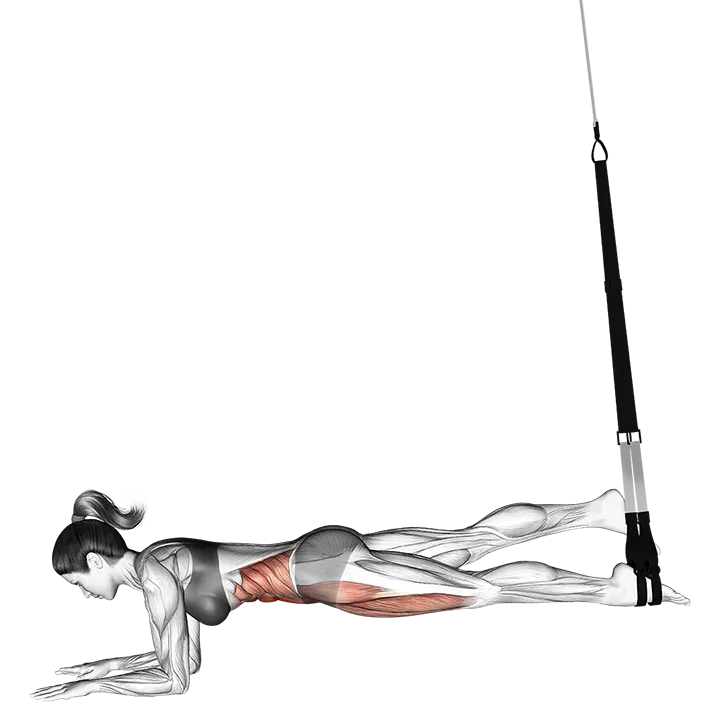
Suspension Single Leg Plank
- Zielmuskel
- Rectus Abdominis
- Synergistenmuskeln
- Obliques, Quadriceps, Tensor Fasciae Latae
- Equipment
- Suspension
- Körperregion
- Waist
- Typ
- Strength

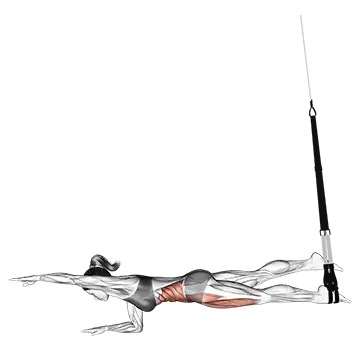
The suspension single leg plank is a demanding core stability exercise that targets the rectus abdominis while the obliques, quadriceps, and tensor fasciae latae work to resist rotation and maintain alignment. Performed with both feet in suspension strap handles and one leg lifted, the unstable surface amplifies anti-extension demands far beyond a standard floor plank. It fits well into strength or conditioning programs as a unilateral core challenge and a natural progression from the two-leg suspension plank.
Suspension Single Leg Plank: So führst du sie aus
- 1Set the suspension straps so the handles hang 6–12 inches off the floor. Face away from the anchor point and place both feet into the handles, laces down.
- 2Walk your hands forward and lower into a push-up position with your hands directly under your shoulders and your body forming a straight line from head to heels.
- 3Brace your core firmly, squeeze your glutes, and press through your hands to reduce swing in the straps.
- 4Without rotating your hips, lift one foot clear of its strap and extend that leg straight back, holding it parallel to the floor.
- 5Hold the position for the target duration — keep your hips level, your lower back flat, and resist any sagging or piking at the hips.
- 6Lower the lifted leg back into the strap under control before releasing tension.
- 7Rest, then repeat on the opposite leg for the prescribed sets.
Technik-Tipps
- Fix your gaze at a point between your hands — looking too far forward strains the neck and breaks spinal alignment.
- Actively draw your navel toward your spine throughout the hold to maximize rectus abdominis engagement rather than relying only on passive tension.
- Press firmly and evenly through the planted foot's strap to dampen swing and keep the setup as stable as possible.
- Start with short hold times of 5–10 seconds per side and only extend to 20–30 seconds once you can control hip rotation and strap movement.
- If the straps sway excessively, shorten the hold rather than compensating with your lower back — stability quality matters more than duration.
Häufige Fehler
- Letting the hips drop or sag: this shifts the load from the core to the lower back and removes the anti-extension challenge the exercise is designed to create.
- Rotating the hips toward the planted-foot side: this cheats the unilateral demand and unloads the obliques that should be resisting the twist.
- Kicking the free leg too high: hyperextending the lower back to raise the leg above hip height defeats the core challenge — keep the leg parallel to the floor.
- Holding your breath during the hold: it spikes blood pressure and ends the set as soon as you run out of air rather than when your core fails; stay braced and keep breathing in shallow, steady breaths.
- Progressing too quickly from the floor plank: the instability of the straps and the removal of one base of support combine to create a much higher difficulty level — build a solid two-leg suspension plank first.
Häufig gestellte Fragen
What muscles does the suspension single leg plank work?
It primarily targets the rectus abdominis. The obliques, quadriceps, and tensor fasciae latae act as synergists, working to resist hip rotation, keep the extended knee straight, and stabilize the hip of the lifted leg.
Is the suspension single leg plank suitable for beginners?
No — it requires a solid foundation of core stability. Master the standard floor plank and the two-leg suspension plank before attempting this variation, as the unstable surface and unilateral load significantly increase difficulty.
How long should I hold the suspension single leg plank?
Aim for 3–5 sets of 10–30 seconds per side. Start at 5–10 seconds and add 2–3 seconds per week as your control of the straps and hip position improves.
How does the suspension single leg plank differ from a standard floor plank?
The suspension straps create instability that forces constant micro-corrections, increasing rectus abdominis and oblique activation compared to a stable floor surface. Lifting one leg further removes a base of support, compounding the anti-rotation and anti-extension demands.
What equipment do I need for this exercise?
You need a suspension trainer anchored to a fixed overhead or high point — any standard suspension strap system will work. No other equipment is required.