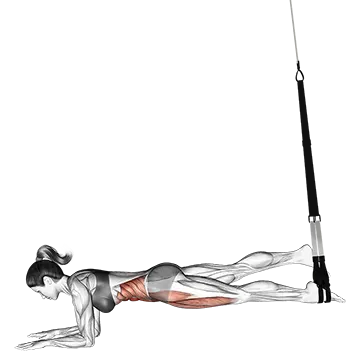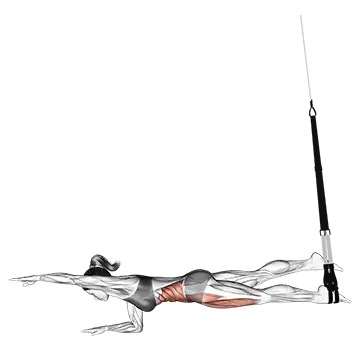
Suspension Standing Ab Rollout
- Zielmuskel
- Rectus Abdominis
- Synergistenmuskeln
- Deltoid Posterior, Latissimus Dorsi, Tensor Fasciae Latae, Teres Major
- Equipment
- Suspension
- Körperregion
- Waist
- Typ
- Strength
The Suspension Standing Ab Rollout is an advanced core exercise performed with TRX-style suspension straps that primarily challenges the rectus abdominis as an anti-extension stabilizer. The latissimus dorsi and teres major drive the arm pull-back, while the posterior deltoid and tensor fasciae latae assist with shoulder extension and hip stability. It builds functional core strength in an upright, load-adjustable position that scales well across experience levels.
Suspension Standing Ab Rollout: So führst du sie aus
- 1Set the suspension straps to approximately chest height and stand facing away from the anchor point.
- 2Grip one handle in each hand with an overhand grip, arms extended in front of you at chest height, and walk your feet forward until the straps are taut.
- 3Lean your body forward slightly so the straps bear some of your weight — this is your starting position.
- 4Brace your core firmly, squeeze your glutes, and establish a straight line from head to heels before you move.
- 5Inhale and slowly extend your arms overhead in a wide arc, allowing your body to lean further toward the anchor while maintaining the rigid plank position throughout.
- 6Continue reaching until your arms are fully extended overhead and your torso approaches parallel to the floor, or as far as core tension allows without your lower back arching.
- 7Pause briefly at full extension to confirm your body line is still straight.
- 8Exhale and drive your arms back down and toward your hips in a controlled arc to return to the starting position.
- 9Reset your brace at the top of each rep and repeat for the desired number of repetitions.
Technik-Tipps
- Tuck your ribs down and tilt your pelvis slightly posterior before each rep — pre-tensioning the rectus abdominis prevents lumbar hyperextension the moment your arms travel overhead.
- Think of the rollout as 'reaching tall' rather than falling forward: deliberate overhead arm drive keeps the latissimus dorsi and teres major under load through the entire arc.
- Control the tempo — aim for 2–3 seconds on the extension and 2 seconds on the return; moving too fast lets momentum carry the load away from the target muscles.
- Adjust difficulty by changing your foot position: stepping closer to the anchor reduces load, stepping farther away increases it — even a few inches makes a significant difference.
- On the pull-back phase, consciously cue pulling your arms down and back rather than simply inward; this keeps the posterior deltoid engaged and produces a fuller contraction.
Häufige Fehler
- Letting the hips sag during extension: this shifts demand away from the rectus abdominis onto the lumbar extensors and can lead to lower-back pain with repeated loading.
- Piking the hips upward on the return: using a hip hike to complete the rep removes the anti-extension challenge and transfers the work to the hip flexors instead of the core.
- Starting at too steep an angle: standing too far from the anchor before building the necessary core strength forces compensatory lumbar arching rather than pure anti-extension effort, raising injury risk.
- Bending the elbows mid-rep: flexing the arms converts the movement into a lat pull-down and diverts the majority of the load away from the rectus abdominis.
- Holding the breath throughout the full rep: failing to exhale on the return raises intra-thoracic pressure unnecessarily and reduces control, especially on longer sets.
Häufig gestellte Fragen
What muscles does the Suspension Standing Ab Rollout work?
The primary muscle is the rectus abdominis, which works as an anti-extension stabilizer throughout the movement. The latissimus dorsi and teres major drive the arm pull-back phase, the posterior deltoid assists with shoulder extension, and the tensor fasciae latae helps stabilize the hips and pelvis during the rollout.
How is the Suspension Standing Ab Rollout different from an ab wheel rollout?
The suspension version is performed standing rather than kneeling, which increases the demand on hip and pelvis stabilization and adds a functional upright component. The straps also allow quick difficulty adjustments by simply changing your foot position, whereas an ab wheel requires a more structured kneeling-to-standing progression to scale the load.
How do I make the Suspension Standing Ab Rollout easier or harder?
Step closer to the anchor point to reduce the load on your core; step farther away to increase it. Beginners should start at a moderate incline and only extend range of motion or increase foot distance once they can maintain a rigid plank from head to heels throughout each rep. Shortening the range of motion by stopping before full arm extension is another way to reduce difficulty.
Is the Suspension Standing Ab Rollout safe for people with lower back issues?
With careful technique — keeping the pelvis neutral, avoiding lumbar hyperextension, and starting at a conservative angle — many people with moderate back concerns can perform this safely. Because it is a high-demand anti-extension movement, anyone with an acute injury or disc issue should consult a healthcare professional before including it in their program.
How many sets and reps should I do for the Suspension Standing Ab Rollout?
For core strength and stability, 3–4 sets of 6–10 controlled repetitions work well. Because the movement places significant demand on the rectus abdominis under a long moment arm, prioritize quality over volume — stop a set as soon as your plank position breaks down, regardless of the rep count, and rest fully between sets.