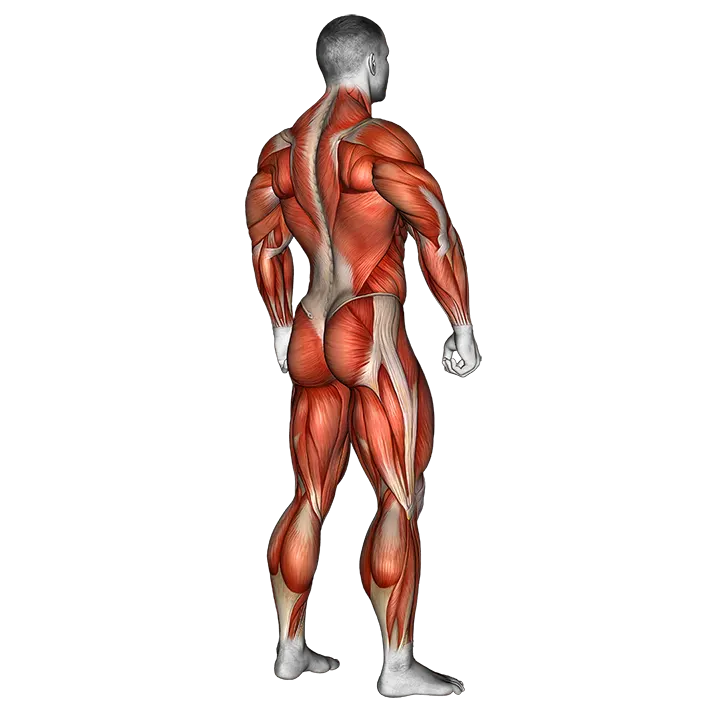
Body muscle. Side back view
- Músculo objetivo
- —
- Equipamiento
- Body weight
- Parte del cuerpo
- Full body
Body muscle. Side back view is an anatomical reference illustration, not a performable exercise. It shows the body's musculature from a side-back angle, so you can see the major muscle groups along the posterior chain and the side of the body at once. Use it to learn anatomy, identify which muscles a movement targets, and plan balanced training.
Cómo hacer el Body muscle. Side back view
- 1Treat this as an anatomy reference, not a workout — there is no movement, target muscle, or rep scheme to perform.
- 2Orient yourself first: the figure is turned so you view it from the side and slightly behind, exposing the back and the outer edge of the body together.
- 3Scan the upper back to identify the posterior shoulders (rear deltoids) and the broad lats sweeping down toward the waist.
- 4Move down to the mid and lower back to locate the spinal erectors running along either side of the spine.
- 5Identify the glutes at the hips, the large muscles that drive hip extension and stabilize the pelvis.
- 6Follow the back of the thigh to the hamstrings, then down to the calves at the back of the lower leg.
- 7Cross-reference what you see here with an exercise you train to confirm which muscles it works from this angle.
- 8Use the view to spot under-trained areas and plan balanced posterior-chain and side-body work.
Consejos de técnica
- Compare this side-back view with front and side reference images so you build a full mental map of each muscle, not just one angle.
- Learn both the common name and the anatomical name (for example glutes / gluteus maximus) so you can follow exercise descriptions accurately.
- Use the view to check training balance — if a posterior muscle group is visible here but rarely in your program, consider adding work for it.
- Trace each muscle's line of pull from origin to insertion to understand which movements load it from this perspective.
Errores comunes
- Treating the illustration as an exercise to perform — it is a static anatomy reference, so there is nothing to do, lift, or rep out.
- Assuming a labeled muscle is the only one working in a real movement; most exercises recruit several muscles, and a reference shows location, not effort.
- Relying on a single view — a side-back image hides front-of-body muscles, so judging your whole physique or program from it alone gives a skewed picture.
- Confusing muscle visibility with muscle size or strength; what stands out in an illustration depends on the angle, not on how developed it is.
- Memorizing positions without learning function — knowing where a muscle sits is far less useful than knowing what movement it produces.
Preguntas frecuentes
Is Body muscle. Side back view an exercise?
No. It is an anatomical reference illustration showing the body's muscles from a side-back angle. There is no movement, target muscle, or rep scheme — use it to learn anatomy and plan training.
What muscles are visible from the side-back view?
From this angle you can see the posterior shoulders (rear deltoids), the lats across the back, the spinal erectors, the glutes at the hips, the hamstrings on the back of the thigh, and the calves on the lower leg.
How can I use this anatomy reference?
Use it to identify posterior-chain and side-body muscle groups, to understand which muscles an exercise targets from this perspective, and to spot under-trained areas when planning a balanced program.
Why can't I see chest or abs in this view?
Because the figure is turned to show the back and the outer side of the body, front-of-body muscles like the chest and abdominals are hidden. Use a front or side reference image to study those.







