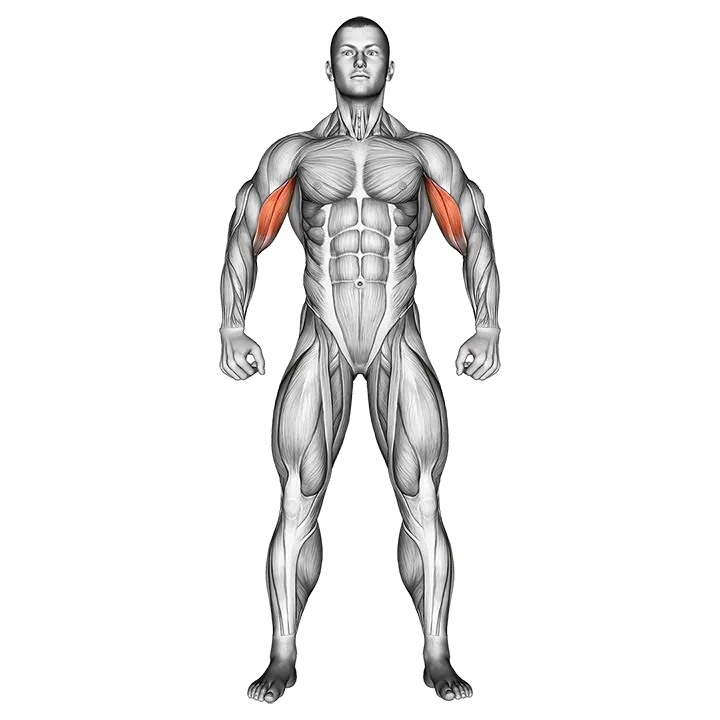
Body muscles. Front view
- Músculo objetivo
- —
- Equipamiento
- Body weight
- Parte del cuerpo
- Full body
Body muscles, front view is an anatomical reference illustration, not a performable exercise — it shows the body's musculature as seen from the front (the anterior view). Use it to learn where the major front-facing muscle groups sit, including the chest (pectorals), abdominals, front shoulders (deltoids), biceps, forearms, and quadriceps, so you can connect what you train to what you see.
Cómo hacer el Body muscles. Front view
- 1Treat this as an anatomy reference, not a workout — there are no reps, sets, or movement to perform.
- 2Orient yourself to the anterior (front) view: you are looking at the body as if it were facing you.
- 3Identify the upper-body push muscles across the chest — the pectorals — that span from the breastbone out to the shoulders.
- 4Locate the abdominals down the center of the torso and the obliques along the sides of the waist.
- 5Find the front shoulders (anterior deltoids) capping the tops of the arms, with the biceps running down the front of the upper arm.
- 6Trace the forearm muscles below the elbow that control grip and wrist movement.
- 7Scan the front of the thighs for the quadriceps, the large muscle group that extends the knee.
- 8Use these landmarks to map an exercise to the muscles it targets, then cross-reference the back (posterior) view for the muscles this front view cannot show.
Consejos de técnica
- Pair this front view with a back (posterior) view so you understand the whole body — the front view alone cannot show muscles like the lats, hamstrings, or glutes.
- Learn the common name and the anatomical name side by side (for example, chest / pectorals) so you can follow both gym talk and textbooks.
- Use the reference to plan balanced training: if you only train muscles visible from the front, you risk neglecting the back of the body.
- Relate the picture to your own body by locating each group on yourself, which makes the mind-muscle connection easier during real training.
Errores comunes
- Treating this as an exercise to perform — it is an illustration, so there is nothing to lift, press, or repeat.
- Assuming the front view shows every muscle; it only shows the anterior surface, so back-of-body muscles are missing and easy to overlook.
- Confusing superficial muscles you can see with deeper stabilizing muscles that an outline diagram does not depict.
- Planning a whole program from the front view alone, which biases training toward visible 'mirror' muscles and creates imbalances.
- Memorizing only the common names and getting lost when a coach or program uses the anatomical terms, or vice versa.
Preguntas frecuentes
Is this an exercise?
No. 'Body muscles. Front view' is an anatomical reference illustration showing the body's musculature from the front. There is no movement, target muscle, or rep scheme — it is a learning and planning aid, not a workout.
What muscles are visible from the front view?
The main front-facing groups are the chest (pectorals), abdominals and obliques, front shoulders (anterior deltoids), biceps, forearms, and quadriceps on the front of the thighs.
How can I use this anatomy reference?
Use it to learn where the front muscle groups sit, to connect exercises to the muscles they work, and to plan balanced training. Pair it with a back (posterior) view for a complete picture of the body.
Why can't I see muscles like the back or hamstrings here?
This is the anterior (front) view, so it only shows muscles on the front surface of the body. Posterior muscles such as the lats, hamstrings, and glutes appear in a separate back-view reference.







