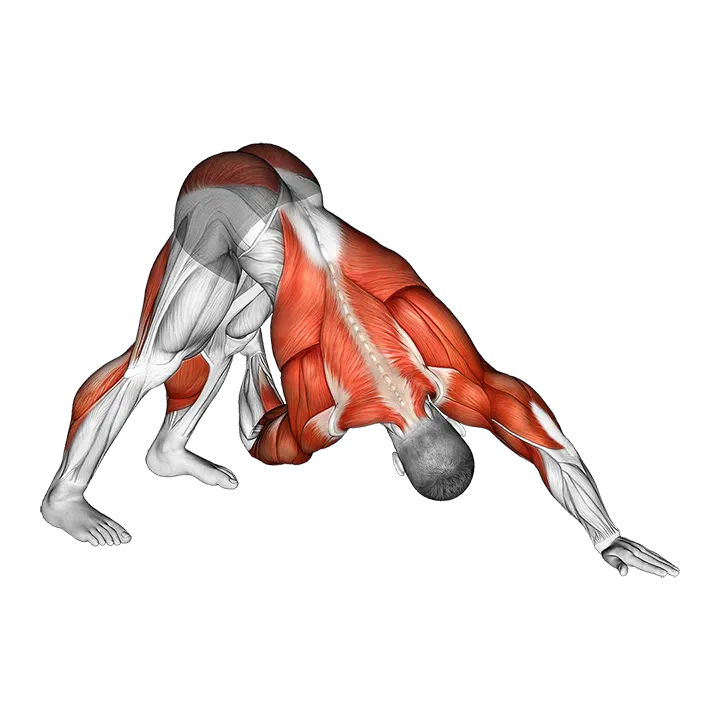
Downward Facing Dog Spine Mobility
- Músculo objetivo
- —
- Equipamiento
- Body weight
- Parte del cuerpo
- Back, Hips, Thighs, Waist
- Tipo
- Stretching
Downward Facing Dog Spine Mobility is a bodyweight stretch built from the classic yoga pose, working the back, hips, hamstrings, and waist as you decompress the spine. Holding an inverted V and adding small spinal movements, it lengthens the posterior chain and improves mobility — a useful warm-up or cool-down with no equipment needed.
Cómo hacer el Downward Facing Dog Spine Mobility
- 1Start on all fours with your hands shoulder-width apart and your knees under your hips, fingers spread wide and pressing into the floor.
- 2Tuck your toes under and lift your hips up and back, straightening your legs to form an inverted V shape with your body.
- 3Press your chest gently toward your thighs and lengthen your spine, reaching your hips toward the ceiling.
- 4Keep your head relaxed between your arms with your ears in line with your upper arms, neck long and free of tension.
- 5Gently round and then lengthen your back through small, controlled movements to mobilize each segment of your spine.
- 6Pedal your heels one at a time toward the floor to ease the stretch through your hamstrings and calves.
- 7Breathe slowly and hold for several breaths, then bend your knees and lower back to all fours to finish.
Consejos de técnica
- Bend your knees slightly if your hamstrings are tight — a long spine matters more than perfectly straight legs.
- Spread your fingers wide and root the base of each finger and palm down to take pressure off your wrists.
- Rotate your upper arms outward and draw your shoulders away from your ears to keep the neck and shoulders relaxed.
- Move with your breath, lengthening the spine on the inhale and deepening the stretch on the exhale.
- Keep the movements small and controlled rather than forcing range — mobility comes from repetition, not strain.
Errores comunes
- Rounding the upper back and collapsing the chest, which shortens the spine and defeats the purpose of the mobility work.
- Locking the knees hard to force the heels down, which pulls tension into the lower back instead of stretching the hamstrings.
- Letting the head hang and craning the neck, which strains the cervical spine instead of keeping it long and neutral.
- Dumping weight into the wrists with flat, passive hands, which overloads the joints and causes wrist pain.
- Holding the breath and tensing through the movement, which limits how far the spine and hips can release.
Preguntas frecuentes
What muscles does Downward Facing Dog Spine Mobility work?
It stretches and mobilizes the back, hips, hamstrings (thighs), and waist. The pose lengthens the whole posterior chain while the small spinal movements free up the back and core.
Is Downward Facing Dog Spine Mobility good for beginners?
Yes. It's a beginner-friendly bodyweight stretch with no equipment needed. Bend your knees as much as you need to keep a long spine, and build range gradually over time.
How long should I hold the pose?
Hold for several slow breaths — roughly 20 to 30 seconds — while adding the gentle spinal movements. Repeat for 2 to 3 rounds as a warm-up or cool-down.
Why do my wrists hurt in Downward Facing Dog?
Usually because weight is dumped into passive, flat hands. Spread your fingers, press through the base of each finger and palm, and shift some load back into your hips to relieve the wrists.
Should my heels touch the floor?
Not necessarily. Many people can't bring their heels flat, and that's fine. Keep a long spine and pedal the heels gently rather than forcing them down at the cost of your lower back.







