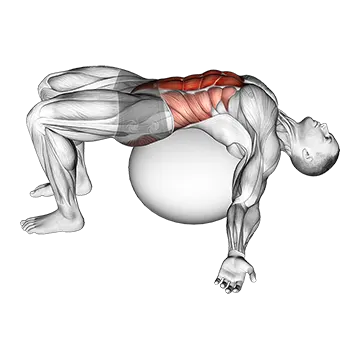
Exercise Ball Back Extension With Rotation
- Músculo objetivo
- Erector Spinae
- Músculos sinergistas
- Gluteus Maximus, Obliques, Rectus Abdominis
- Equipamiento
- Stability ball
- Parte del cuerpo
- Back
- Tipo
- Strength

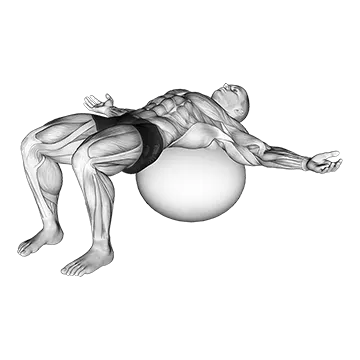


The exercise ball back extension with rotation is a stability-ball movement that targets the erector spinae of the lower back, with the glutes, obliques, and abs assisting. Lying prone over the ball, you extend your spine to lift your torso and add a twist at the top, building lower-back strength and rotational control at the same time.
Cómo hacer el Exercise Ball Back Extension With Rotation
- 1Kneel behind the stability ball and roll forward so the ball sits under your hips and lower abdomen, with your torso draped over it.
- 2Brace your feet against the floor or a wall, spread roughly shoulder-width apart for a stable base.
- 3Let your upper body round over the ball and place your hands lightly behind your head or crossed over your chest.
- 4Brace your core, squeeze your glutes, and extend your spine to raise your torso until your body forms a straight line from head to heels.
- 5At the top of the extension, rotate your torso smoothly to one side without losing the straight, extended position.
- 6Rotate back to center under control, then lower your torso over the ball to the start.
- 7Repeat the extension and rotate to the opposite side, alternating sides each rep.
- 8Finish your set and roll off the ball with control.
Consejos de técnica
- Lead the lift with your lower back and glutes rather than throwing your head and neck back.
- Keep the rotation slow and deliberate so the obliques drive the twist instead of momentum.
- Keep your neck in line with your spine and your gaze toward the floor through the extension.
- Set your feet against a wall or have a partner anchor them if the ball feels unstable under load.
- Exhale as you extend and rotate, and inhale as you lower back over the ball.
Errores comunes
- Hyperextending past a straight line at the top, which over-compresses the lower spine and risks the erector spinae.
- Twisting fast with momentum instead of control, which shifts work off the obliques and can strain the lower back.
- Pulling on the back of your head with your hands, which strains the neck and cheats the rep.
- Letting the hips slide off the ball because the feet aren't braced, costing tension and stability.
- Rotating before reaching full extension, which collapses the position and reduces erector spinae engagement.
Preguntas frecuentes
What muscles does the exercise ball back extension with rotation work?
It primarily works the erector spinae of the lower back, with the gluteus maximus, obliques, and rectus abdominis assisting — the obliques especially during the rotation phase.
Is the exercise ball back extension with rotation good for beginners?
Yes, as long as you start with bodyweight only and control the movement. Master a straight-line back extension first, then add the rotation once you can hold a stable position over the ball.
How many sets and reps should I do?
For most lifters, 2–3 sets of 10–15 reps per side works well. Prioritize a controlled extension and rotation over speed or extra reps.
What's a good alternative to the exercise ball back extension with rotation?
A standard stability-ball back extension without the twist isolates the erector spinae, while a Roman-chair (hyperextension) bench back extension is a sturdier option if the ball feels unstable.
Where should I feel this exercise?
You should feel it through your lower back and glutes during the extension, with the obliques along your sides working as you rotate at the top. Sharp lower-back pain means you're over-extending — reduce your range.