
Exercise Ball Hug
- Músculo objetivo
- Erector Spinae
- Equipamiento
- Stability ball
- Parte del cuerpo
- Back
- Tipo
- Stretching
The exercise ball hug is a gentle back stretch that drapes your torso over a stability ball to round and decompress the spine, lengthening the erector spinae that run along your back. It's a low-effort way to relieve back tension, improve spinal mobility, and unwind after sitting or training.
Cómo hacer el Exercise Ball Hug
- 1Kneel on the floor in front of a stability ball, positioning the ball just in front of your chest and stomach.
- 2Wrap your arms around the front of the ball and lean your chest and torso onto it as if hugging it.
- 3Let your back round naturally over the curve of the ball, allowing your spine to lengthen and decompress.
- 4Relax your head, neck, and shoulders, and let your body weight sink into the ball.
- 5Breathe slowly and deeply, exhaling to release a little further into the stretch with each breath.
- 6Hold the position and feel a mild stretch along the muscles running down your back, never to the point of pain.
- 7To release, slowly walk your hands in and lift your torso back to a tall kneeling position.
Consejos de técnica
- Let gravity do the work — relax your back muscles completely rather than actively pulling yourself over the ball.
- Use a slightly under-inflated ball for more give if a firm ball feels uncomfortable against your stomach.
- Keep the movement smooth and static; never bounce or rock to force a deeper stretch.
- Coordinate the stretch with your breathing, sinking a touch lower on each exhale.
- Stop and ease off immediately if you feel any sharp pain, tingling, or numbness.
Errores comunes
- Bouncing or jerking on the ball to push deeper, which can strain the erector spinae instead of relaxing them.
- Holding your breath, which keeps your back muscles tense and limits how much the spine can lengthen.
- Tensing the shoulders and neck, which prevents the upper back from rounding and decompressing.
- Stretching into pain rather than a mild pull, which risks aggravating the lower back instead of relieving it.
- Using a fully rigid, over-inflated ball that gives no support and makes it hard to settle into the stretch.
Preguntas frecuentes
What muscles does the exercise ball hug stretch?
It mainly stretches the erector spinae — the long muscles running along either side of your spine — as your back rounds over the ball and the spine gently decompresses.
How long should I hold the exercise ball hug?
Hold for about 20–30 seconds while breathing slowly, and repeat 2–3 times. Hold longer if it feels good, but stay in a mild stretch rather than pushing into discomfort.
Is the exercise ball hug good for the lower back?
Yes — draping over the ball rounds and decompresses the spine, which can help relieve tension in the lower back and erector spinae. Keep it gentle and stop if you feel any sharp pain.
How should I breathe during the stretch?
Breathe slowly and deeply through the hold. Exhale as you settle a little further over the ball, and avoid holding your breath, which keeps the back muscles tense.
Is the exercise ball hug good for beginners?
Yes. It's a low-effort, supported stretch with no load, so it suits beginners. Just move into and out of it slowly and keep the stretch within a comfortable range.
Ejercicios relacionados
 Back Extension on Exercise BallBack
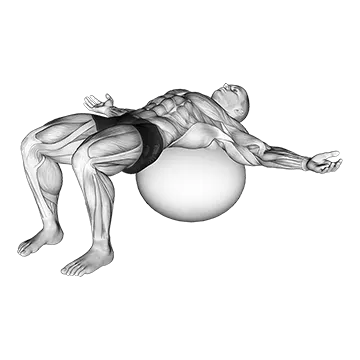 Back RelaxationBack
 Exercise Ball Back Extension With Arms ExtendedBack
 Exercise Ball Back Extension With Hands Behind HeadBack
 Exercise Ball Back Extension With Knees Off GroundBack
 Exercise Ball Back Extension With RotationBack
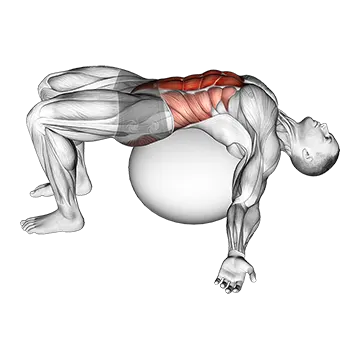 Exercise Ball Back StretchBack
 45 degrees Back ExtensionHips