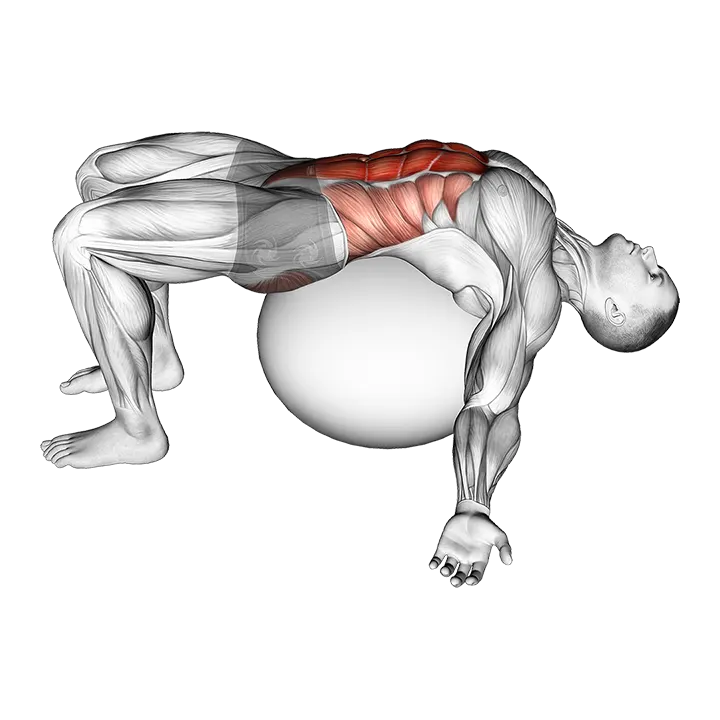
Exercise Ball Back Stretch
- Músculo objetivo
- Erector Spinae
- Músculos sinergistas
- Gluteus Maximus
- Equipamiento
- Stability ball
- Parte del cuerpo
- Back
- Tipo
- Stretching
The exercise ball back stretch is a gentle mobility drill that uses a stability ball to decompress and lengthen the spine, primarily stretching the erector spinae along the length of your back, with the glutes (gluteus maximus) helping support the position. Draping your back over the ball opens the chest and relieves stiffness, making it a useful cool-down or recovery movement after sitting or lifting.
Cómo hacer el Exercise Ball Back Stretch
- 1Sit on top of a stability ball with your feet flat on the floor, roughly shoulder-width apart, and your knees bent at about 90 degrees.
- 2Slowly walk your feet forward, letting the ball roll under your lower and mid back as you ease your torso backward.
- 3Continue rolling until the ball supports your mid back and your spine drapes over its curve, hips relaxed and slightly extended.
- 4Let your arms fall out to the sides or reach gently overhead, allowing your chest to open and your back to lengthen.
- 5Relax your head and neck, keeping them supported and in line with your spine rather than dropping them sharply back.
- 6Breathe slowly and deeply, exhaling as you let your back sink a little further into the stretch, and hold for 20 to 30 seconds.
- 7To finish, walk your feet back toward the ball, engage your core, and curl up to a seated position with control.
Consejos de técnica
- Move into and out of the stretch slowly so the ball stays stable and your back is never jolted.
- Keep your feet planted and wide enough to give the ball a solid, balanced base throughout the hold.
- Use your breathing to deepen the stretch — let each exhale release a little more tension through the erector spinae.
- Choose a ball sized so that when you sit on it your hips and knees are level; this gives your spine the right amount of curve to stretch over.
- Ease off immediately if you feel any sharp pain or pinching in your lower back rather than pushing through it.
Errores comunes
- Letting the head drop back too far, which strains the neck instead of relaxing it and can cause dizziness.
- Dropping into the position too quickly, which destabilizes the ball and risks rolling off or tweaking the back.
- Holding your breath and staying tense, which keeps the erector spinae contracted and limits how much the back actually lengthens.
- Using a ball that is too small or too large, which either over-arches the lower back or fails to support the spine through the stretch.
- Placing your feet too close together, which makes the ball wobble and forces you to brace instead of relax.
Preguntas frecuentes
What muscles does the exercise ball back stretch work?
It mainly stretches the erector spinae, the muscles running along your spine, while the glutes (gluteus maximus) help support and stabilize the position as your back drapes over the ball.
How long should I hold the exercise ball back stretch?
Hold the position for about 20 to 30 seconds while breathing slowly, and repeat for two or three rounds. Stretching gently rather than forcing the range is what relieves stiffness.
Is the exercise ball back stretch good for beginners?
Yes. It is a low-intensity stretch, but beginners should move slowly, keep their feet wide for balance, and use a wall or chair nearby for support until they feel steady on the ball.
Should I feel this stretch in my lower back?
You should feel a gentle lengthening along the spine and mid to lower back, never a sharp pinch. If you feel pain in the lower back, ease off, reposition the ball, and reduce how far you arch.
What size stability ball should I use for this stretch?
Pick a ball that lets your hips and knees sit roughly level when you sit on it — usually 55 cm for shorter people and 65 cm for taller. The right size gives your spine a comfortable curve to stretch over.
Ejercicios relacionados
 Back Extension on Exercise BallBack
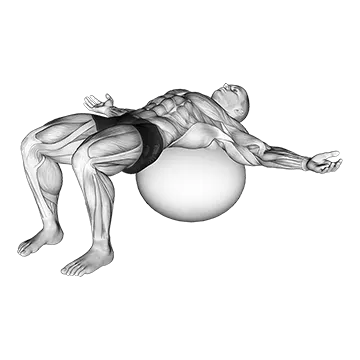 Back RelaxationBack
 Exercise Ball Back Extension With Arms ExtendedBack
 Exercise Ball Back Extension With Hands Behind HeadBack
 Exercise Ball Back Extension With Knees Off GroundBack
 Exercise Ball Back Extension With RotationBack
 Exercise Ball HugBack
 45 degrees Back ExtensionHips