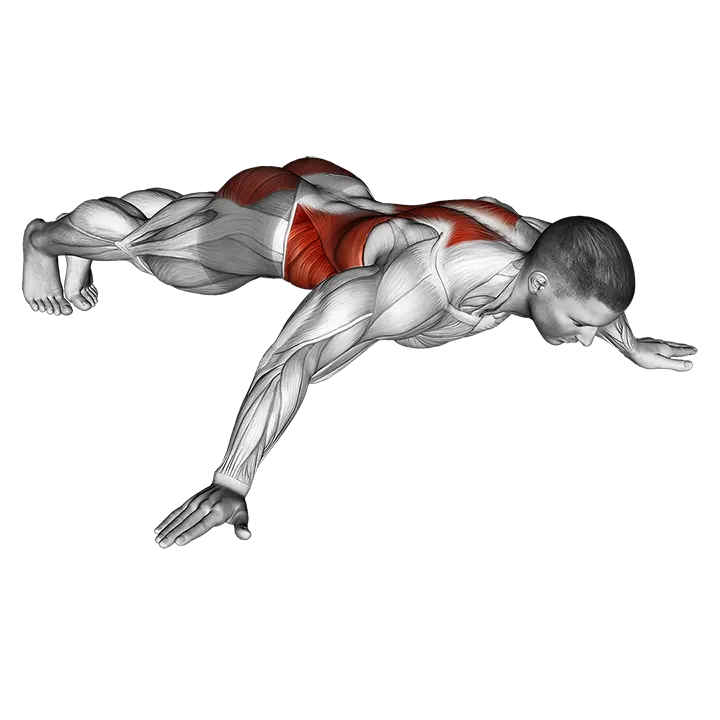
Iron Cross Plank
- Músculo objetivo
- Gluteus Maximus, Latissimus Dorsi, Obliques, Rectus Abdominis, Trapezius Lower Fibers, Trapezius Middle Fibers
- Equipamiento
- Body weight
- Parte del cuerpo
- Back
- Tipo
- Strength
The Iron Cross Plank is an advanced bodyweight strength exercise that challenges the gluteus maximus, latissimus dorsi, obliques, rectus abdominis, and lower and middle trapezius fibers by holding a plank with arms extended out to the sides in a T position. The wide arm placement removes the mechanical advantage of hands stacked under the shoulders, increasing the demand on the lats, glutes, and core. It builds full-body isometric strength and scapular stability.
Cómo hacer el Iron Cross Plank
- 1Lie face down on the floor and extend your arms straight out to the sides so your body forms a cross or T shape, palms flat on the floor.
- 2Press through your palms and the balls of your feet to lift your entire body off the floor, forming a straight line from head to heels.
- 3Squeeze your glutes firmly to prevent your hips from sagging toward the floor.
- 4Brace your core — draw the navel slightly in and tighten the abs — to lock the spine in a neutral position.
- 5Retract and depress your shoulder blades to engage the middle and lower trapezius and keep the chest from collapsing.
- 6Pull the lats in slightly as if trying to resist the arms being pulled further apart.
- 7Hold your gaze just in front of your fingertips so your neck stays neutral and in line with the spine.
- 8Breathe steadily in and out without letting your hips rise or drop during the hold.
- 9Lower with control when you can no longer maintain a rigid, straight-body position.
Consejos de técnica
- Think of your body as a single rigid plank — any sag at the hips or pike at the waist means you have lost position.
- Set your feet at hip width or slightly wider; a narrow, feet-together stance shrinks your base and makes the hips much harder to keep level.
- Keep the ribcage pulled down toward the pelvis instead of letting it flare, so the abs hold the line rather than the lower back.
- Start with short holds of 10–15 seconds and build duration before adding sets, as the leverage demands are far greater than a standard plank.
- If the full Iron Cross is too demanding, practice with arms at a 45-degree angle from the body before progressing to a full 90-degree T position.
Errores comunes
- Allowing the hips to sag toward the floor, which transfers load off the glutes and core and places compressive stress on the lower back.
- Letting the elbows bend during the hold, which reduces the leverage challenge and shifts effort away from the lats and core.
- Hiking the hips into a pike position to compensate for insufficient core strength, making the hold easier but eliminating the training stimulus.
- Holding the breath, which spikes intra-abdominal pressure and makes sustained holds significantly harder and less controlled.
- Allowing the shoulder blades to wing or protract, which removes trapezius engagement and can strain the shoulder capsule under load.
Preguntas frecuentes
What muscles does the Iron Cross Plank work?
The Iron Cross Plank primarily targets the gluteus maximus, latissimus dorsi, obliques, rectus abdominis, and the lower and middle fibers of the trapezius. The wide arm position increases demand on all of these muscles compared to a standard forearm or high plank.
Is the Iron Cross Plank harder than a regular plank?
Yes, significantly. Moving the arms out to a T position eliminates the mechanical support of having hands directly under the shoulders, multiplying the torque on the core, lats, and glutes. Most people find it several times more demanding than a standard plank.
How long should I hold an Iron Cross Plank?
Beginners should aim for 10–20 second holds with full-body rigidity and build up gradually. Quality of position matters more than duration — stop the set as soon as form breaks down.
Can I do the Iron Cross Plank if I am new to planks?
No — this is an advanced variation best suited to those who can comfortably hold a standard plank for 60 seconds or more with solid form. Build foundational core and lat strength first before attempting the Iron Cross Plank.
How do I progress toward the Iron Cross Plank?
Start with a standard high plank, then gradually walk your hands wider week by week until they reach a 45-degree angle, then eventually a full 90-degree T position. Scapular retraction exercises like face pulls also help build the trapezius strength needed.







