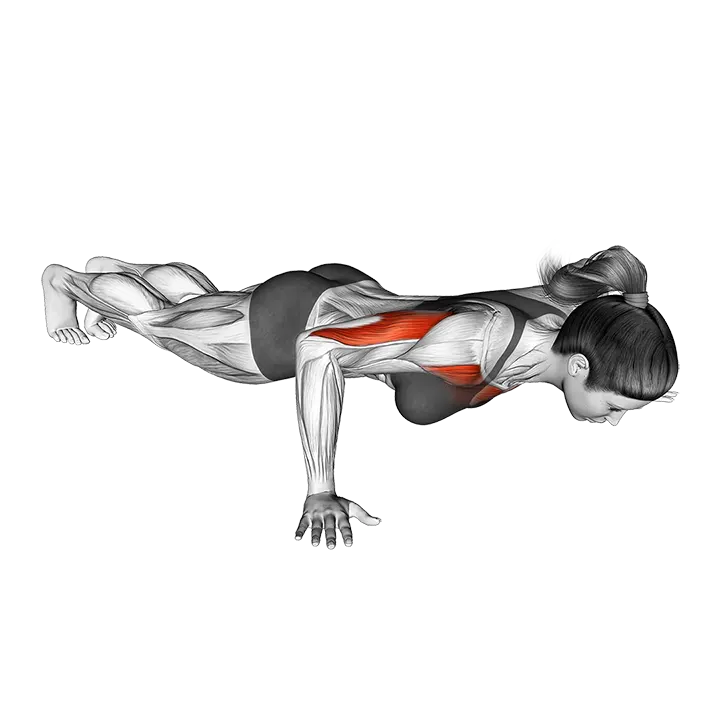
Isometric Hold Wide Hand Push-up
- Músculo objetivo
- —
- Equipamiento
- Body weight
- Parte del cuerpo
- Chest
- Tipo
- Strength
The isometric hold wide hand push-up is a bodyweight chest exercise that uses a wider-than-shoulder-width hand placement to emphasize the outer chest, combined with a static hold at the lowered position to maximize time under tension. It requires no equipment and is effective for building chest strength and muscular endurance.
Cómo hacer el Isometric Hold Wide Hand Push-up
- 1Get into a high plank position with your hands placed wider than shoulder-width apart, fingers pointing forward or slightly outward, and arms fully extended.
- 2Brace your core, squeeze your glutes, and keep your body in a straight line from head to heels throughout the movement.
- 3Lower your chest toward the floor by bending your elbows, keeping them flared outward at roughly a 45–75° angle to your torso.
- 4Stop when your chest is just above the floor or at your chosen mid-range depth — your elbows should be bent to approximately 90°.
- 5Hold this lowered position without moving for the prescribed duration (typically 2–5 seconds), maintaining full-body tension.
- 6Press through your palms to push yourself back up to the starting position with your arms fully extended.
- 7Complete your reps, performing the isometric hold on each repetition.
Consejos de técnica
- Keep your hips level throughout — do not let them sag toward the floor or pike upward, as this reduces chest engagement and stresses the lower back.
- During the hold, actively press your hands into the floor as if trying to spread them apart; this cues your chest to stay contracted under load.
- Control your breathing during the isometric phase — exhale fully before initiating the press back up.
- Start with shorter holds (2–3 seconds) before progressing to longer durations as your strength and stability improve.
Errores comunes
- Letting the hips sag during the hold, which shifts tension away from the chest and onto the lower back and shoulders.
- Placing the hands too close together, which reduces the wide-hand advantage and takes emphasis off the outer chest.
- Rushing through the hold by not counting the full duration, which defeats the purpose of increasing time under tension.
- Flaring the elbows straight out to 90° rather than a moderate angle, which places unnecessary stress on the shoulder joints.
- Losing full-body rigidity between reps, causing the movement to become disjointed rather than a controlled, repeatable pattern.
Preguntas frecuentes
What does the isometric hold do in a wide hand push-up?
The isometric hold pauses the movement at the lowered position, keeping your chest under tension for longer than a standard rep. This increased time under tension builds chest strength and endurance without needing additional weight.
How wide should my hands be for a wide hand push-up?
Place your hands noticeably wider than shoulder-width — roughly 1.5 times shoulder-width is a common starting point. The wider stance shifts more of the work onto the outer chest compared to a standard push-up.
How long should I hold the isometric position?
2–5 seconds per rep is a practical range for most people. Beginners should start at 2 seconds and progress gradually. Longer holds dramatically increase difficulty, so adjust based on your strength level and the number of reps in your set.
Is this exercise suitable for beginners?
It is more demanding than a standard push-up due to the wide hand placement and added isometric hold. Beginners should first build comfort with regular push-ups before adding the hold, or reduce the hold duration to 1–2 seconds to start.
Can I do this exercise every day?
Like any strength exercise, the chest needs recovery time between sessions. Training it 2–4 times per week with adequate rest between sessions is typically more effective for strength and muscle development than daily training.







