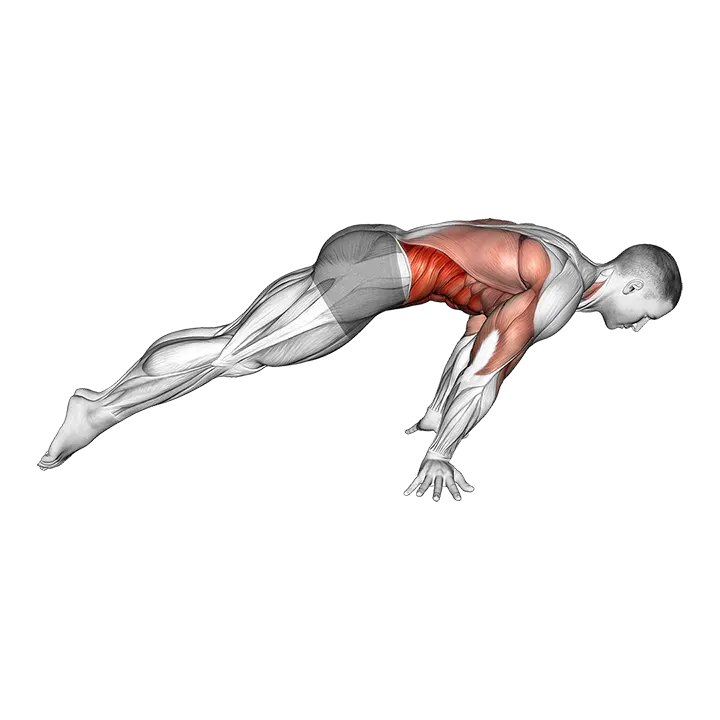
Lean planche
- Músculo objetivo
- —
- Equipamiento
- Body weight
- Parte del cuerpo
- Waist
- Tipo
- Stretching
The lean planche is a foundational bodyweight skill and stretching exercise that builds core and shoulder stability by training your body to hold a near-horizontal position with arms straight. It conditions the waist, anterior shoulder girdle, and wrists through progressive static holds. Use it as an entry point for planche progressions or as a mobility and body-tension drill.
Cómo hacer el Lean planche
- 1Get into a push-up position with your hands flat on the floor, fingers pointing forward or slightly outward, directly beneath your shoulders.
- 2Shift your shoulders forward in front of your wrists by leaning through your arms until the angle between your arms and the floor decreases noticeably.
- 3Tuck your hips under and squeeze your core tight so your entire body forms one rigid, slightly angled plank from head to heel.
- 4Press firmly through your palms, spreading your fingers to distribute weight evenly and reduce wrist strain.
- 5Keep your elbows fully locked and your arms straight throughout the hold — do not allow them to bend.
- 6Hold the position for a target duration (3–10 seconds to start), breathing steadily and maintaining full-body tension.
- 7Lower your knees or hips to the floor with control to exit the hold, then rest before repeating.
Consejos de técnica
- Protract your shoulder blades — push them apart and round them slightly — rather than letting them pinch together, to engage the supporting muscles correctly.
- Build hold time gradually: short, near-perfect holds are more productive than longer holds with collapsed form.
- Warm up your wrists thoroughly before each session with circles and light compression drills, as this position places significant load on the wrist joint.
- Film yourself from the side occasionally to check that your lean angle is progressing and your body line remains straight.
- If wrists are painful, try using push-up handles or parallettes to reduce wrist extension.
Errores comunes
- Bending the elbows during the hold, which shifts the skill into a push-up rather than training the static planche position.
- Allowing the hips to sag, which breaks the rigid body line and reduces the core-tension demand that makes the exercise effective.
- Leaning forward without protracting the scapulae, placing all the load passively on the wrist and elbow joints instead of actively through the shoulder girdle.
- Holding your breath, which spikes intra-abdominal pressure unnecessarily and limits hold duration — breathe steadily throughout.
- Jumping too far forward too soon before building wrist and shoulder tolerance, which increases injury risk at the wrist and elbow.
Preguntas frecuentes
What is a lean planche?
A lean planche is a bodyweight skill drill where you shift your shoulders past your wrists in a straight-arm push-up position and hold a rigid, angled body line. It develops the shoulder, core, and wrist conditioning needed to progress toward a full planche.
Is the lean planche a strength or stretching exercise?
It bridges both categories. The static hold trains isometric strength and body tension, while the wrist extension and shoulder protraction position also stretches and mobilises those joints. It is typically used as a mobility and skill-building drill rather than a primary strength movement.
How long should I hold the lean planche?
Start with holds of 3–5 seconds and accumulate 3–5 sets with full rest between them. As your wrist and shoulder tolerance improves, extend holds to 10–15 seconds. Quality of position matters more than duration.
Do I need any equipment for the lean planche?
No. The lean planche requires only your bodyweight and a flat floor surface. Push-up handles or parallettes are optional accessories that reduce wrist extension if needed.
How do I progress from the lean planche toward a full planche?
Increase your lean angle gradually over weeks and months until your body is parallel to the floor. Common progression steps include the tuck planche, advanced tuck planche, straddle planche, and finally full planche. Consistent, patient hold-time accumulation is more effective than rushing the angle forward.







