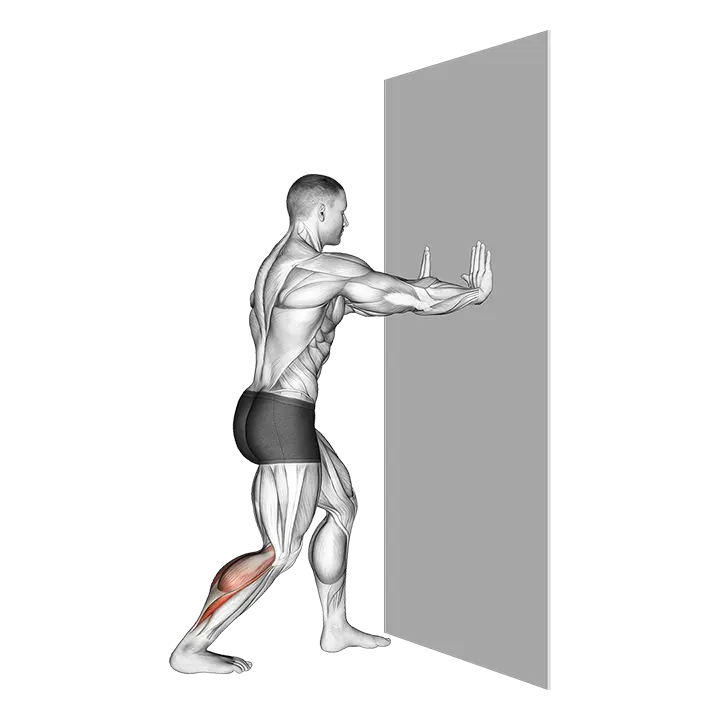
Leaning Heel Back Achilles Stretch
- Músculo objetivo
- —
- Equipamiento
- Body weight
- Parte del cuerpo
- Calves
- Tipo
- Stretching
The Leaning Heel Back Achilles Stretch is a bodyweight flexibility exercise that targets the Achilles tendon and the calf muscles. By leaning into a wall while pressing the heel of the back foot flat into the floor, you create a deep, sustained stretch along the lower leg. It is especially effective for improving ankle mobility, relieving calf tightness, and reducing Achilles tendon stiffness after activity.
Cómo hacer el Leaning Heel Back Achilles Stretch
- 1Stand facing a wall at arm's length and place both hands flat against it at roughly shoulder height.
- 2Step one foot back about 60–90 cm (2–3 feet), keeping the toes of both feet pointing straight forward.
- 3Bend the front knee slightly while keeping the back leg straight.
- 4Press the heel of the back foot firmly into the floor so the entire sole maintains contact with the ground.
- 5Lean your body forward toward the wall by bending the front knee further, shifting your weight gently onto your hands.
- 6Keep your back leg straight and your back heel grounded — do not allow it to rise.
- 7Hold the stretched position for 20–30 seconds, breathing steadily and allowing the calf and Achilles tendon to relax into the stretch.
- 8Release, switch legs, and repeat on the other side.
- 9Perform 2–3 holds per leg as part of a warm-up or cool-down routine.
Consejos de técnica
- Keep both feet pointing straight ahead throughout the stretch — allowing the back foot to turn outward reduces tension on the Achilles tendon.
- The stretch should be felt low in the calf and into the back of the heel; if you only feel it in the mid-calf, step the back foot slightly closer to the wall.
- Breathe slowly and continuously — exhaling as you deepen the lean helps the tissue relax and lengthen more effectively.
- Maintain a neutral spine and avoid rounding the lower back as you lean into the wall.
- For a deeper stretch, slightly bend the back knee — this shifts the emphasis from the gastrocnemius to the soleus and the Achilles tendon itself.
Errores comunes
- Letting the back heel lift off the floor: this removes tension from the Achilles tendon entirely and defeats the purpose of the stretch.
- Turning the back foot outward: external rotation of the foot reduces the stretch on the Achilles and can place unwanted stress on the ankle joint.
- Rushing through the hold: spending fewer than 15–20 seconds in the position does not give the tendon and connective tissue enough time to respond to the stretch.
- Overarching or rounding the lower back: a neutral spine is needed to transfer the stretch properly into the lower leg rather than compensating through the lumbar region.
- Stretching aggressively on a cold Achilles tendon: performing this stretch before any light movement — especially after long periods of inactivity — can irritate or strain the tendon; a brief warm-up walk is recommended first.
Preguntas frecuentes
What does the Leaning Heel Back Achilles Stretch target?
This stretch primarily targets the Achilles tendon and the calf muscles of the back leg. Keeping the back knee straight emphasizes the gastrocnemius, while slightly bending it shifts focus toward the soleus and the tendon itself.
How long should I hold the Leaning Heel Back Achilles Stretch?
Hold each side for 20–30 seconds and repeat 2–3 times per leg. Research on static stretching suggests that holds of at least 20 seconds are needed to produce meaningful increases in tissue length and flexibility.
Can I do this stretch if I have Achilles tendinopathy?
Light stretching may be appropriate for some stages of Achilles tendinopathy, but aggressive or painful stretching can worsen the condition. Consult a physical therapist or sports medicine professional before incorporating this stretch if you are managing a tendon injury.
When is the best time to do the Leaning Heel Back Achilles Stretch?
This stretch is most effective as part of a post-workout cool-down when the tissue is warm, or after a brief 5-minute walk before a training session. Avoid performing it on a completely cold Achilles tendon first thing in the morning without any prior movement.
How is this stretch different from a standard standing calf stretch?
The key difference is heel position — this variation explicitly cues pressing the back heel into the floor while leaning forward, which maximises tension on the Achilles tendon specifically. Many standard calf stretches focus higher up the calf and can miss the tendon if the heel is not actively grounded.







