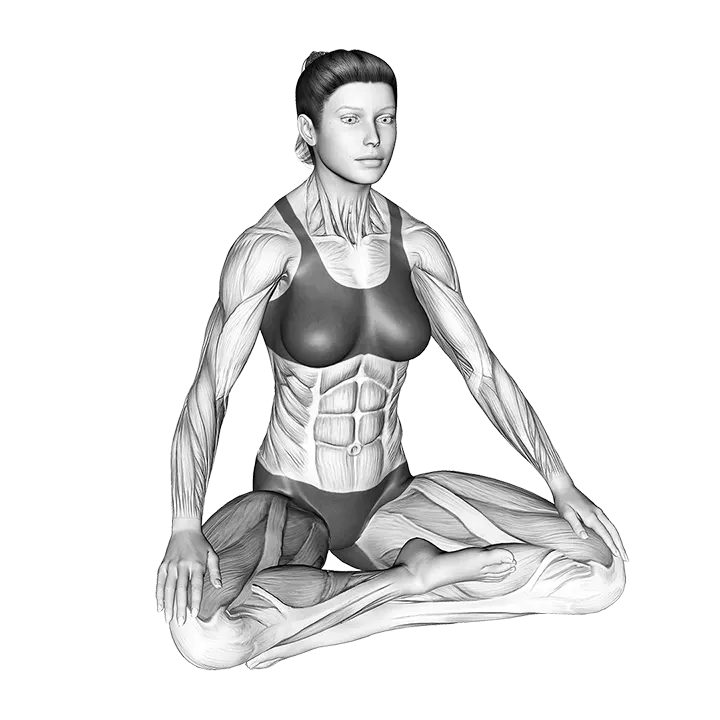
Meditation
- Músculo objetivo
- —
- Equipamiento
- Body weight
- Parte del cuerpo
- Stretching
- Tipo
- Stretching
Meditation is a mindfulness-based recovery practice that reduces mental stress, sharpens focus, and supports the nervous system between training sessions. Using only your body and breath, it requires no equipment and can be performed before or after a workout, or on rest days to accelerate mental and physical recovery.
Cómo hacer el Meditation
- 1Find a quiet space and sit on the floor, a chair, or a yoga mat with your hips elevated slightly above your knees if possible.
- 2Sit tall with your spine upright, your shoulders relaxed away from your ears, and your hands resting on your thighs or in your lap.
- 3Close your eyes or soften your gaze toward the floor a few feet in front of you.
- 4Take three slow, deep breaths — inhale through your nose for a count of four, hold briefly, then exhale fully through your nose or mouth for a count of six.
- 5Allow your breathing to return to its natural rhythm and shift your attention to the physical sensation of each breath entering and leaving your body.
- 6When your attention drifts to thoughts, sounds, or sensations, notice this without judgment and gently redirect your focus back to the breath.
- 7Continue for your chosen duration — start with five minutes and work up to ten to twenty minutes as the practice becomes familiar.
- 8When your timer signals, take one slow, deep breath, then gradually open your eyes and allow a moment before standing.
Consejos de técnica
- Prioritize posture over comfort — a tall spine keeps you alert rather than drowsy, so resist the urge to slouch against a wall unless you have a back injury.
- Use a timer so you are not checking the clock, which interrupts focus; a gentle chime tone is less jarring than a standard alarm.
- Anchor your attention to a specific sensation — the air at your nostrils, the rise of your chest, or the pause between breaths — rather than trying to 'clear your mind'.
- If sitting on the floor causes discomfort, sit on a folded blanket or firm cushion to tilt the pelvis forward and ease pressure on the lower back.
- Consistency matters more than session length — five minutes daily produces more benefit than a single long session once a week.
Errores comunes
- Trying to force the mind blank — the goal is to observe thoughts as they arise and return attention to the breath, not to suppress thinking; fighting thoughts increases tension rather than reducing it.
- Slouching or leaning back against a wall out of habit — this tends to induce drowsiness and prevents the alert, upright state that makes meditation effective.
- Quitting after a few sessions because the mind feels busy — mental chatter is normal and expected, especially early on; noticing distraction is itself the practice.
- Holding or controlling the breath throughout the session — after the initial deep breaths, let your breathing be completely natural so the body can self-regulate.
- Skipping meditation on high-stress days because 'there is no time' — those are precisely the sessions with the greatest recovery and focus benefit.
Preguntas frecuentes
How does meditation help with fitness and athletic recovery?
Meditation activates the parasympathetic nervous system, lowering cortisol and heart rate, which creates conditions favorable to muscle repair and sleep quality. It also improves focus and pain tolerance, which can translate directly to better performance during training.
How long should I meditate as a beginner?
Start with five minutes per session and add one to two minutes each week until you reach ten to twenty minutes. Even short daily sessions produce measurable reductions in perceived stress within two to four weeks.
Should I meditate before or after a workout?
Either timing works. Pre-workout meditation helps you arrive mentally focused and reduces performance anxiety. Post-workout meditation accelerates the transition from a sympathetic (fight-or-flight) to a parasympathetic (rest-and-digest) state, supporting recovery.
Does it matter what position I sit in?
No specific position is required. The key criteria are a tall spine, relaxed shoulders, and a stable base. A chair with both feet flat on the floor works just as well as a cross-legged floor position — choose whichever lets you stay upright without fidgeting.
Is meditation a replacement for sleep or active recovery?
No — meditation complements sleep and other recovery methods but does not replace them. Think of it as a tool to reduce mental fatigue and nervous system stress, used alongside adequate sleep, nutrition, and rest days.







