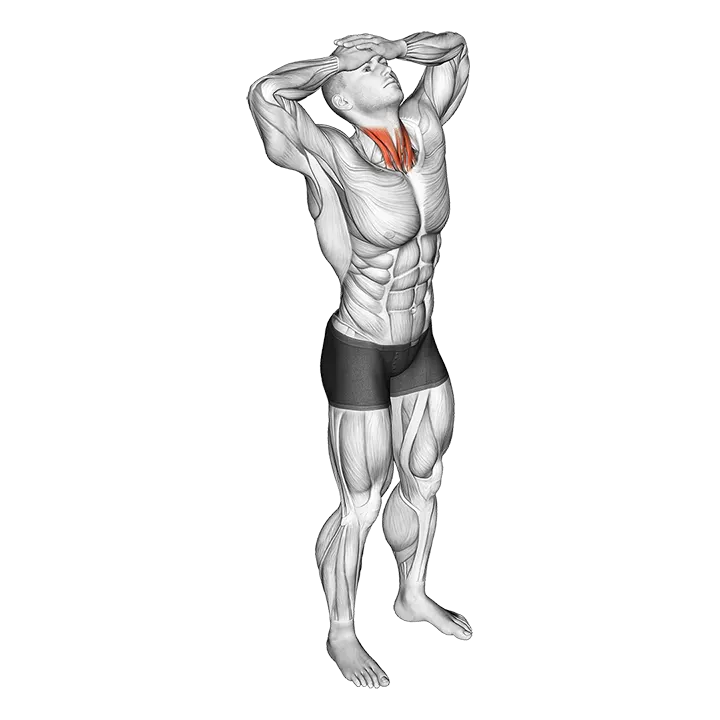
Neck Flexor Stretch
- Músculo objetivo
- —
- Equipamiento
- Body weight
- Parte del cuerpo
- Neck
- Tipo
- Stretching
The Neck Flexor Stretch targets the anterior muscles of the neck — primarily the sternocleidomastoid, anterior scalenes, and longus colli — which commonly shorten and tighten from prolonged forward head posture. By gently extending the neck or performing a controlled chin tuck with retraction, you lengthen these muscles and restore range of motion. This stretch is particularly useful for desk workers, cyclists, swimmers, and anyone who spends extended time looking down at a screen or handlebars.
Cómo hacer el Neck Flexor Stretch
- 1Sit or stand tall with your spine in a neutral position, shoulders relaxed and pulled slightly back and down.
- 2Begin with a chin tuck: gently draw your chin straight back, as if making a slight double chin, to align your head over your spine.
- 3From the tucked position, slowly tilt your head back by lifting your chin toward the ceiling, allowing your neck to extend gently.
- 4Stop as soon as you feel a mild stretch along the front and sides of your neck — do not force further range of motion.
- 5Keep your mouth closed and your jaw relaxed throughout; avoid letting your mouth drop open as you extend.
- 6Hold the stretched position for 20 to 30 seconds, breathing slowly and allowing the anterior neck muscles to release.
- 7To exit, bring your chin back to neutral slowly and with control — do not let your head drop forward.
- 8Repeat 2 to 3 times per session, resting briefly between holds.
Consejos de técnica
- Move into the stretch slowly and pause at the first sign of resistance — neck tissue responds better to gentle, sustained tension than to aggressive range of motion.
- Keep your shoulders down and away from your ears throughout; shrugging the shoulders reduces the stretch on the scalenes and sternocleidomastoid.
- Breathe steadily during the hold; exhaling fully can help the anterior neck muscles relax slightly deeper into the stretch.
- If you feel any dizziness, sharp pain, or tingling, return to neutral immediately and consult a healthcare professional before continuing.
- For a side-bias variation, add a small lateral tilt away from the side you want to emphasize — this shifts more load onto the scalenes of the ipsilateral side.
Errores comunes
- Forcing the neck into maximum extension: aggressively pushing past the point of mild tension can compress cervical vertebrae and irritate facet joints; always stop at the first sensation of stretch.
- Letting the mouth fall open: dropping the jaw as you extend reduces tension on the anterior neck muscles and signals that you are using passive momentum rather than controlled movement.
- Allowing the shoulders to rise: elevating the shoulders shortens the path between the clavicle and skull, reducing the stretch on the sternocleidomastoid and scalenes — keep them anchored down.
- Holding the breath: breath-holding increases cervical muscle tension and shortens the effective duration of the stretch; maintain slow, steady breathing throughout the hold.
- Moving too quickly into or out of the position: rapid neck extension or a sudden return to neutral can trigger protective muscle guarding; treat every transition as part of the stretch itself.
Preguntas frecuentes
What muscles does the Neck Flexor Stretch target?
It primarily lengthens the neck flexors on the front and sides of the neck: the sternocleidomastoid, the anterior and middle scalenes, and the deep longus colli. These are the muscles that pull the head forward and down, and they tend to shorten with prolonged forward head posture.
How often should I do the Neck Flexor Stretch?
For most people dealing with tightness from desk work or device use, 2 to 3 sessions per day works well — for example, once in the morning, once mid-afternoon, and once in the evening. Each session can include 2 to 3 holds of 20 to 30 seconds. If you are very tight, start with one session daily and increase gradually.
Is it normal to feel a pulling sensation in my throat?
A mild stretch sensation along the front of the throat and the sides of the neck is normal and expected. If you feel pain, sharp discomfort, or any difficulty swallowing, ease out of the stretch. Sensation that radiates into your arms or causes numbness warrants assessment by a physiotherapist or physician.
Can I do this stretch if I have a cervical disc issue or neck injury?
Not without medical clearance first. Neck extension can load the posterior cervical structures and may aggravate certain disc conditions, stenosis, or instability. Check with your physiotherapist or physician before performing any neck extension-based stretch if you have a diagnosed cervical condition.
How does this stretch help with forward head posture?
Forward head posture develops partly because the anterior neck muscles — especially the sternocleidomastoid and scalenes — adaptively shorten when the head is held forward for long periods. Regularly stretching these muscles, combined with strengthening the deep neck flexors and mid-back, can gradually restore neutral head alignment over time.







