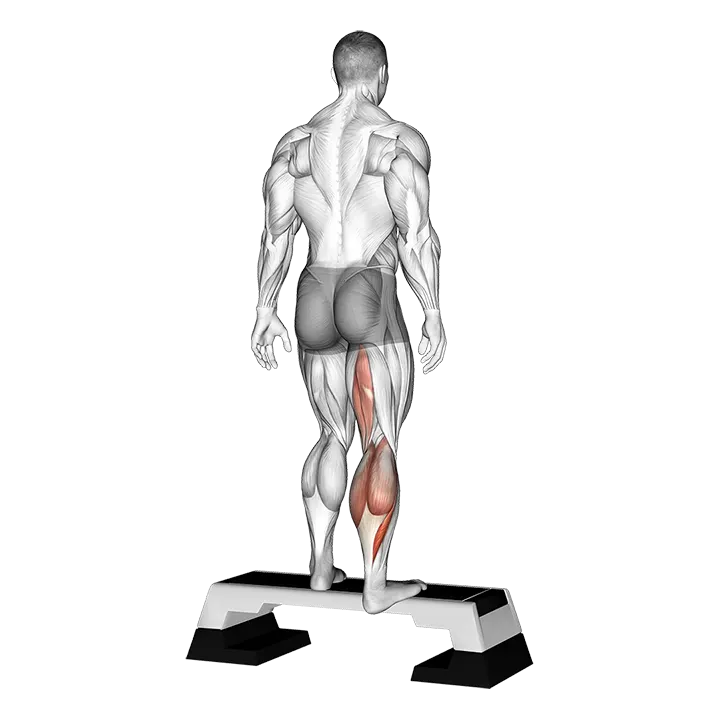
Plantar Flexor And Foot Inverter Stretch
- Músculo objetivo
- —
- Equipamiento
- Body weight
- Parte del cuerpo
- Calves
- Tipo
- Stretching
The plantar flexor and foot inverter stretch is a bodyweight ankle mobility exercise that targets the plantar flexors of the calf (gastrocnemius and soleus) alongside the foot inverter muscles (primarily the tibialis posterior). By combining ankle dorsiflexion with foot eversion, it addresses the full range of motion at the ankle joint and is useful for improving flexibility, reducing tightness after calf-heavy training, and supporting overall lower-leg mobility.
Cómo hacer el Plantar Flexor And Foot Inverter Stretch
- 1Sit on the floor with your legs extended in front of you, or sit on a chair with your feet flat on the ground and your working leg crossed over your opposite knee.
- 2Take hold of your foot with both hands — wrap one hand around the heel and place the other across the top of the foot.
- 3Gently pull your toes and forefoot upward toward your shin to dorsiflex the ankle, feeling a stretch along the back of the calf.
- 4While maintaining that dorsiflexion, slowly rotate the sole of your foot outward (eversion) so the bottom of your foot faces away from your body.
- 5Hold the combined position — ankle dorsiflexed and foot everted — for 20–30 seconds, breathing slowly and letting the muscles relax with each exhale.
- 6Release the stretch gradually, return the foot to a neutral position, and repeat on the same side for 2–3 rounds before switching feet.
Consejos de técnica
- Move into the stretch slowly and progressively — ankle ligaments are sensitive, so avoid forcing the range of motion.
- Keep your breathing steady throughout the hold; exhaling fully helps the calf and inverter muscles release further into the stretch.
- If you feel the stretch only in the heel cord and not along the inner ankle, add a little more eversion by rotating the sole slightly further outward.
- Perform this stretch after exercise when the tissues are warm; avoid aggressive stretching on a cold ankle.
Errores comunes
- Forcing the foot into eversion too quickly, which can overload the lateral ankle ligaments and increase injury risk rather than improve mobility.
- Holding the breath during the stretch, which keeps the muscles contracted and limits how far you can relax into the position.
- Letting the knee bend during a seated floor version, which reduces tension on the gastrocnemius and diminishes the plantar flexor component of the stretch.
- Bouncing or pulsing through the end range instead of holding steadily, which triggers a protective stretch reflex and prevents meaningful flexibility gains.
Preguntas frecuentes
What muscles does the plantar flexor and foot inverter stretch target?
It targets the plantar flexors — primarily the gastrocnemius and soleus in the calf — alongside the foot inverter muscles, especially the tibialis posterior. Together these muscles control ankle pointing and inward rotation of the foot.
When should I do this stretch?
It works best as a post-workout or cool-down stretch when the calf and ankle tissues are already warm. Doing it on a cold ankle, especially with forced eversion, raises the risk of ligament irritation.
How long should I hold the plantar flexor and foot inverter stretch?
Hold each position for 20–30 seconds and perform 2–3 rounds per side. Research on static stretching suggests holds of at least 20–30 seconds are needed to produce lasting flexibility improvements.
Is this stretch suitable for beginners?
Yes, but beginners should start with gentle dorsiflexion and add eversion gradually over several sessions. If you have a history of ankle sprains, consult a physiotherapist before including the eversion component.
What is a good alternative to the plantar flexor and foot inverter stretch?
A wall calf stretch covers the plantar flexor component, while a towel ankle eversion exercise targets the inverter muscles separately. Combining both gives similar coverage if the combined stretch feels uncomfortable.







