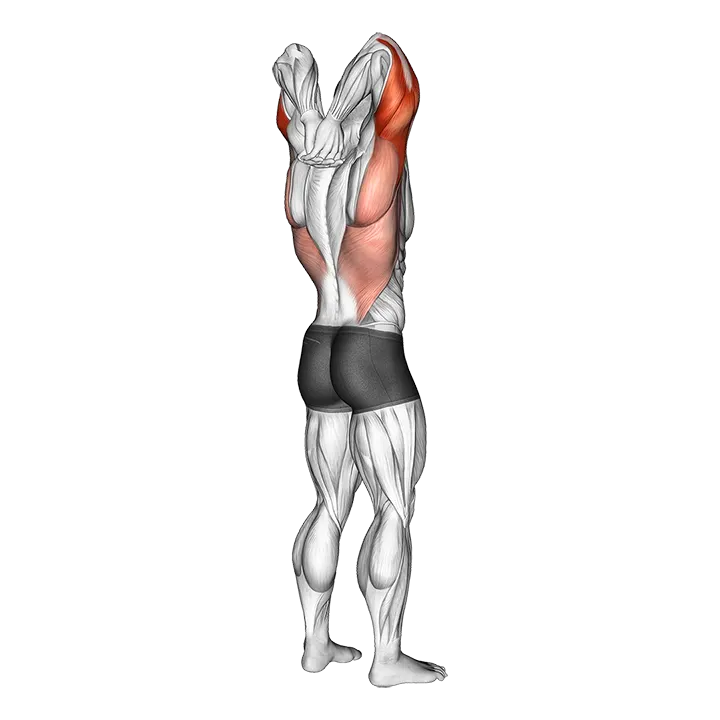
Reaching Down Triceps Stretch
- Músculo objetivo
- —
- Equipamiento
- Body weight
- Parte del cuerpo
- Upper Arms
- Tipo
- Stretching
The Reaching Down Triceps Stretch is a bodyweight upper-arm stretch where you raise one arm overhead, bend the elbow so the hand drops down behind your head, and use gentle pressure to deepen the stretch through the triceps. It is an effective way to improve elbow flexibility, ease tightness in the back of the upper arm, and prepare the triceps for pressing or overhead work.
Cómo hacer el Reaching Down Triceps Stretch
- 1Stand or sit tall with your feet hip-width apart and your spine neutral.
- 2Raise your right arm straight overhead, keeping your bicep close to your ear.
- 3Bend your right elbow so your right hand drops down behind your head and toward the middle of your upper back.
- 4Allow your elbow to point toward the ceiling and stay close to the side of your head.
- 5Reach your left hand up and gently grasp your right elbow or forearm.
- 6Apply light downward pressure with your left hand to deepen the stretch through the right triceps.
- 7Hold the stretch for 20–30 seconds, breathing steadily throughout.
- 8Release the pressure, straighten your right arm, and lower it to your side.
- 9Repeat on the left side, performing an equal number of sets on each arm.
Consejos de técnica
- Keep your stretching elbow pointing up throughout — letting it flare out to the side reduces triceps tension.
- Avoid arching your lower back as you raise the arm overhead; engage your core lightly to keep your spine neutral.
- Apply pressure gradually and stop if you feel any sharp discomfort in the elbow or shoulder.
- Keep your chin level and your neck relaxed — do not let the position pull your head forward.
- Breathe slowly and steadily; exhaling during the hold helps the muscle release further.
Errores comunes
- Pulling the elbow too aggressively with the opposite hand, which overstresses the elbow joint and defeats the gradual release the stretch requires.
- Letting the elbow drift away from the head and flare outward, which reduces the stretch on the triceps and shifts strain toward the shoulder.
- Arching the lower back while reaching overhead, which creates lumbar compression instead of an isolated upper-arm stretch.
- Holding the breath during the stretch, which keeps the muscles contracted and prevents them from relaxing into the position.
- Skipping the opposite side or rushing through it, which creates asymmetry in triceps flexibility over time.
Preguntas frecuentes
What does the Reaching Down Triceps Stretch target?
It primarily stretches the triceps brachii, the large muscle on the back of the upper arm responsible for extending the elbow. Raising the arm overhead and bending the elbow places the long head of the triceps under a full stretch.
How long should I hold the stretch?
Hold each side for 20–30 seconds. For general flexibility, two to three holds per side is sufficient. If you are working on persistent tightness, you can extend to 45 seconds while keeping the pressure moderate.
When is the best time to do this stretch?
It fits well as part of a cool-down after pressing or overhead work, or as a standalone mobility drill on rest days. Avoid performing intense static stretching on a completely cold muscle — a brief warm-up walk or a few arm circles first is helpful.
Is this stretch suitable for people with shoulder or elbow issues?
It can be, but proceed cautiously. Use only gentle pressure from the assisting hand, and stop if you feel sharp pain or instability in the shoulder or elbow. If you have a known injury, check with a physiotherapist before adding this stretch.
What are good alternatives if this position is uncomfortable?
A cross-body triceps stretch — pulling the straight arm across the chest — targets the lateral head of the triceps and requires no overhead range. A towel or resistance band can also be used in place of the free hand if shoulder mobility limits how far you can reach.







