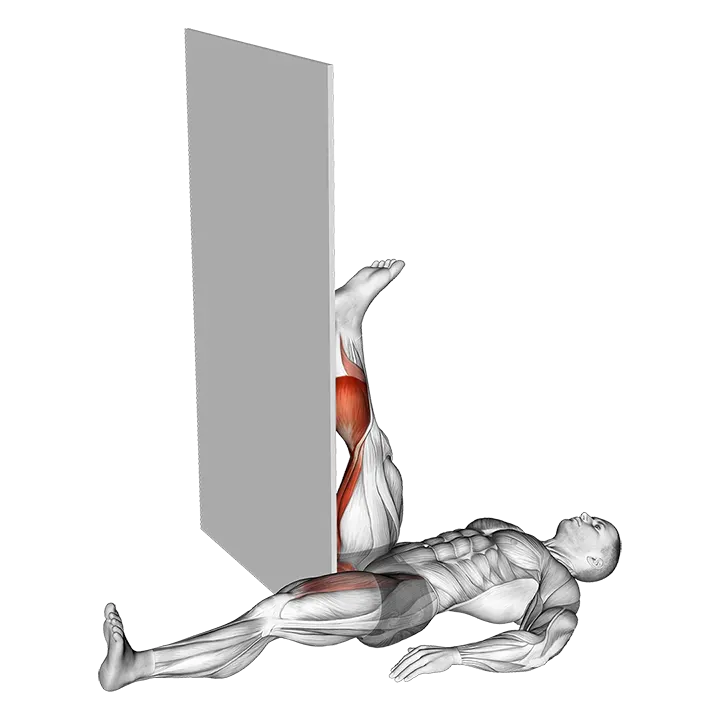
Recumbent Knee Flexor Stretch
- Músculo objetivo
- —
- Equipamiento
- Body weight
- Parte del cuerpo
- Thighs
- Tipo
- Stretching
The Recumbent Knee Flexor Stretch is a supine bodyweight stretch that targets the posterior thigh by lengthening the muscles responsible for bending the knee — primarily the hamstrings. Lying on your back and extending one leg toward vertical with gravity assisting the hold makes it an accessible, low-effort way to improve hamstring flexibility and ease tightness in the thighs.
Cómo hacer el Recumbent Knee Flexor Stretch
- 1Lie flat on your back on a mat with both knees bent and feet flat on the floor.
- 2Draw one knee toward your chest and clasp both hands behind your thigh, just above the knee.
- 3Slowly straighten that leg as much as your flexibility allows, pressing the heel toward the ceiling.
- 4Keep your opposite leg flat on the floor or bent with the foot planted, whichever keeps your lower back comfortable.
- 5Flex your foot so the toes point toward your shin — this increases the stretch through the full length of the hamstring.
- 6Hold the position for 20–30 seconds, breathing steadily and allowing the muscle to relax into the stretch on each exhale.
- 7Release the leg slowly, lower it back to the start position, and repeat on the opposite side.
Consejos de técnica
- Straighten the knee only as far as you can without rounding your lower back off the floor — quality of position matters more than how high the leg goes.
- Breathe out slowly during the hold; each exhale allows the hamstring to release a little further without forcing.
- Keep your head and shoulders relaxed on the mat so tension does not migrate into your neck and upper back.
- Dorsiflexing the foot (toes toward shin) adds a gentle calf and sciatic-nerve component; point the toes to soften the stretch if it feels too intense.
- Progress gradually — hold for longer rather than pulling the leg harder to avoid straining the hamstring.
Errores comunes
- Bending the knee excessively during the hold, which reduces tension on the hamstrings and makes the stretch less effective.
- Pulling the leg toward the chest rather than toward the ceiling, which shifts the stretch away from the knee flexors and into the hip.
- Letting the lower back arch or lift off the floor, which places stress on the lumbar spine and signals that the leg has been pushed too far.
- Holding the breath or tensing the body during the stretch, which prevents the hamstring from relaxing and limits range-of-motion gains.
- Bouncing or pulsing the leg to force a deeper position, which triggers the stretch reflex, increases injury risk, and reduces long-term flexibility gains.
Preguntas frecuentes
What muscles does the Recumbent Knee Flexor Stretch target?
It targets the knee flexors — primarily the hamstring group (biceps femoris, semitendinosus, semimembranosus) along the back of the thigh. Dorsiflexing the foot during the hold can also create a mild stretch through the gastrocnemius and the sciatic nerve pathway.
How long should I hold a Recumbent Knee Flexor Stretch?
Hold each repetition for 20–30 seconds and perform 2–3 holds per side. Research on static stretching suggests that holding for at least 30 seconds per bout produces meaningful short-term flexibility improvements over time.
Can I do this stretch if I have tight hamstrings and cannot straighten my knee fully?
Yes — extend the leg only as far as you can while keeping your lower back flat on the floor. Flexibility will improve gradually with consistent practice, and a partially bent knee still creates a useful stretch through the posterior thigh.
Is the Recumbent Knee Flexor Stretch good as a warm-up or cool-down?
It is best suited as a cool-down or recovery stretch after exercise, since prolonged static stretching before activity can temporarily reduce muscle force output. Use dynamic leg swings before training and save this supine hold for afterward.
What is the difference between this stretch and a standing hamstring stretch?
The recumbent version is performed lying down, so there is no balance demand and the pelvis is anchored to the floor, making it easier to isolate the hamstring without compensating through the lower back. Many people find it gentler and more controllable than standing variations.







