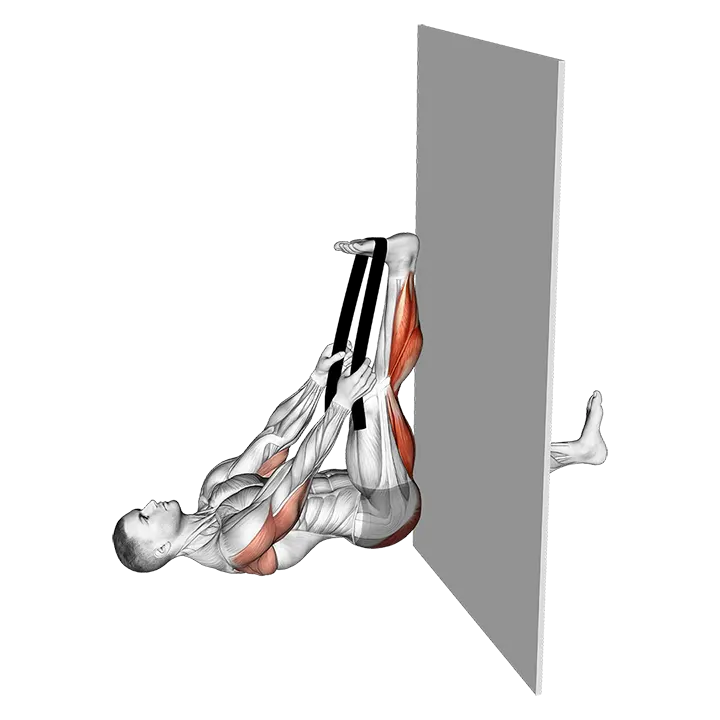
Recumbent Knee Flexor Stretch With Towel
- Músculo objetivo
- —
- Equipamiento
- Body weight
- Parte del cuerpo
- Thighs
- Tipo
- Stretching
The Recumbent Knee Flexor Stretch With Towel is a lying hamstring stretch that uses a towel looped around your foot to help you pull the leg toward you and deepen the stretch along the back of the thigh. Performing it on your back removes strain from the lower back and lets you isolate the knee flexors more effectively than standing alternatives. It is well suited to post-workout recovery, injury rehabilitation, and improving hamstring flexibility over time.
Cómo hacer el Recumbent Knee Flexor Stretch With Towel
- 1Lie flat on your back on a mat with both legs extended and your lower back gently pressed toward the floor.
- 2Loop a towel, resistance band, or belt around the arch of one foot, holding one end in each hand.
- 3Keeping the other leg straight and relaxed on the floor, slowly raise the working leg toward the ceiling by pulling on the towel.
- 4Stop when you feel a firm stretch along the back of the thigh — do not force the leg beyond a comfortable range.
- 5Keep your knee as straight as possible without locking it hard; a very slight bend is acceptable if hamstring tightness prevents full extension.
- 6Hold your shoulders and head flat on the mat throughout; avoid curling the upper body forward.
- 7Breathe slowly and steadily, relaxing further into the stretch on each exhale.
- 8Hold the end position for 20–45 seconds, then gently lower the leg back to the floor.
- 9Repeat on the opposite leg for the same duration.
Consejos de técnica
- Keep the non-stretching leg actively pressed into the floor to stabilize your pelvis and prevent it from rotating.
- Use the towel as a passive aid, not a pulley — let gravity and your breath do the work rather than yanking the leg higher.
- Point your toes toward your shin (dorsiflexion) to add a mild calf stretch and increase tension along the entire posterior chain.
- Progress the stretch gradually over multiple sessions; flexibility gains happen with consistent, low-force holds rather than aggressive pulling.
- If you feel discomfort behind the knee rather than along the belly of the hamstring, reduce the angle slightly and check that your knee is not hyperextended.
Errores comunes
- Pulling the towel too hard and forcing the leg up: this creates ballistic tension that can strain the hamstring instead of lengthening it.
- Letting the lower back arch off the floor: losing pelvic stability shifts the stretch away from the hamstring and can compress the lumbar spine.
- Bending the knee excessively: a significant bend shortens the hamstring and reduces the stretch stimulus at the knee flexors.
- Holding the breath: breath-holding increases muscular tension and prevents the muscle from relaxing into the stretch.
- Curling the head and shoulders up to reach the towel: this recruits the neck and hip flexors unnecessarily and reduces the effectiveness of the stretch.
Preguntas frecuentes
How long should I hold the recumbent knee flexor stretch with a towel?
Hold each repetition for 20–45 seconds to allow the hamstring to relax into the stretch. Perform 2–3 holds per leg, resting briefly between them.
Can I do this stretch if I have tight hamstrings and cannot straighten my leg?
Yes. Keep a slight bend in the knee and raise the leg only as far as you can while feeling a comfortable stretch. As flexibility improves over weeks, you will be able to straighten the leg further.
What can I use instead of a towel for this stretch?
A resistance band, a yoga strap, or a belt all work equally well. The key is having something long enough to loop around your foot while keeping your arms relatively relaxed.
When is the best time to do this stretch?
This stretch is most effective after a workout when muscles are warm, or as part of a dedicated flexibility session. Avoid performing deep static stretches on completely cold muscles.
Is the recumbent knee flexor stretch safe for people with lower back pain?
The lying position is generally gentler on the lower back than standing hamstring stretches because it offloads the spine. Keep the non-stretching leg flat on the floor and avoid over-pulling the towel; consult a healthcare professional if you have a specific back condition.







