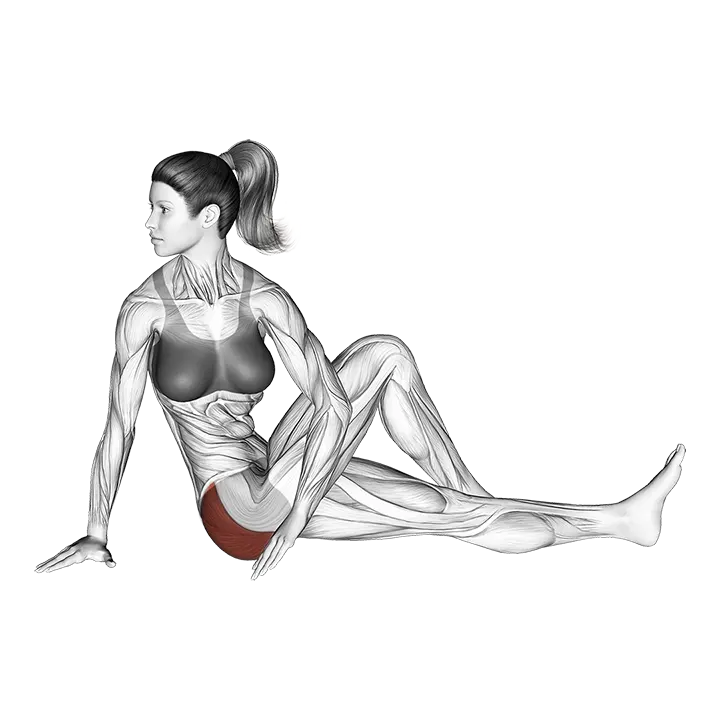
Seated Knee Up Rotation Stretch
- Músculo objetivo
- —
- Equipamiento
- Body weight
- Parte del cuerpo
- Hips
- Tipo
- Stretching
The Seated Knee Up Rotation Stretch is a bodyweight floor exercise that mobilises the hip rotators, glutes, and piriformis by drawing one knee up and rotating the torso toward it. The combined hip flexion and spinal rotation deepens the stretch across the outer hip, making it an effective drill for improving hip mobility and relieving tightness from prolonged sitting or lower-body training.
Cómo hacer el Seated Knee Up Rotation Stretch
- 1Sit on the floor with your legs loosely extended in front of you and your spine tall.
- 2Bend your right knee and draw your right foot in toward your body so the sole rests flat on the floor, with your right thigh angled upward.
- 3Place your left hand on the outside of your right knee for light support without pushing the knee down.
- 4Sit upright and take a slow breath in to lengthen your spine before you rotate.
- 5On the exhale, rotate your torso to the right, leading with your right shoulder moving back and your chest turning toward the right side.
- 6Use your left hand against the outside of your right knee as a gentle anchor to deepen the rotation without forcing it.
- 7Hold the rotated position for 20–30 seconds, breathing slowly and allowing the hip and outer glute to release with each exhale.
- 8Slowly unwind the rotation and return to the upright starting position.
- 9Repeat on the opposite side, bending your left knee and rotating your torso to the left.
Consejos de técnica
- Initiate the rotation from your mid-back rather than your neck — keep your chin level and let the thoracic spine do the turning.
- Stay tall through the entire hold; allowing the spine to slump removes the rotational tension that makes this stretch effective.
- Use your grounding hand (placed on the floor behind you or on the raised knee) lightly — resist the urge to yank the knee to create more range.
- Let each exhale invite a slightly deeper rotation rather than muscling into the end range on the first breath.
Errores comunes
- Rotating from the lower back instead of the thoracic spine, which compresses the lumbar discs and reduces the stretch on the hip rotators.
- Letting the torso lean back or collapse to one side, which shortens the effective rotation and shifts the stretch away from the intended hip muscles.
- Forcing the raised knee toward the floor with the supporting hand, which can strain the knee rather than increase the hip stretch.
- Holding the breath throughout the hold, which keeps the surrounding muscles tense and prevents the hip from softening into a deeper position.
- Rushing through the stretch without pausing at end range, which gives the hip rotators insufficient time under tension to release.
Preguntas frecuentes
What muscles does the Seated Knee Up Rotation Stretch target?
The stretch primarily targets the hip rotators, glutes, and piriformis. Drawing the knee up creates hip flexion while the torso rotation adds a rotational component that deepens the stretch across the outer hip and gluteal area.
How is this stretch different from a standard seated spinal twist?
A standard seated spinal twist focuses mainly on the thoracic spine and paraspinal muscles. In the Seated Knee Up Rotation Stretch the raised knee creates simultaneous hip flexion, directing more of the stretch into the hip rotators and piriformis rather than primarily the back muscles.
How long should I hold each side?
Aim for 20–30 seconds per side and complete 2–3 rounds. If you have persistent hip tightness, extending the hold to 45–60 seconds can be beneficial provided you stay within a comfortable, pain-free range.
Can this stretch help with sciatic nerve pain?
Tightness in the piriformis can compress the sciatic nerve and cause discomfort in the hip and down the leg. Gently stretching the piriformis and hip rotators with exercises like this one may relieve that compression, but consult a healthcare professional if you have diagnosed sciatica before beginning any stretching programme.
Is this stretch suitable as a warm-up or cool-down?
It is best used as a cool-down or standalone mobility session because the sustained static hold is most effective on warm tissue. If used before a workout, keep holds short — around 10–15 seconds — and focus on smooth, controlled movement rather than pushing for maximum range.







