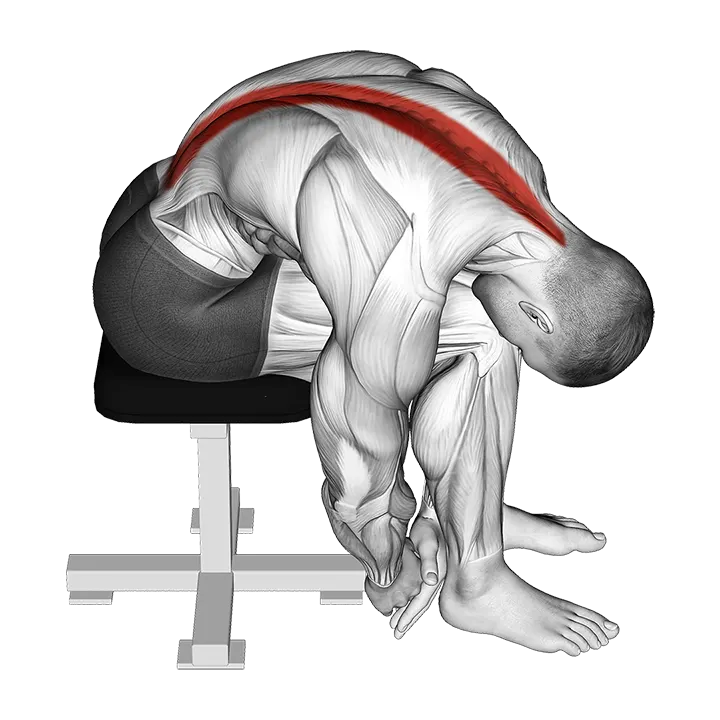
Seated Lower Trunk Extensor Lateral Flexor Stretch
- Músculo objetivo
- —
- Equipamiento
- Body weight
- Parte del cuerpo
- Back
- Tipo
- Stretching
The Seated Lower Trunk Extensor Lateral Flexor Stretch is a bodyweight seated stretch that simultaneously targets the erector spinae, quadratus lumborum, and obliques by combining a forward lean with a lateral side bend. It releases tension along the lower back and the sides of the trunk, making it an effective recovery and mobility drill for anyone who sits for extended periods or experiences tightness in the lower back and flanks.
Cómo hacer el Seated Lower Trunk Extensor Lateral Flexor Stretch
- 1Sit upright on the floor or a firm surface with both legs extended straight in front of you and your spine tall.
- 2Cross your right ankle over your left so your legs remain roughly parallel and relaxed, or simply keep both legs extended side by side — choose whichever position lets you sit most stably.
- 3Place your left hand on the floor beside your left hip for light support.
- 4Raise your right arm overhead, elongating the right side of your body.
- 5On an exhale, hinge forward from the hips while simultaneously leaning your raised arm and torso diagonally toward the left — combining a forward fold with a side bend so you feel the stretch across your lower back and right flank.
- 6Lower your right arm gently toward the floor to your left as you deepen the combined lean, letting the right side of your lower trunk lengthen.
- 7Hold the end position for 20–30 seconds, breathing slowly and allowing the erector spinae, quadratus lumborum, and obliques on the right side to release with each exhale.
- 8Slowly return to the upright starting position on an inhale.
- 9Switch sides — raise your left arm overhead and lean diagonally to the right — and hold for the same duration.
Consejos de técnica
- Think of the movement as a diagonal arc rather than a pure side bend or a pure forward fold — the combination is what simultaneously loads both the extensors and the lateral flexors.
- Keep your sit bones grounded throughout; if one hip lifts off the floor as you lean, reduce the range until your hip flexibility improves.
- Breathe into the stretched side on each inhale and consciously relax that area on each exhale to progressively deepen the stretch without forcing.
- Keep the arm you raise long and reaching — a limp or bent arm shortens the lever and reduces the lateral lengthening through the trunk.
- Move in and out of the stretch slowly to avoid triggering a protective muscular reflex that would limit how far you can go.
Errores comunes
- Bending only sideways without any forward component, which isolates the lateral flexors but misses the lower back extensors that this combined stretch is specifically designed to reach.
- Letting the lower back round heavily into a C-curve instead of hinging from the hips, which compresses the lumbar spine and shifts the stretch away from the target muscles.
- Lifting the opposite hip off the floor during the lean, which causes the pelvis to rotate and reduces the stretch on the lateral trunk muscles on the working side.
- Holding the breath and bracing the core tightly, which keeps the target muscles contracted and prevents them from lengthening into the stretch.
- Rushing through the hold or bouncing at end range, which triggers a protective stretch reflex in the erector spinae and obliques and can cause a muscle strain.
Preguntas frecuentes
What muscles does the Seated Lower Trunk Extensor Lateral Flexor Stretch target?
The stretch targets the erector spinae (lower back extensors), the quadratus lumborum (a deep muscle that runs along the sides of the lumbar spine), and the obliques (lateral trunk flexors). Combining a forward hinge with a side lean puts all three groups under stretch simultaneously.
How is this stretch different from a regular seated side bend?
A pure seated side bend mainly loads the lateral flexors — the obliques and quadratus lumborum — but leaves the erector spinae relatively unloaded. Adding a forward-lean component to the side bend brings the lower back extensors into the stretch as well, making this a more complete lower trunk mobility drill.
Can I do this stretch if I have lower back pain?
Mild tightness is generally fine to address with gentle stretching, but if you have a diagnosed disc herniation, acute muscle strain, or significant pain, consult a healthcare professional before attempting this exercise. Start well within your comfortable range and stop if you feel any sharp, shooting, or radiating pain.
How long and how often should I hold this stretch?
Hold each side for 20–30 seconds and perform 2–3 rounds per side. Doing this once or twice daily — especially after prolonged sitting or following a lower-body or back training session — will produce noticeable improvements in lower trunk flexibility over several weeks.
Is this stretch suitable as a warm-up before a workout?
It is best used as a post-workout cool-down or a standalone mobility drill, as sustained static stretching is most effective on already-warm tissue. If used before training, keep holds short (10–15 seconds) and focus on gentle movement rather than pushing to end range.







