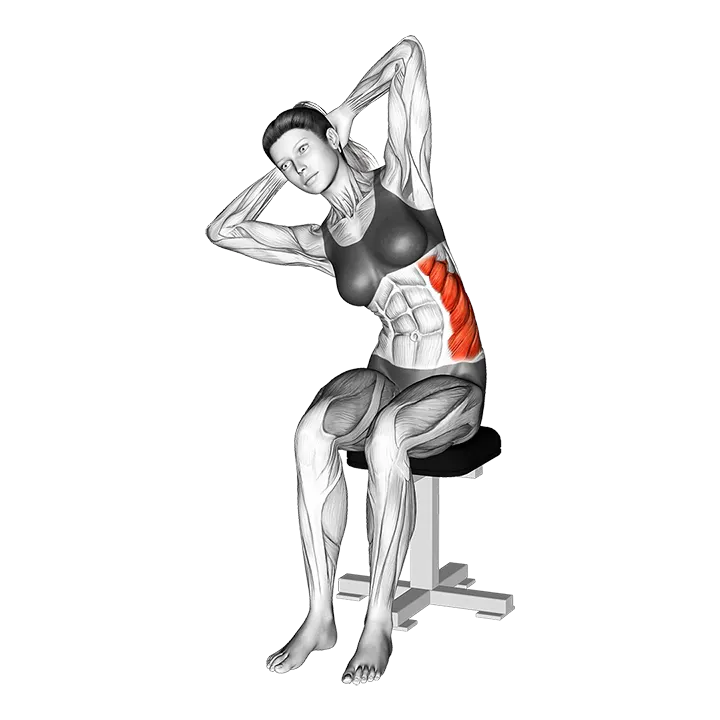
Seated Lower Trunk Lateral Flexor Stretch
- Músculo objetivo
- —
- Equipamiento
- Body weight
- Parte del cuerpo
- Waist
- Tipo
- Stretching
The Seated Lower Trunk Lateral Flexor Stretch targets the lateral flexor muscles of the trunk, primarily the quadratus lumborum, external and internal obliques, and the lateral intercostals along the side of the torso. Performed seated in a chair, it requires no equipment and is ideal for relieving tightness in the waist after prolonged sitting or as part of a daily mobility routine.
Cómo hacer el Seated Lower Trunk Lateral Flexor Stretch
- 1Sit upright on a sturdy chair with your feet flat on the floor, hip-width apart, and your hips positioned evenly on the seat.
- 2Place one hand on your thigh or the side of the chair for light support.
- 3Raise your opposite arm overhead, keeping it close to your ear with your elbow slightly soft.
- 4Take a slow breath in to lengthen your spine before you begin the movement.
- 5As you exhale, slowly lean your torso to the side toward the supporting hand, bending laterally at the waist and letting your raised arm arc gently overhead.
- 6Hold the stretch at the end range where you feel a comfortable pull along the side of your trunk and waist — avoid any sharp or pinching sensations.
- 7Breathe steadily and hold the position for 20–30 seconds, allowing the lateral flexors to relax with each exhale.
- 8Return to the upright starting position in a controlled manner.
- 9Repeat on the opposite side, performing 2–3 holds per side.
Consejos de técnica
- Keep both sit bones evenly grounded on the chair throughout the stretch to isolate the lateral trunk rather than rotating the pelvis.
- Lead the movement with a long spine — think of growing tall before you bend to the side, not collapsing at the waist.
- Use your exhale to sink a few millimetres deeper into the stretch; never force the range with momentum.
- Keep the arm overhead close to your ear to maximise the stretch along the obliques and quadratus lumborum.
- If you feel any discomfort in the lower back or hip, reduce the range of motion and ensure you are bending purely to the side rather than rotating forward or backward.
Errores comunes
- Lifting the opposite hip off the chair: this reduces the stretch on the lateral flexors and can place uneven stress on the lumbar spine — keep both sit bones firmly in contact with the seat.
- Rotating the torso forward or backward instead of bending purely sideways: rotation shifts the load away from the lateral flexors and may strain the spinal joints — focus on moving in a single frontal plane.
- Dropping the head toward the shoulder: letting the neck flex unnecessarily can create tension in the cervical spine — keep the neck neutral and the gaze facing straight ahead.
- Using momentum or bouncing into the stretch: ballistic movements in a passive stretch can trigger the stretch reflex and cause muscle strain — move slowly and hold the position statically.
- Holding the breath: breath-holding increases intra-abdominal pressure and limits the depth of the stretch — breathe slowly and rhythmically throughout the hold.
Preguntas frecuentes
What muscles does the Seated Lower Trunk Lateral Flexor Stretch target?
This stretch primarily lengthens the lateral flexor muscles of the trunk, including the quadratus lumborum, the external and internal obliques, and the lateral intercostals. These muscles run along the sides of the waist and are responsible for bending the spine sideways.
How long should I hold the Seated Lower Trunk Lateral Flexor Stretch?
Hold each side for 20–30 seconds and perform 2–3 repetitions per side. This duration is sufficient to allow the muscle tissue to relax and begin to lengthen without overstressing the connective tissue.
Can I do this stretch if I have lower back pain?
Many people find gentle lateral flexion stretches helpful for relieving lower back tightness, but you should stay within a pain-free range and consult a healthcare professional if you have an existing back condition before adding new stretches to your routine.
When is the best time to perform this stretch?
This stretch is most effective after a light warm-up or at the end of a workout when muscles are warm. It also works well as a midday desk break to counteract the lateral tightness that builds from prolonged sitting.
How is this different from a standing side stretch?
The seated position stabilises the pelvis and lower body, isolating the stretch to the lateral trunk muscles more precisely than a standing version where the hips may shift. This makes it a safer option for beginners or anyone with balance concerns.







