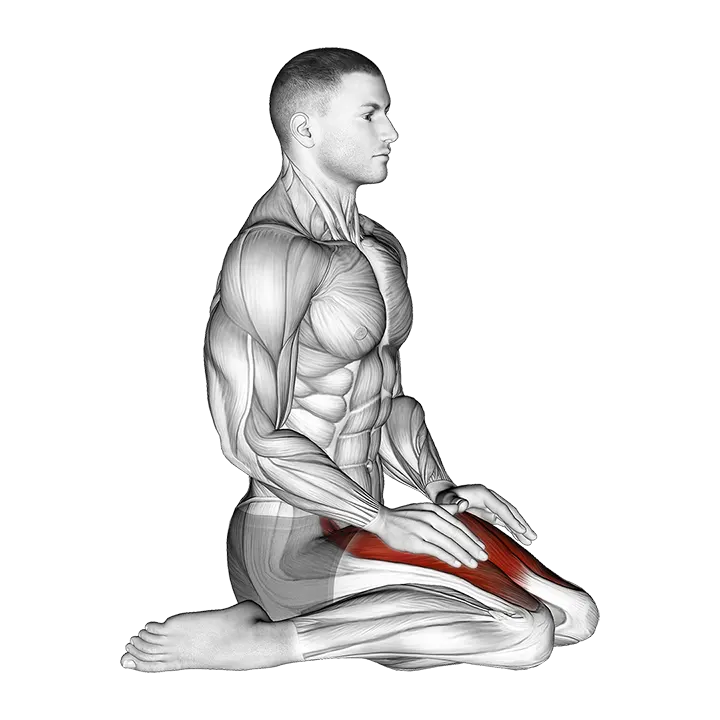
Seated Quadriceps Stretch
- Músculo objetivo
- —
- Equipamiento
- Body weight
- Parte del cuerpo
- Thighs
- Tipo
- Stretching
The seated quadriceps stretch lengthens the quadriceps — the four muscles running along the front of the thigh — by drawing the heel toward the glutes while seated on a chair or bench. It relieves tightness built up from prolonged sitting or heavy leg training and is an effective cooldown movement for improving front-thigh flexibility and reducing knee strain.
Cómo hacer el Seated Quadriceps Stretch
- 1Sit sideways near the edge of a sturdy chair or bench so your right side faces the backrest and you have open space behind your left leg.
- 2Plant your left foot flat on the floor with your left knee bent at roughly 90°, keeping your torso upright and your core lightly engaged.
- 3Bend your right knee and reach back with your right hand to grasp your right foot or ankle, drawing your heel toward your right glute.
- 4Gently press your right hip forward and keep both knees close together so the stretch isolates the front of the right thigh rather than the hip flexor alone.
- 5Sit tall — avoid leaning forward or twisting your torso; keep your spine neutral throughout.
- 6Hold the position for 20–30 seconds, breathing slowly and allowing the quadriceps to relax further with each exhale.
- 7Release the foot slowly and lower the leg back to the floor.
- 8Switch sides: reposition on the chair so your left side faces the backrest, and repeat the stretch on the left leg.
Consejos de técnica
- Breathe out steadily as you hold the stretch — exhaling helps the nervous system release muscular tension and deepens the stretch without forcing it.
- Keep both knees aligned and close together throughout; letting the stretched knee flare outward reduces the load on the quadriceps and shifts stress onto the knee joint.
- If you cannot comfortably reach your foot, loop a towel, resistance band, or belt around your ankle to bridge the gap — never strain your shoulder or lower back trying to reach.
- Avoid tilting your pelvis forward or arching your lower back; a neutral spine ensures the stretch stays in the thigh and away from the lumbar vertebrae.
- Never bounce or pulse the leg to deepen the stretch — static, sustained tension is safer and more effective for improving flexibility.
Errores comunes
- Pulling the heel out to the side instead of straight toward the glute — this rotates the knee and places uneven stress on the joint rather than stretching the quadriceps evenly.
- Leaning the torso forward to compensate for limited flexibility — this unloads the quadriceps and directs the stretch into the hip instead, defeating the purpose of the exercise.
- Holding the breath or bearing down — this increases muscular tension and prevents the muscle from fully lengthening; steady nasal breathing is essential for an effective static stretch.
- Rushing through the hold with fewer than 15 seconds — the muscle spindle reflex needs around 20–30 seconds to release, so shorter holds produce little lasting flexibility benefit.
- Sitting too close to the middle of the chair seat — insufficient clearance behind the hip makes it physically impossible to draw the heel back far enough for a meaningful stretch.
Preguntas frecuentes
When is the best time to do the seated quadriceps stretch?
This stretch is most effective as part of a post-workout cooldown, when muscles are warm and pliable. It is also well-suited for desk workers who want to relieve quadriceps tightness after long periods of sitting, though in that case a brief warm-up walk first will improve the response.
How long should I hold the stretch?
Hold each side for 20–30 seconds. Research on static stretching consistently shows this duration is needed to move past the initial stretch reflex and achieve meaningful increases in muscle length. Repeat for 2–3 sets per side if flexibility is a goal.
I feel the stretch mainly in my hip, not my thigh — what am I doing wrong?
This usually means the pelvis has tilted forward or the torso has leaned over. Sit upright, gently tuck your tailbone to neutral, and press the front of the bent hip slightly forward while keeping the knees together. That repositioning shifts the tension back into the quadriceps.
Can I do this stretch if I have knee pain?
Mild knee tightness often improves with careful quadriceps stretching since releasing the quads reduces the pull on the patella. However, if you feel sharp pain inside the knee while bending the joint or pulling the foot back, stop and consult a healthcare professional before continuing.
How is the seated version different from a standing quadriceps stretch?
The seated version removes the balance challenge entirely, making it accessible for people with limited stability or those who are recovering from injury. Sitting also stabilizes the pelvis more consistently, which can help isolate the quadriceps and prevent the compensatory hip-flexor involvement that commonly occurs in the standing variation.







